




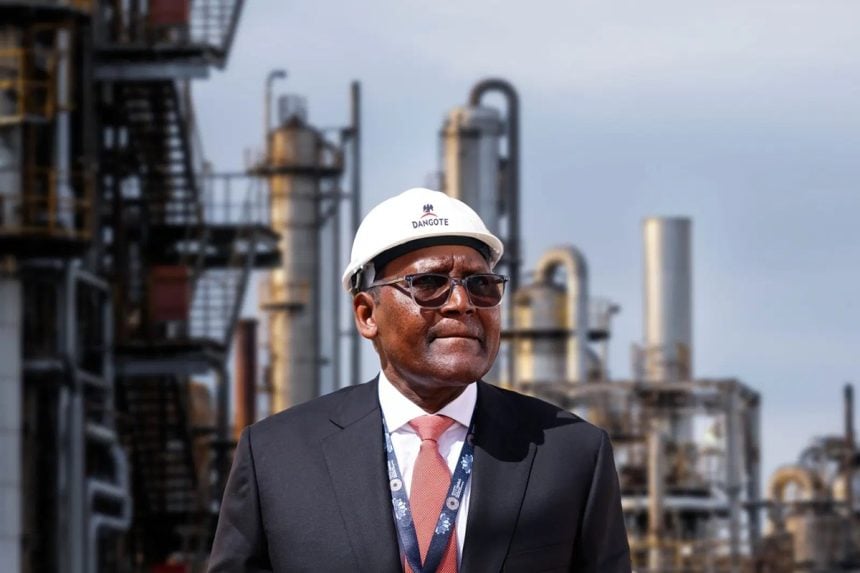
With a N65.22 trillion valuation, a N2.15 trillion fundraising target and plans to double its refining capacity, Dangote Refinery is offering investors more than shares, it is offering a stake in Nigeria’s industrial transformation. Kehinde Akinseinde-Jayeoba examines the company’s transition from mega-project to listed giant on the NGX, and the critical question facing investors: whether its remarkable growth can translate into sustainable returns and justify its towering valuation.
From oil importer to refining powerhouse
For decades, Nigeria lived with one of the most frustrating contradictions of an oil-producing country: it had crude oil in abundance, yet lacked sufficient domestic refining capacity to turn much of that crude into the petrol, diesel, aviation fuel and other petroleum products required to keep the economy running. The country exported crude, earned foreign exchange from it and then spent a significant portion of that foreign exchange importing refined products. The consequences were felt far beyond the petroleum industry, filtering through transport costs, food prices, manufacturing expenses, inflation and household incomes. The Dangote Petroleum Refinery was conceived against this backdrop, but what began as an extraordinarily ambitious industrial project has now reached a point where its future is being placed, quite literally, in the hands of the market.
The planned initial public offering of Dangote Refinery and Petrochemicals FZE is therefore more than another corporate transaction on the Nigerian Exchange (NGX). The company is offering 4.1 billion new shares at N525 each, seeking to raise approximately N2.1525 trillion from investors. After expenses estimated at about N41.49 billion, the refinery expects to retain approximately N2.11 trillion. Based on the offer price and the enlarged share capital, the company has an indicative equity value of about N65.22 trillion. That valuation would immediately make the refinery one of the most valuable companies in Nigeria and give the NGX a listed industrial asset of a scale rarely seen in the country’s capital market. Yet the real significance of the offer lies beyond the headline figures. The IPO is effectively asking investors to put a price on Nigeria’s ambition to become a major refining and industrial centre while simultaneously asking whether the refinery can turn its enormous physical scale into sustainable shareholder value.

A ₦65trn valuation changes the game
For Aliko Dangote, President of Dangote Industries Limited and Chief Executive of Dangote Petroleum Refinery, the transaction is deliberately intended to be broader than a conventional fundraising exercise. Speaking at the signing ceremony for the IPO, he described it as an “IPO for the People”, stressing that the objective was to give Nigerians and other Africans an opportunity to own a stake in the refinery. The minimum subscription has been set at just 10 shares, or ₦5,250 at the offer price, a structure Dangote said was deliberately designed to allow ordinary Nigerians, including the company’s drivers, cooks, workers and managers, to participate. His argument is that ownership should not be restricted to wealthy investors or institutional funds when the asset itself has become such an important part of Nigeria’s industrial story. In his view, the IPO offers Nigerians an opportunity to move from simply being consumers of petroleum products to becoming shareholders in the company producing those products, potentially allowing them to participate in the wealth created as the business expands.
The numbers behind the big bet
That philosophy gives the IPO an important social dimension, but the investment case ultimately rests on numbers. The refinery’s financial performance in the first half of 2026 provides perhaps the strongest argument yet that the business has moved beyond being merely a huge construction project waiting to prove itself. Revenue rose to ₦19.13 trillion in the first six months of 2026 from ₦8.64 trillion in the corresponding period of 2025, while profit after tax swung dramatically from a loss of ₦386.1 billion in the first half of 2025 to a profit of ₦2.50 trillion in the first half of 2026. That represents a turnaround of almost ₦2.89 trillion in the bottom line within a year. The company also generated approximately ₦1.75 trillion in cash from operations during the period, providing evidence that the improvement was not simply an accounting recovery but was accompanied by substantial operating cash generation.
From mega-project to money-making machine
The improvement in financial performance coincided with the refinery’s transition into stable, large-scale production. After years of construction, commissioning and performance testing, the facility moved towards full-capacity operations across its processing units from March 2026, with performance testing reaching rates of up to 700,000 barrels per day in June. The impact was visible in product volumes. Petrol sales increased from approximately 3.09 million tonnes in the first half of 2025 to about 6.06 million tonnes in the same period of 2026, while diesel volumes rose from about 1.76 million tonnes to approximately 2.86 million tonnes. These numbers help explain why investors are paying attention to the IPO. They suggest that the refinery is beginning to demonstrate the commercial potential that was embedded in its enormous physical infrastructure. It is no longer simply a promise of what Nigeria could build; it is increasingly a business capable of generating significant revenue and profit at scale.
That transformation is central to the argument advanced by Ayodele Akinwunmi, Chief Economist at United Capital Group, who describes the refinery as a strategic project capable of changing Nigeria’s position in the regional energy market. According to him at an investor’s meeting on Friday, Nigeria is gradually moving from being a major importer of refined petroleum products towards becoming a country capable of supplying refined products to African and international markets. The implication, he argues, extends beyond the refinery’s balance sheet because greater domestic refining could reduce the foreign exchange previously required to import finished petroleum products while creating additional foreign exchange through exports. The refinery’s products also have wider industrial applications, particularly through its petrochemical output, creating linkages with manufacturing, plastics, healthcare and other industries. In that sense, the investment is not simply about producing petrol; it is about building an industrial ecosystem around refining and petrochemicals.
Akinwunmi also believes the capital-market implications could be substantial. With a minimum subscription of ₦5,250, he argues that the IPO provides an unusually accessible entry point into a company of enormous scale, allowing investors who would ordinarily be excluded from major corporate transactions to participate. More importantly, he sees the listing as a possible catalyst for other large Nigerian businesses to enter the market. If Dangote Refinery can successfully complete one of the country’s largest IPOs and establish itself as a listed company, other large privately held businesses, international oil companies, government-owned enterprises and major technology companies could become more willing to consider the capital market as a source of funding and a mechanism for wider ownership. The significance of the transaction for the NGX, therefore, may ultimately be measured not only by the size of the Dangote listing but by whether it encourages a new generation of mega-listings.
But is ₦525 worth it?
Yet for all the enthusiasm surrounding the refinery, the ₦525 offer price introduces a question that investors cannot avoid: is the valuation justified? At approximately ₦65.22 trillion, the implied equity value is enormous even by the standards of the Nigerian market. The size of the valuation means that investors are not merely buying into the refinery’s current performance; they are paying for expectations of substantial future earnings, expansion and cash generation. This is where the caution expressed by Teslim Shitta-Bey, Chief Economist and Managing Editor of Proshare Nigeria, becomes particularly important. He argues that the true value of the company cannot be established until the market begins to trade the shares because the market, rather than the company or its advisers, will ultimately determine what investors are willing to pay.
The difficulty is that Dangote Refinery does not have the long operating history normally available when analysts value mature companies. The business only began operations in 2024, meaning investors have relatively limited historical data from which to assess its earnings power over an entire business cycle. Traditional valuation methods are consequently more difficult to apply. The refinery has not established a long dividend history, its earlier operating periods were characterised by losses and its free-cash-flow record is still developing. As Shitta-Bey points out in an interaction with the Nigerian Tribune, analysts have therefore had to place greater emphasis on projected earnings and future cash flows in arriving at the ₦525 offer price. The valuation is consequently, to a significant degree, a bet on what the refinery will become over the next five years rather than simply a reflection of what it has historically been.
That does not necessarily make the offer price unreasonable, but it does make the transaction different from an IPO involving a mature company with a long record of profitability and dividend payments. Investors buying Dangote Refinery shares will have to accept a greater degree of uncertainty and will need to monitor whether the extraordinary financial improvement recorded in 2026 can be sustained. The first-half numbers are undeniably strong, but the market will want to see how margins behave as production stabilises, how much cash remains after operating and capital expenditure, how quickly debt can be reduced and whether the company can consistently translate its production capacity into shareholder returns. In other words, the most important numbers for investors may not be the numbers contained in the IPO prospectus alone, but the numbers the company produces after it becomes a listed entity.
The expansion comes with a bigger bill
That scrutiny becomes even more important when the refinery’s expansion plans are considered. The facility currently has a refining capacity of approximately 700,000 barrels per day and plans to add another roughly 700,000 barrels per day, potentially taking total capacity to about 1.4 million barrels per day. The proposed expansion is expected to require about US$14.3 billion, meaning that the IPO proceeds of approximately ₦2.15 trillion will finance only part of the company’s future capital requirements. The remainder is expected to come from internally generated cash and other financing sources. The expansion therefore creates a potentially powerful growth opportunity, but it also means the company will remain capital-intensive for years. Investors will have to assess whether the additional capacity can generate returns that justify the enormous capital required to build it.
The refinery’s borrowing position adds another layer to that calculation. Total borrowings stood at approximately US$6.24 billion at the end of 2025 before falling to about US$5.67 billion by June 2026. The decline is encouraging and suggests that the improvement in cash generation is already having an impact on the balance sheet. Nevertheless, the level of indebtedness remains significant, particularly for a company preparing to undertake another multibillion-dollar expansion. Interest rates, crude oil prices, refined-product prices and foreign exchange movements could all influence the cost of financing and the company’s profitability. For investors, therefore, the refinery’s story will not simply be about revenue growth; it will also be about how effectively management converts revenue into free cash flow while controlling leverage and financing costs.
Beyond petrol: the industrial multiplier
The wider economic implications may ultimately prove even more significant than the financial performance of the company itself. Nigeria has spent decades dealing with the consequences of inadequate domestic refining capacity, and the Dangote Refinery represents perhaps the most visible attempt to reverse that structural weakness through private-sector investment. If the refinery can consistently process domestic crude and supply the Nigerian market, the country could reduce its exposure to imported refined products and the foreign exchange pressures associated with those imports. If it also maintains sufficient export volumes, the refinery could become an important source of foreign exchange earnings. That combination, import substitution on one side and export generation on the other, is what makes the project particularly important to an economy that has struggled with foreign-exchange shortages and external vulnerability.
The potential impact does not stop at petrol, diesel and aviation fuel. The refinery’s petrochemical operations create opportunities for downstream industries that depend on petroleum-based inputs. Manufacturing, plastics, healthcare, packaging and other sectors could benefit from greater availability of locally produced feedstocks, potentially reducing dependence on imported inputs and creating new opportunities for local production. The scale of the refinery could also position Nigeria as an important supplier of refined petroleum products to other African markets. With the African Continental Free Trade Area gradually creating a larger integrated market, Nigeria’s geographical size, population and industrial base could give the refinery a strategic advantage in supplying neighbouring and wider African economies.
Can Dangote trigger a new era for the NGX?
Ejikeme Okoli, Director, Africa at United Capital, sees the IPO as more than a conventional Nigerian capital-market transaction. He argues that it comes at a time when economic reforms, improving macroeconomic indicators and the performance of the Nigerian equities market are beginning to make the country more attractive to global investors. In his assessment, the Dangote IPO could become a form of capital-market integration, giving investors outside Nigeria the opportunity to participate in an African industrial asset while demonstrating that African businesses can create capital-market solutions capable of attracting international capital. The significance, therefore, lies not merely in the amount of money raised but in the possibility of establishing a model through which large African businesses can use domestic capital markets to finance expansion while broadening ownership.

For the NGX, the listing could be transformative. A company with an indicative equity value of about ₦65.22 trillion would immediately become a dominant constituent of the exchange, potentially changing market weightings and increasing the importance of the industrial and oil-and-gas segments. Its sheer size could attract greater attention from domestic institutional investors and international funds seeking exposure to Nigeria’s energy and industrial sectors. It could also improve the depth and diversity of the market by giving investors access to a business model different from the banks, telecommunications companies, consumer goods manufacturers and other sectors that have traditionally dominated the Nigerian equities market.
But perhaps the most important contribution of the listing would be the message it sends about the relationship between industrialisation and the capital market. For years, the Nigerian capital market has been criticised for failing to attract enough of the country’s largest private businesses. Dangote Refinery offers a different model. A major industrial asset can be built with private capital, transition into profitability and then access the public market to raise additional capital and distribute ownership more widely. If that model works, other large businesses could follow. The eventual impact could therefore extend beyond the Dangote Group, creating a pipeline of large companies capable of deepening the NGX and increasing the number of investable assets available to Nigerian and international investors.
For investors, the glamour ends after listing
Still, investors entering the offer need to understand that an IPO is not simply an opportunity to buy a famous company at a fixed price. Abideen Alade, Head Trader at United Capital Securities, stresses that investors should approach the transaction as a medium- to long-term commitment. Unlike buying an existing listed share on the exchange, where a transaction is reflected in an investor’s position after settlement, a primary-market transaction involves an application, subscription, reconciliation, regulatory approval, allotment and eventual crediting of shares. More importantly, once the shares begin trading, the price will be determined by demand and supply. The company’s national importance does not guarantee that the market price will rise immediately, or that every investor will make money.
This is particularly relevant because the IPO has been deliberately structured to encourage retail participation. Eligible retail investors who subscribe and hold their allotted shares continuously for 12 months can receive an incentive share, with another free share potentially available after another 12 months, subject to the terms of the offer. The incentive is relatively small compared with the size of the transaction, but its symbolism is significant. It reinforces the idea that the refinery’s next chapter is intended to involve a broader ownership base rather than remaining entirely within the hands of its existing shareholders.

The real test begins after the IPO
For Dangote, that broader ownership is also part of a much larger industrial philosophy. He has repeatedly argued that Africa must become more confident in building its own productive capacity rather than depending on external economies for critical goods and energy. His Vision 2030 strategy, which places African industrialisation and energy security at the centre of the group’s expansion plans, reflects that ambition. The refinery is consequently being positioned not simply as a Nigerian business but as an anchor for a broader African industrial strategy, with the company already looking beyond Nigeria through investments and ambitions in countries including Ethiopia, Kenya, Tanzania and Namibia.
That vision is compelling, but the market will ultimately judge the refinery by a more unforgiving standard: returns. Investors will want to know whether management can maintain production, protect margins, reduce debt, fund expansion, generate free cash flow and eventually deliver sustainable dividends. They will also watch how the company performs when global oil prices change, refining margins narrow or foreign-exchange conditions become less favourable. The refinery has demonstrated that it can produce at scale; the next challenge is demonstrating that it can consistently create value at scale.
That is why the Dangote Refinery IPO should be viewed neither simply as a national celebration nor merely as another investment opportunity. It is both an industrial milestone and a financial test. The company has already demonstrated the capacity to generate extraordinary revenue and, in the first half of 2026, extraordinary profit. What remains to be proven is whether those numbers represent the beginning of a sustainable earnings cycle capable of supporting a ₦65.22 trillion valuation and financing a new phase of expansion.
For Nigeria, the stakes are broader still. The country has spent decades talking about energy security, local refining, industrialisation, foreign-exchange stability and economic diversification. Dangote Refinery represents one of the clearest attempts to turn those ambitions into physical infrastructure. Its success could reduce dependence on imported petroleum products, strengthen exports, deepen industrial linkages, create jobs and provide the capital market with one of its most important listed companies.
Conclusion
The IPO therefore places an unusual proposition before investors. At ₦525 per share, they are not simply buying a stake in a refinery capable of processing up to 700,000 barrels of crude oil a day. They are buying into the expectation that the business can double that capacity, expand across Africa, generate sustained cash flows, manage billions of dollars in financing and become one of the continent’s most important energy companies.
And it is precisely why the market’s verdict on Dangote Refinery could become one of the clearest tests yet of how investors value Nigeria’s industrial future, whether the ₦65.22 trillion valuation will prove to be the price of a national industrial champion, or the beginning of an even bigger expectation that the company must now work to justify.

Stay ahead with the latest updates!
Join The Podium Media on WhatsApp for real-time news alerts, breaking stories, and exclusive content delivered straight to your phone. Don’t miss a headline — subscribe now!
Chat with Us on WhatsApp