




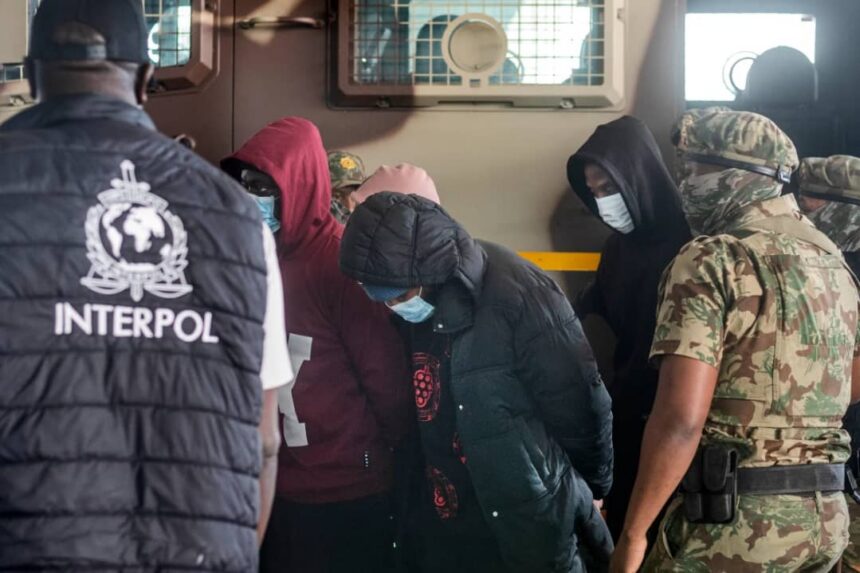
Members of the elite tactical police unit escort six Nigerians nationals being extradited to US for participating in romance scams, in Cape Town, South Africa, Friday, Sept. 11,2026. (AP Photo)
Latest development: September 11, 2026
Primary locations: Cape Town, South Africa; United States
For years, the case remained largely buried in the slow machinery of international criminal justice.

Six Nigerian nationals were arrested in Cape Town in 2021. The allegations against them were serious: that they belonged to an organised criminal network and had helped defraud more than 100 women in the United States through carefully constructed online romances.
Five years later, the case has returned to the headlines.
South Africa has agreed to extradite the six men to the United States, where they are expected to face charges of wire fraud and money laundering. South African authorities said the suspects were to be handed over to officials of the Federal Bureau of Investigation and the United States Secret Service in Cape Town on September 11, 2026
The alleged losses exceed 100 million South African rand, or about $6.2 million, according to the South African Directorate for Priority Crime Investigation, commonly known as the Hawks. The alleged victims included retirees and businesspeople who were reportedly drawn into sophisticated online relationships before being persuaded to send money or valuables.
This is not a conviction story. It is an extradition and prosecution story involving allegations that will now be tested in a United States court.
The relationships that allegedly became financial traps
Romance scams are built around a simple but powerful deception: the victim is made to believe that an online relationship is genuine.
Investigators say the six suspects allegedly used that emotional connection to target women in the United States. The women were not, according to the reports, approached with an obvious demand for money at the beginning. Instead, the alleged scheme depended on time, trust and carefully maintained identities.
Once the relationship was established, the victim could be asked to help with an emergency, a business opportunity, travel arrangements, medical bills or another urgent financial problem.
South African police described the alleged relationships as sophisticated. That description suggests that investigators believe the suspects were not acting through random messages alone, but as part of a broader and organised operation. However, the public statements reviewed do not provide a complete breakdown of the alleged roles played by each of the six men, the individual identities used or the exact amount attributed to each accused person.
The Black Axe allegation
The suspects are alleged to be members of Black Axe, a criminal network that has been linked by international law-enforcement agencies to cyber-enabled financial crimes, including romance fraud, cryptocurrency scams and investment fraud.
South African police and Interpol have described Black Axe as an organised criminal network with operations extending beyond Nigeria. The organisation’s name has appeared in a number of international investigations, but an allegation that a suspect is connected to the network is not, by itself, proof of membership or proof of the specific crimes charged in this case.
The six men were arrested in Cape Town in 2021 during a major operation by the Hawks. Their eventual extradition in 2026 shows how long international cases can take when arrests, evidence gathering, court proceedings and surrender procedures involve more than one country.
Why the case matters
The alleged scheme is significant because it illustrates how a crime that begins on a phone or computer can move across borders with very little visible contact between offender and victim.
The alleged victims were in the United States. The suspects were arrested in South Africa. The prosecution will now take place in the United States. The accused men are Nigerian nationals, while the financial trail may involve several countries, bank accounts, digital platforms and intermediaries.
That creates a difficult investigative task. Prosecutors will likely have to connect the accused individuals to the online identities, communications, financial transfers and alleged laundering arrangements. They may also have to show that the defendants knowingly participated in a coordinated scheme rather than merely having contact with victims or other suspects.
The South African authorities have not publicly disclosed the full evidence gathered during the 2021 arrests. Neither have the reports reviewed set out the names of the alleged victims or the specific dates of each alleged fraud.

The price of loneliness—and trust
The human cost of romance fraud is often hidden behind the financial figures.
The victims in this case were described as women, including pensioners and businesspeople, who were allegedly persuaded that they were dealing with romantic partners. Their financial losses were reportedly accompanied by emotional betrayal and humiliation.
That combination often makes victims reluctant to report what happened. In many cases, the offender does not merely steal money; the offender first creates a personal story in which the victim believes she is helping someone she loves.
The alleged use of online relationships also means that the criminals may not need to meet their victims physically. A false identity, repeated messages, photographs and a convincing personal history can create the appearance of intimacy without a face-to-face meeting.

The case therefore raises a wider question about how digital fraud has evolved. The old image of the internet scammer sending a crude bulk email has been replaced by alleged operations that rely on patience, emotional manipulation and multiple participants.
A wider international crackdown
The extradition comes amid renewed international efforts against organised cybercrime groups operating across West Africa and elsewhere.
Interpol said a recent operation targeting West African criminal networks led to 58 arrests and the identification of 263 suspects connected to different forms of organised crime. In a separate South African operation, police raided seven locations in Johannesburg allegedly linked to romance and investment scams, arresting 39 people, seizing about $2.67 million and freezing more than 250 bank accounts.
Those figures do not establish that the six Cape Town suspects were involved in every operation mentioned. They provide the broader law-enforcement context in which the extradition is taking place.
The authorities are increasingly treating online romance fraud not as isolated deception by individuals, but as part of organised financial crime involving recruitment, false identities, money movement and laundering.
What the court will have to decide

The extradition itself does not determine guilt.
In the United States, prosecutors will still have to prove the elements of the charges against each defendant. That may include proving that the accused knowingly participated in a scheme to defraud, that they used communications or financial systems in furtherance of the alleged fraud, and that money was moved or concealed in ways that amount to laundering.
The prosecution may also have to establish the individual conduct of each defendant rather than relying only on the existence of a wider network.
The men are entitled to the presumption of innocence unless and until they are convicted.
The long shadow of a five-year wait
The most striking feature of the case is perhaps the delay.
The suspects were arrested in 2021, but the extradition announcement came on September 11, 2026. That five-year gap reflects the legal and diplomatic complexity of transferring accused persons from one country to another.
For the alleged victims, it has meant a long wait for the case to move closer to trial. For investigators, it has meant preserving digital evidence, tracing financial records and maintaining cooperation between agencies operating under different legal systems.
The eventual handover is therefore not the end of the case. It is the beginning of the next stage.
The six accused men will now face the American justice system over allegations that they used online affection as a route to financial exploitation.
If prosecutors succeed, the case could become another major example of how romance fraud has grown into a transnational business model. If the evidence falls short, the court will have to say so.
First Weekly Fact Check
Established from official and credible reports:
Six Nigerian nationals arrested in Cape Town in 2021 are being extradited to the United States in connection with alleged wire fraud and money laundering offences.
South African police allegation:
The men are alleged to belong to the Black Axe organised criminal network and to have targeted more than 100 women in the United States.
Reported alleged loss:
More than 100 million rand, estimated at over $6 million.
Reported victims:
Pensioners and businesspeople who were allegedly drawn into online romantic relationships before being defrauded.
Not yet established:
The guilt of any of the six accused persons, the precise role of each defendant, the identity of all alleged victims and the full amount allegedly attributed to each suspect.
Important date clarification:
The arrests were made in 2021. The extradition is the new development announced on September 11, 2026; the alleged fraud is not being presented as a crime that occurred for the first time this week.
*Sources: South African Police Service/Hawks; Associated Press (AP); Reuters; eNCA; The Cable.
*First Weekly editorial note: The allegations contained in this report are attributed to the South African authorities and other credible reports cited. The accused persons remain presumed innocent unless and until convicted by a competent court.
Stay ahead with the latest updates!
Join The Podium Media on WhatsApp for real-time news alerts, breaking stories, and exclusive content delivered straight to your phone. Don’t miss a headline — subscribe now!
Chat with Us on WhatsApp