



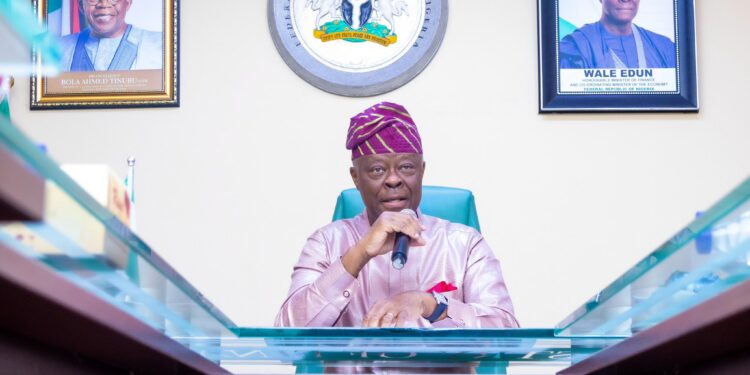
Wale Edun, minister of finance and coordinating minister of the economy, says the federal government will not reintroduce fuel subsidy despite rising petrol prices triggered by the Middle East conflict.
Edun spoke on Tuesday during a media briefing of the G-24 on the sidelines of the launch of the April 2026 global financial stability report by the International Monetary Fund (IMF).
The minister said Nigeria’s 2023 reforms under President Bola Tinubu, including the removal of petrol subsidy and the liberalisation of the foreign exchange market, were necessary steps that have received support from global financial institutions.

He added that although the reforms are beginning to yield results, they have been affected by external shocks beyond the country’s control.
“As you know, in the case of Nigeria, that moved very rapidly under the President who came in 2023 to remove subsidies on petroleum products, and to also remove subsidies that were related to the foreign exchange markets,” Edun said.
“And so those gains, which, if we look at them, were moving at pace and have now been negatively affected by an external shock, which had nothing to do with Nigeria or developing countries as a whole.
“Having made so much progress, it is important that we don’t return to generalised subsidies, a sort of relapse into policies that have not proven successful in the past.”
Edun warned that reversing the policies would undermine economic stability, insisting that targeted relief measures remain the most viable option.
‘PRIORITISE THE VULNERABLES RATHER THAN REVERSE REFORMS’
The minister, who currently chairs the Intergovernmental Group of 24 (G-24), said Nigeria and other oil-producing countries should prioritise targeted and temporary support for vulnerable citizens rather than reversing key economic reforms.
Responding to questions on how the crisis is affecting emerging economies, Edun said the impact differs from what was observed during the COVID-19 pandemic, noting that the transmission is not one-directional.
“For the oil-producing countries, the Ecuador and Nigeria, you may say, there is the transmission of higher oil prices into higher revenues,” Edun said.
“All of that is meaningful for the governments at this time, which is totally different from oil-importing countries, who clearly face escalated costs.
“But I must say that it’s also not a one-way street, in the sense that even an oil-producing country does have transmission of the higher costs, which feeds through from gas prices to fertilizer to food prices and so forth. So it is on both sides that this current energy crisis is affecting countries.
“I think that the idea is to be able to have the resilience to weather the current shocks, and that means the buffers that have been built have to be used. But I think that it is a question of using targeted and temporary relief, particularly for the poor and the most vulnerable, to help them through the cost-of-living spike, as opposed to rolling back the transformations which economies have taken.”
On April 14, Zaach Adedeji, chairman of Nigeria Revenue Service (NRS), said at an oil price benchmark of $120 per barrel, Nigeria’s annual subsidy bill could have risen to between N38 trillion and N52 trillion — consuming as much as 56 to 76 percent of the country’s N68 trillion 2026 budget.

Stay ahead with the latest updates!
Join The Podium Media on WhatsApp for real-time news alerts, breaking stories, and exclusive content delivered straight to your phone. Don’t miss a headline — subscribe now!
Chat with Us on WhatsApp