


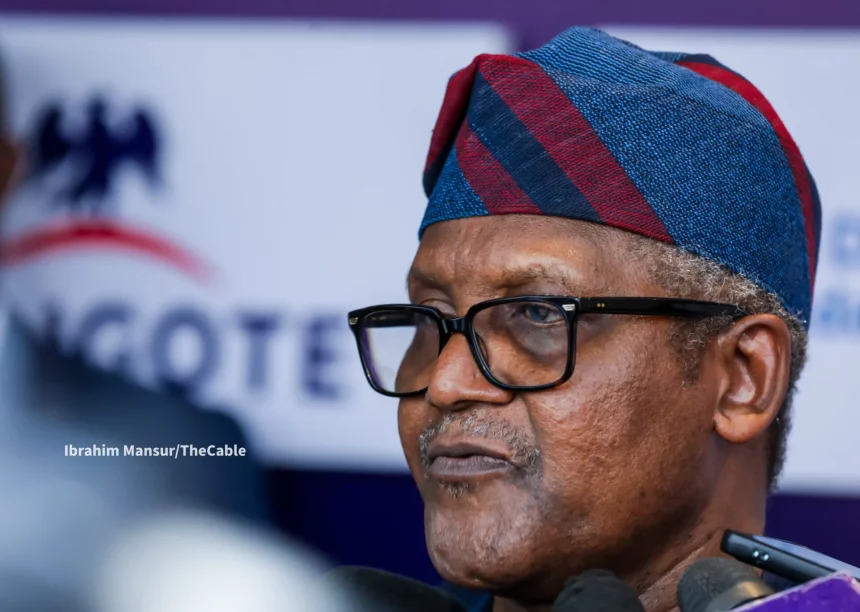
Aliko Dangote, chief executive officer (CEO), Dangote Group, is a big winner from the US-Iran crisis.
In a report on Friday, Wall Street Journal (WSJ) said Dangote is reaping the benefits of building the $20 billion refinery.
According to the report, Dangote is reaping the benefits after going “through hell” while developing the project, which was plagued by a decade of delays and cost overruns that ultimately doubled its price tag.

“The huge refinery reached full capacity in February—just in time to supply the world with diesel, jet fuel and gasoline that doesn’t need to pass through the Strait of Hormuz,” the report reads.
“Surging demand for refined petroleum products has boosted Dangote’s wealth by some $4.86 billion since the start of the year, according to the Bloomberg Billionaires Index, bringing his net worth to about $34.8 billion.
“Dangote’s repeated bets on the rise of Africa’s middle class, from cement to sugar to salt, have helped the 69-year-old become the world’s 65th-wealthiest person.”
WSJ said the refinery’s output of petrol, diesel, and jet fuel has increased more than 70 percent so far this year.
Devakumar Edwin, group vice-president (GVP) at Dangote Industries, told WSJ that Dangote plans to take the refinery public on the Nigerian Exchange (NGX) later this year, targeting a valuation of at least $50 billion.
He added that the company also intends to pursue a secondary listing — most likely in New York.
‘US-IRAN WAR: ENERGY SHOCK BENEFITS SUPPLIERS UNAFFECTED BY DISRUPTION’
WSJ said the refinery’s plans show how the energy shock triggered by the Iran war is benefiting suppliers unaffected by the disruption in the Middle East.
“Rising demand for Nigeria’s crude and refined products has boosted the country’s wider economy, supporting its currency and limiting rising gasoline prices,” the publication said.
“The conflict has been a particular boon for Dangote, whose refinery is by far the largest in Africa.”
According to the report, the Dangote refinery began producing in 2024, “and the business has now been turbocharged by the war”.
EDWIN: DEMAND FOR DANGOTE REFINERY PRODUCTS HAVE RISEN ACROSS SUB-SAHARAN AFRICA
Edwin told the publication that demand for the refinery products has surged from across sub-Saharan Africa this year, while jet-fuel exports to Europe have increased.

The GVP said he expects the refinery’s expansion to 1.4 million barrels per day by 2028 to cost about $13 billion.
According to the report, Dangote is also working on constructing another refinery in Lamu, a pristine archipelago off the coast of Kenya.
Edwin said the Lamu project, which includes the construction of a port, is expected to take about three years and cost about $15 billion.
He added that the company already has selected a site and is ready to begin design work.
‘LOCAL FEEDSTOCK SUPPLY REMAINS MAJOR CHALLENGE FOR DANGOTE REFINERY’
One major challenge for Dangote, according to the report, is securing sufficient local crude oil to feed the refinery.
“So far, Nigeria’s state oil company, NNPC, hasn’t been able to deliver even close to what Dangote requires,” WSJ said.
“That is because the government needs to sell crude to overseas buyers to service oil-backed loans and fulfill long-term export contracts.”
Another challenge for Dangote refinery, according to the report, is expanding its customer base.
“To that end, the company plans to buy its own ships to cut transport costs, set up a distribution hub in Namibia to better supply southern Africa and build a 1,500-mile-plus pipeline to pump its products to landlocked countries such as Zimbabwe, Botswana and Zambia,” WSJ said.

With the huge volume, Edwin said the major challenge will be distribution.
Stay ahead with the latest updates!
Join The Podium Media on WhatsApp for real-time news alerts, breaking stories, and exclusive content delivered straight to your phone. Don’t miss a headline — subscribe now!
Chat with Us on WhatsApp