



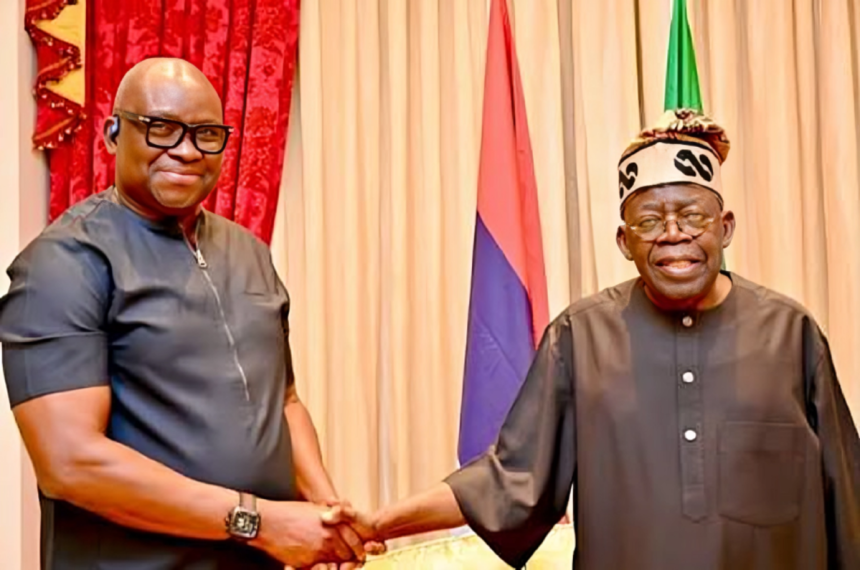
Former Governor of Ekiti State, Ayodele Fayose, has said it will be difficult for opposition parties to defeat President Bola Tinubu in the 2027 general election, arguing that an incumbent administration cannot be easily removed from power, particularly when it has the machinery of government at its disposal.
Fayose also urged Nigerians to begin conversations about who should succeed Tinubu in 2031, insisting that the country should allow the South to complete its tenure before power returns to the North in line with the country’s political understanding.
The former governor, who spoke during an interview on TVC News on Monday, as monitored by Nigerian Tribune, said opposition politicians seeking to challenge Tinubu should first put their political structures in order rather than rely on criticism of the President or the formation of alliances.

He said: “No Nigerian president will be removed cheaply. It is not common. Yes, it happened in the days of Jonathan, but it is not common. You cannot just wish a sitting government out of power because you want to take over.”
Fayose, who has repeatedly declared his support for Tinubu’s re-election, said the President had recorded some improvements in the economy, particularly in the exchange rate, although he acknowledged that the administration was not perfect.
“I am not saying Tinubu is perfect, but he has done so well, so far, so good. When things go bad, recovery is not easy. When an economy fails, recovery is not easy.
“Somebody will tell me, have we not gone as far as N1,700 to the dollar? Have we not moved down from that? Today, the dollar is below N1,400. It is not perfect, but it is better,” he said.
The former governor, who is the chairman of the Rural Electrification Agency (REA), also defended the removal of fuel subsidy, arguing that the resources saved could be channelled towards meeting government obligations, including the payment of salaries, rather than allowing a few privileged individuals to benefit from the system.
He challenged opposition politicians criticising the policy to clearly state whether they would reverse it if elected, describing what he considered their inconsistent positions as part of the politics of winning elections.
Fayose further argued that Nigeria’s political and institutional complexities would make it difficult for any new administration to govern solely on the strength of campaign promises, stressing that the National Assembly, religious considerations, ethnic interests and the country’s diversity would influence governance.
On criticisms of Tinubu’s administration by former President Olusegun Obasanjo, Fayose accused the former leader of seeking public attention, saying his interventions were often driven by personal interests rather than a consistent commitment to offering solutions.
While acknowledging that criticism was legitimate in a democracy, he maintained that public figures should go beyond fault-finding and offer practical alternatives.
“Criticism is good. I criticise people, but you must equally provide a solution, not just run your mouth. Everybody has a view. Your vote is one man’s vote. You are not the controller of the country,” he said.
He also dismissed suggestions that Obasanjo’s criticism could significantly affect Tinubu’s electoral fortunes, arguing that the political influence of former officeholders should not be equated with the active followership enjoyed by candidates contesting elections.
Fayose, however, acknowledged the right of opposition figures, including former Vice-President Atiku Abubakar and Peter Obi, to contest the 2027 election, but advised them to accept the outcome of the process in good faith.
On the proposed opposition coalition to produce a single presidential candidate against Tinubu, he questioned the effectiveness of such an arrangement, insisting that political parties and their candidates should concentrate on building genuine grassroots support.

He also dismissed the suggestion that the APC should be worried about efforts by opposition figures to unite against the President, arguing that electoral success would ultimately depend on the ability of political actors to convince voters.
The former governor, who reaffirmed his membership of the Peoples Democratic Party (PDP), said he had no intention of defecting to another political party, adding that he would rather withdraw from partisan politics than join another party.
“I am indeed a member of the PDP. I would never go to another political party. Never, ever. The moment I stop being a member of the PDP, I will withdraw from politics,” he declared.
Fayose further said the country needed to overcome its deep-seated ethnic and religious divisions, which he described as major obstacles to national development.

He expressed concern that political debates were increasingly shaped by ethnic and religious sentiments, warning that such divisions could undermine efforts to rebuild the economy and strengthen national unity.
He also commended Tinubu for what he described as his administration’s efforts to engage young Nigerians, particularly through the use of digital platforms, saying constructive engagement with the younger generation was important for the country’s future.
Looking beyond the 2027 election, Fayose urged Nigerians to begin discussing the country’s leadership direction after Tinubu’s tenure, arguing that the South should be allowed to complete its turn in the presidency before power shifts to the North.
He said the next four years should be used to consolidate the country’s political stability and prepare the ground for a smooth transition in 2031, rather than creating unnecessary political tension.
Fayose maintained that Nigeria’s political development required patience, compromise and respect for the country’s power-sharing understanding, adding that the country’s diversity made it imperative for political leaders to accommodate competing interests.
Stay ahead with the latest updates!
Join The Podium Media on WhatsApp for real-time news alerts, breaking stories, and exclusive content delivered straight to your phone. Don’t miss a headline — subscribe now!
Chat with Us on WhatsApp