

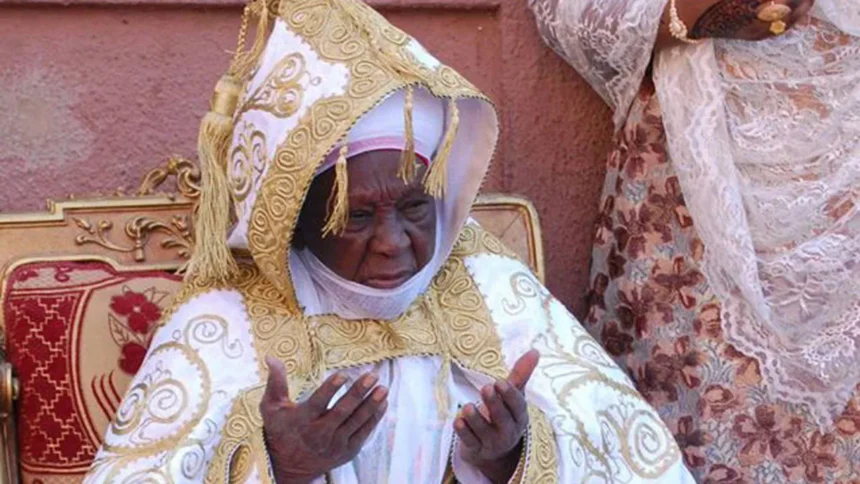
For nearly two decades, Umar Faruk Umar has sat atop one of northern Nigeria’s most storied thrones — the custodian of Hausa heritage in Daura and a familiar royal host to presidents, diplomats, and power brokers. The 60th emir of Daura has now found himself at the centre of an unprecedented controversy that has tested the moral authority of the ancient stool.
In Nigerian public life, few traditional titles carry the historical weight of Sarkin Daura. Regarded in folklore and history as the spiritual cradle of the Hausa people — tied to the legend of Bayajidda and Queen Daurama — the Daura Emirate has long projected an aura of quiet dignity, conservatism, and cultural permanence.
Since his appointment on March 1, 2007, following the death of his elder brother and predecessor, Muhammadu Bashar dan Umaru, who reigned for 41 years, Umar has embodied that continuity.

Yet, in recent days, the monarch has been thrust into the national and international spotlight not for a royal durbar or a state visit, but over grave allegations of sexual misconduct right inside his palace.
FROM CLASSROOMS TO POLITICS

Born in Daura, Katsina, to Umaru Abdurrahman — who served as Bunturawan Daura and later Magajin Garin Daura — Umar spent decades across local education, legislative politics, and traditional administration before wearing the royal turban.
Umar’s exact age is not consistently reported in publicly available records. Some biographical accounts list his birth date as May 5, 1936, suggesting he is 90 in 2026, while other reports cite 1931, which would make him 95.
A biographical account published by Rumbun Ilimi, a Hausa-language historical and educational resource, also lists May 5, 1936. The Czech Embassy in Abuja, following a visit to Daura in July 2015, states the emir’s age as 84, a detail that supports the alternative 1931 birth year.
His early education began at Quranic school and elementary primary school in Zango, before he completed his studies in Baure following his father’s posting there as district head.
He later undertook clerical and adult education courses at Ahmadu Bello University (ABU), Zaria, and began his working life as an adult education supervisor across Baure and Zango districts, rising to become an adult education officer under the Daura Native Authority.
Umar also tested the waters of partisan and local governance before ascending the throne. During the second republic, he was elected to the Kaduna state house of assembly in 1979 on the platform of the defunct National Party of Nigeria (NPN), serving as chief whip of the house and winning re-election in 1983 to represent Daura district.
At the time, Daura and the entire present-day Katsina area were part of the old Kaduna state. Katsina state was later carved out of Kaduna on September 23, 1987, by the military administration of Ibrahim Babangida.
He was speaker of the Katsina state house of assembly from 1988 to 1990.
JOURNEY TO THE THRONE OF BAYAJIDDA

Umar’s formal ascent within the traditional hierarchy accelerated on May 5, 1992, when his elder brother, the late Emir Muhammadu Bashar, turbaned him as Danburam Daura and the first district head of Babban Mutum.
On January 9, 2006, he was transferred to serve as district head of Baure, a posting he held for just over a year until the death of his brother created a vacancy on the Daura throne.

Following the recommendations of the Daura Emirate kingmakers on February 28, 2007, then-Katsina state governor Umaru Musa Yar’Adua approved Umar’s appointment as the 60th emir of Daura on March 1, 2007.
The appointment was conveyed in a letter signed by Mustapha Inuwa, then secretary to the Katsina state government.
Later that year, in December 2007, the federal government conferred on him the national honour of Commander of the Order of the Niger (CON), cementing his place among the country’s first-class traditional rulers.
For years, Umar’s public image was defined by royal pageantry and proximity to the corridors of power.

That profile expanded significantly between 2015 and 2023 during the presidency of Muhammadu Buhari, Daura’s most famous modern son.
Beyond his engagements with political leaders, Umar has used his traditional position to intervene in community affairs and comment on governance.
He has also taken disciplinary action within the traditional hierarchy. In May 2025, he removed Iliya Dakaci, the village head of Mantau in Baure local government area, following protests over allegations of involvement in kidnapping.
A PERSONAL LIFE IN THE PUBLIC EYE

Away from his official responsibilities, Umar’s marriages have occasionally attracted public attention, particularly because of the considerable age differences between him and some of his reported wives.
In 2015, the monarch reportedly married Gimbiya Aisha Umar Faruk and in January 2017, the couple welcomed their first child.

The marriage attracted renewed attention in December 2021 when the emir reportedly married Aisha Iro Maikano, who was 20 at the time.
The wedding reportedly took place in Katsina state on December 11, 2021, in a low-key ceremony. The bride was identified as the daughter of Iro Maikano, a traditional title holder.
About seven months later, in July 2022, the emir reportedly married another woman, A’isha Yahuza Gona, aged 22, in Safana, Katsina state.
ALLEGATION OF SEXUAL VIOLATION

That carefully curated legacy of royal authority collided abruptly with an allegation of sexual violation when a foreign female tourist who identified herself as Mirka accused Umar of sexually assaulting her.
The tourist, with Instagram handle @beduinqa, said the incident occurred on November 14, 2026, during a visit to the emir’s palace in Daura.
According to her account, she had travelled to Nigeria as part of a wider world tour and visited the palace during her last day in the country.
She published footage reportedly recorded with smart glasses, showing the encounter.
In her account, what began as a routine cultural courtesy call turned distressing when the monarch allegedly held her hand, kissed her cheek, and touched her breasts without consent, reportedly laughing off her repeated protests.
“Emir, you cannot be touching,” Mirka is heard saying in the video.
Mirka said she waited till she had departed Nigeria before making the footage public.
The now viral clip drew swift intervention from human rights organisations. Amnesty International condemned the alleged conduct and demanded an immediate, transparent investigation by Nigerian authorities.
Ahmad Gumi, an Islamic cleric based in Kaduna, said emirs found guilty of immoral conduct should be removed from office immediately to protect the integrity of the traditional institution.
In an open letter to Dikko Radda, Katsina governor, former military governor of Kaduna state Abubakar Umar argued that suspending the monarch would not amount to a declaration of guilt, but would demonstrate that “nobody, regardless of age, status or traditional authority, is above accountability”.
The Daura Emirate Council says that it is examining the footage to determine whether it is authentic or has been altered using technology.
The emir has not personally issued a response to the allegation.
For Umar, the controversy represents arguably the sternest test of his 19-year reign. Traditional rulers in northern Nigeria wield immense moral and cultural influence.
Whether the ongoing reviews and calls for a formal investigation vindicate the palace or deepen the crisis, the episode has already left an indelible mark on the final chapters of Umar’s reign — placing an ancient throne under intense public scrutiny amid modern demands for transparency, accountability, and the rule of law.
Stay ahead with the latest updates!
Join The Podium Media on WhatsApp for real-time news alerts, breaking stories, and exclusive content delivered straight to your phone. Don’t miss a headline — subscribe now!
Chat with Us on WhatsApp