



It is disheartening how some overzealous people are deliberately trying to distort or misrepresent the judgment of the Federal High Court, Abuja, delivered by Justice Peter Odo Lifu on 5 November 2026 in the case of Nafiu Bala Gombe v. Senator David Mark, Ogbeni Rauf Aregbesola and Others, in order to cast aspersions on the judge and misinform the public.
I saw a post on Facebook in which the person who posted it claimed that he had read the judgment and that there is nowhere the judge said that the presidential candidate of the ADC, Atiku Abubakar, was affected. Even though Atiku Abubakar is not a party to the case, he belonged to the Senator David Mark faction of the ADC and he benefited from the acts carried out by that faction, which acts the court held to be illegal, null and void.
In the interest of the integrity of a public institution such as the judiciary, which is very central to the democratic system of the country and to its well-being, I wish to put the record straight.

“Atiku’s name is not in the judgment” does not mean Atiku is not affected
The argument now circulating on Facebook runs like this:
After receiving the Certified True Copy of Justice Lifu’s judgment, we can state without hesitation that the entire charade has collapsed. Nowhere in that entire ruling is the name of Atiku Abubakar or any other legitimate candidate mentioned.
That may be true as a matter of naming. It is false as a matter of law.
A judgment does not have to mention a beneficiary by name for that beneficiary’s title to fall with the authority that conferred it.
What Justice Lifu decided was not about Atiku personally. It was about the source of Atiku’s candidacy. The court held that the emergence of Senator David Mark and Rauf Aregbesola as national officers of the ADC had not been shown to comply with the democratic election requirements of Section 82(3) of the Electoral Act, 2022. It set aside the resolutions of the party’s 99th National Executive Committee meeting held on 29 July 2025, restrained INEC from recognising or dealing with Mark, Aregbesola and the other affected persons as national officers, and declared actions and decisions taken by the disputed leadership from 29 July 2025 null and void.
Atiku Abubakar is not a party to the case, but he is not an outsider to that leadership. He belonged to the Senator David Mark faction. His presidential candidacy emerged from the congresses, convention and primary conducted under that very leadership — the leadership the court has held to be illegitimate, undemocratic and illegal.
That is the elementary point the Facebook post misses:
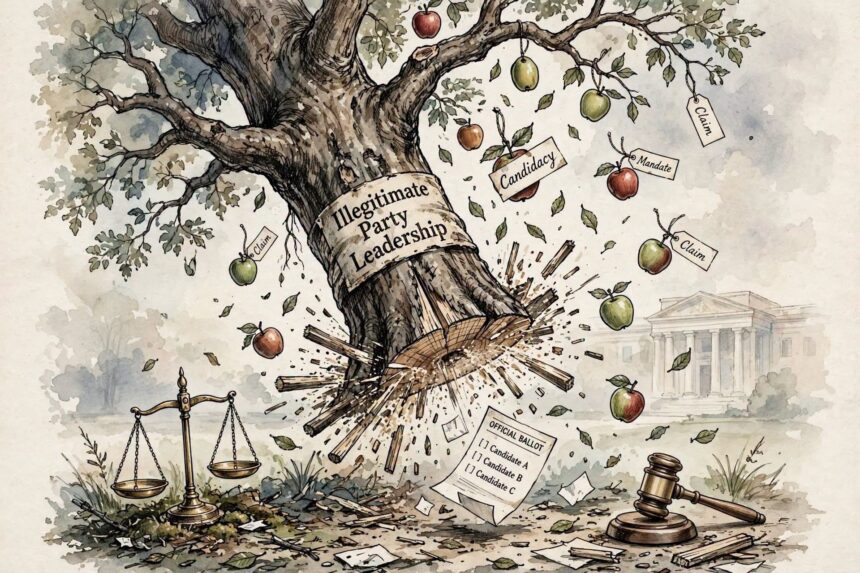
If the tree is cut down, you do not need a separate order cutting down each fruit on the tree.
To say “Atiku’s name is nowhere in the judgment, therefore his candidacy is safe” is like saying a man who bought a house from a person who had no title to sell it keeps the house simply because the court judgment voiding the seller’s title did not mention the buyer’s name. The buyer’s title falls because the seller had no title to pass. In the same way, a candidacy that flows from an illegal leadership cannot stand merely because the candidate was not personally named.
Nigerian decided cases reinforce this proposition
This proposition is firmly settled in Nigerian law.
- You cannot put something on nothing — Macfoy v. U.A.C. Ltd (1961)
In Macfoy v. U.A.C. Ltd, repeatedly adopted by the Supreme Court of Nigeria, it was held:
“If an act is void, then it is in law a nullity. It is not only bad, but incurably bad. There is no need for an order of the court to set it aside. It is automatically null and void without more ado, though it is sometimes convenient to have the court declare it to be so. And every proceeding which is founded on it is also bad and incurably bad. You cannot put something on nothing and expect it to stay there. It will collapse.”
Applied here: if the Mark-led leadership was void, every act founded on it — including the primary that produced a candidate — is founded on nothing.
- The candidate takes his title from the party’s lawful process — Amaechi v. INEC & Ors (2008)
In Amaechi v. INEC, the Supreme Court held, on Section 221 of the 1999 Constitution, that it is political parties, not individuals, that contest elections. There is no independent candidacy. Without a political party, a candidate cannot contest.
The court therefore held that votes cast for the PDP belonged to the party’s lawful candidate, Amaechi, even though Omehia’s name was on the ballot. Omehia’s participation was an illegal act and he could not be heard to claim benefits for his illegality.
That is the exact converse of the present case, and it proves the same principle: the candidate takes his title from the party’s lawful process, not from his own name appearing somewhere. If the process is lawful, the lawful beneficiary takes the benefit. If the process is unlawful, the beneficiary of the unlawful process takes nothing.
- No valid primary, no candidate — APC v. Marafa & Ors (2019)
This is the closest Nigerian election authority. The Supreme Court held that the APC in Zamfara State had not conducted valid primaries. The consequence was not merely that the party leadership was faulted. The consequence was that the party had no candidates at all, and all the votes cast for its candidates were wasted.

No candidate had to be personally named in the order nullifying the primaries for his candidacy to fall. The candidacy fell because the primary that produced it fell.
That destroys the Facebook argument in one sentence: Atiku did not need to be named, because his candidacy did not stand on its own name. It stood on the Mark faction’s primary.
- A judgment binds parties and privies
On the narrower question of who can benefit from a judgment, Nigerian law does not limit a judgment to the names on the writ. A judgment is conclusive as against parties and privies.
See Makoshi Daniel v. Senator Alex Kadiri (2010): a person who is not a party to a suit is not ordinarily bound, but a person who is in privity with a party is equally bound with the party.
See also Alhaji Mukaila Akinsanya v. Attorney-General of the Federation (2012): for purposes of res judicata, a “party” includes one who, being aware of a matter in which he has an interest at stake, allows his battle to be fought by another, intending to take the benefit of his championship if he succeeds.
Atiku was not a nominal party, but he was in privity of interest with the Mark faction: his candidacy was the very benefit that faction was fighting to preserve. He cannot claim the benefit of the faction’s success while denying the burden of its failure.
- No one profits from his own wrong
The Supreme Court has repeatedly held that a person cannot benefit from his own wrong, and that equity will not allow a party to benefit from his own iniquity: Teriba v. Adeyemo (2010) 13 NWLR (Pt. 1211) 242; PDP v. Ezeonwuka (2017) LPELR-42563 (SC).
A candidate who emerges from a process held to be undemocratic and illegal cannot retain the fruit of that process by pointing out that his own name was not mentioned.
The remedy is appeal, not Facebook
The other fallacy is to blame an “APC cabal” that allegedly “weaponised the judiciary.” But this was not an APC case. It was Nafiu Bala Gombe v. ADC & Ors, an internal ADC dispute filed by an ADC officer against his own party’s leadership. No amount of shouting about propaganda or political sabotage answers the legal question the court decided: was the Mark-led leadership validly and democratically elected in accordance with the ADC Constitution, the 1999 Constitution and the Electoral Act? Justice Lifu held that it was not.

And the proper remedy for a party that disagrees with a judgment is not a Facebook post. It is an appeal. The receipt of the Certified True Copy is precisely what enables the Mark faction to go to the Court of Appeal. Until that court varies or sets aside Justice Lifu’s judgment, the judgment stands, and its orders stand with it.
In short:
Absence of a name is not absence of legal effect.
Nullification of the leadership necessarily carries with it nullification of the acts done under that leadership.
Atiku’s candidacy is one of those acts.
Calling the judgment “propaganda” does not make it any less a judgment.
The judgment has not collapsed. What has collapsed is the argument that a candidate can keep the benefit of an illegal process while pretending the process never happened.
Stay ahead with the latest updates!
Join The Podium Media on WhatsApp for real-time news alerts, breaking stories, and exclusive content delivered straight to your phone. Don’t miss a headline — subscribe now!
Chat with Us on WhatsApp