



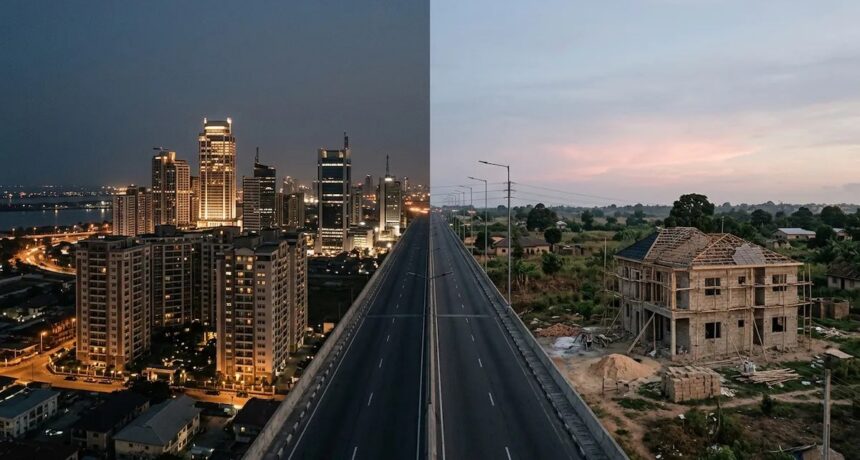
Lagos’s rent shock has not made housing cheaper. It has exported the problem to Epe, Ikorodu, Badagry, and across the state line into Ogun — where land is affordable and almost nothing else is ready for the people arriving on it.
A note on the family below: The Oyedokuns are an illustrative composite, not a specific reported household — their routine is drawn from patterns documented across thousands of Mowe, Ibafo and Sagamu commutes. The traffic conditions, fuel prices and infrastructure details referenced alongside them are real, separately sourced, and cited through this piece.
Three-thirty in the morning
The Oyedokun household in Mowe is awake before the town around it. By 3.30am the lights are already on — a quick wash, whatever breakfast can be managed standing up, the last checks on the children still half-asleep in the back seat. The target is not to arrive at the office by resumption; resumption is 9am, a lifetime away. The target is to beat Kara Bridge.

Kara Bridge — the stretch of the Lagos-Ibadan Expressway where the road crosses from Ogun State into Lagos, by the old cattle market — has become a kind of border post for Mowe’s exiles. Cross it before the expressway wakes up and the run into town can take under an hour. Cross it after, and it can swallow an entire morning: when repair works to the bridge’s expansion joints hit the road in 2026, commuters described gridlock stretching from the bridge itself back to the tollgate and beyond, one motorist leaving work at 5pm and still sitting in traffic at 8pm, fuel burning uselessly at ₦1,300 a litre in stationary cars. The Oyedokuns do not gamble on which kind of morning they will get. They simply leave before there is a choice to make.
So they arrive at the office car park at around 6am — three hours before resumption — and it is here, seat reclined and engine off, that they get the only stretch of real sleep their day allows. Not in the house they built. In the car park. This is not a bad day. This is the routine, most weekdays, until they finally get home again around 10pm.
By Lagos’s own measure, the Oyedokuns are a rare success story: homeowners, not tenants, at a time when only 31 percent of Lagos residents can say the same. They built the house themselves, in Mowe, on the Ogun side of the state line. The catch is that the achievement required leaving Lagos State altogether — and the sum that got them there is the same one a growing number of households are running, whether or not they say it aloud.
The rent gap: core Lagos vs. the corridors
Average annual rent, 2-bedroom flat (₦)
Ikoyi
₦17.25m
Victoria Island
₦18m
Lekki Phase 1
₦10m
Ikeja / Surulere / Yaba
~₦5m

Ikorodu
₦1.08m
Badagry
₦0.48m

Bar length scaled to Victoria Island’s average as reference. Figures are industry averages (kolaking.substack.com, Businessday, Legit.ng, Rio Times, GTI Capital Research) and vary by building class — treat as indicative, not audited.
A two-bedroom flat in Ikoyi now rents for an average of ₦17.25 million a year — at the high end, upward of ₦70 million, and at the low end still north of ₦8 million. In Victoria Island, the average sits closer to ₦18 million; in Lekki Phase 1, rents have climbed to an average of ₦10 million. Move inland to Yaba, Surulere or Ikeja, and the number falls to somewhere between ₦4.75 million and ₦5 million — still out of reach for most households, but no longer absurd.
Now do the same sum forty, fifty, sixty kilometres out — in Ikorodu, in Badagry, or, like the Oyedokuns, across the state line entirely. In Ikorodu, a two-bedroom flat averages ₦1.08 million a year. In Badagry, closer to ₦480,000. Land in Mowe, Ibafo or Sagamu can be bought and built on outright for a fraction of what a decade of Lekki rent would cost. That is the arithmetic pulling people to the edge of the map, and past it: a household that cannot find ₦5 million for a flat in Surulere, or that simply wants to own rather than rent for the rest of its working life, can do the sum once and never pay Lagos rent again.
Doing the sum once is doing a great deal of work in that sentence. What it leaves out is 3.30am. It leaves out Kara Bridge, and the ₦1,300-a-litre fuel spent idling in front of it, and the fact that the only uninterrupted sleep the Oyedokuns get most days happens in a car park, three hours before anyone expects them at a desk. That trade-off — what the arithmetic promises against what it actually costs — is the subject of this piece. So is the question of why the centre became this expensive in the first place, what is actually being done about it, and what would have to change, in financing, land law, transit and industrial policy, before “affordable Lagos” stops meaning “somewhere else, and up at 3.30am to get there.”
How the centre priced itself out
3.4m Estimated Lagos housing unit deficit (2025) GTI Capital / Estate Intel
₦6tn Needed annually to close the gap — ~3× the state’s capital budget GTI Capital Research

80–120% Rent increase, 2024–2026, vs. 7–9% wage growth GTI Capital Research
31% Lagos homeownership rate; 51% rent Fortren & Company
Lagos’s housing deficit is variously estimated. GTI Capital Research, drawing on Estate Intel data, puts it at 3.4 million units as of 2025 — up from 2.95 million in 2016, a 15 percent increase in nine years against an annual need of roughly 227,600 new homes. The state’s own Commissioner for Housing cited “more than 3.3 million” in May 2026; a separate Estate Intel estimate runs closer to 2.7 million. Older, higher figures — 22 million statewide, nearly 28 million nationally — circulate in political speeches and track a different, less transparent methodology.
A caveat worth stating once None of the figures in this piece rest on a fully current, independently validated population count — Nigeria has not held an internationally validated census since 2006. Every number that follows should be read as a serious, sourced estimate, not an audited one.
Closing the gap GTI has measured would cost an estimated ₦6 trillion a year — roughly three times Lagos State’s entire annual capital budget. That is the financing side of the story. The rental side is blunter still: rents across Lagos have risen an estimated 80 to 120 percent between 2024 and 2026, against wage growth of only 7 to 9 percent over the same period, according to GTI’s analysis. Some residents, the firm estimates, now spend 60 to 70 percent of monthly income on rent. It should not be a surprise, against that backdrop, that Lagos’s homeownership rate sits at just 31 percent, with 51 percent of residents renting, per a Fortren & Company survey of African cities — nor that the rate stays low even among people who could technically service a mortgage: a tenant funding an annual lump-sum rent, plus a customary agency fee, has little left over to accumulate a deposit.
Related reading This paper has tested this arithmetic before. In Beyond the Backlash: Testing Hamzat’s Rent Math, we ran the Lagos State Deputy Governor’s own public rent-affordability advice against the numbers renters actually face. The figures above pick up where that piece left off — this time following the money to the edge of the map rather than testing the advice itself.
Four forces did most of the damage.
The first is straightforwardly inflationary: naira depreciation and general inflation have pushed up the price of cement, reinforcement steel and imported fittings, and developers have passed those capital costs straight through to tenants and buyers.
The second is a mismatch between what gets built and who can afford it. Much of the new formal private pipeline — Estate Intel and Businessday reporting both note this — targets luxury and diaspora buyers, sometimes priced or pegged in foreign currency, at a moment when diaspora remittances are increasingly cited as a distinct driver of Lagos property demand: Nigerians abroad treating property as a dollar-denominated store of value, competing directly against resident, naira-earning buyers for the same prime stock.
Who can afford what — and where new supply actually prices
GTI affordability bands, at 9.75% mortgage rate / 20-year tenor
Low-income: under ₦3.51m
Lower-middle: ₦3.51m–₦8.79m
Middle: ₦8.79m–₦29.87m
Upper-middle: ₦29.87m–₦105.42m
Most of the new formal-sector pipeline prices above ₦200 million — off this scale entirely, and clearing none of the four affordability bands most Lagosians actually fall into.
The third is financing itself, and it is less about the cost of capital than its shape. Development in Lagos typically takes two to seven years; formal financing, sources at Prindex Properties and Deloitte note, is typically available for only twelve to eighteen months.
“Capital is available. The problem is how is risk measured? How is it managed?” — Dr Bola Adigun, Deloitte
Nigerian pension funds, meanwhile, hold roughly ₦30 trillion in assets but allocate only about 5 percent to housing-related instruments, against a regulatory ceiling of 30 percent — a policy choice sitting idle, not a shortage of money.
Poser If the money already exists and the ceiling already allows it, what, exactly, is pension capital waiting for?
The fourth, and the one most often left out of the rent conversation entirely, is land itself. Under the Land Use Act of 1978, all land is vested in state governors, whose consent is required for virtually any transfer. Fewer than 5 percent of land parcels nationally are estimated to carry a formal title, which makes land what the economist Hernando de Soto called dead capital: unmortgageable, hard to insure, hard to develop formally. Because the Act is entrenched under Section 315(5) of the 1999 Constitution, fixing it requires a constitutional amendment rather than an ordinary Act of the National Assembly — which is a large part of why reform keeps being promised and never quite arriving. Kaduna State’s mass land-titling programme is the most-cited domestic proof that an alternative is possible.
What this piece does not cover This is an examination of the formal rental market’s periphery-ward drift. It does not cover the separate, harsher crisis of forced evictions from informal waterfront settlements — Makoko, Ilubirin, and, as recently as this month, Oworonshoki — where residents are not choosing to move but being displaced outright, in some cases at night with minutes’ notice. That is a related but distinct failure, and Lagos Metropolitan intends to cover it on its own terms.
The exile’s ledger
The rent-savings side of the calculation is real. So is the cost side, and it rarely makes it into the estate agent’s pitch.
₦1tn–₦4tn Range of annual productivity-loss estimates from Lagos traffic Various — figures contested, see below
75% Of weekly working hours lost to gridlock, for some commuters Businessday
16,500 ha Alaro City / Lekki Free Zone footprint driving Epe’s boom SOM masterplan
Estimates of what Lagos gridlock actually costs vary enormously by source and year — figures of ₦1 trillion, ₦3.8 trillion and ₦4 trillion in annual productivity losses have all appeared in recent reporting, and one analysis put some commuters’ lost time at 75 percent of their weekly working hours. The range itself is telling: nobody has a clean number, but everybody agrees the number is large. A household that saves ₦4 million a year moving from Surulere to Ikorodu is not banking that saving in a vacuum; it is trading it against hours, fuel, and — increasingly, as more households make the same trade — worsening congestion on the roads that connect the periphery to the jobs that still sit almost entirely on the Island and the central mainland.
Not every corridor is exiled equally. Epe is the outlier. The Lekki-Epe Expressway upgrade, the Dangote Refinery, the Alaro City/Lekki Free Zone — a 16,500-hectare mixed-use free zone at Ibeju-Lekki masterplanned by the US architecture firm SOM — and a proposed Lekki International Airport have turned Epe into Lagos’s most speculative land market and arguably something other than a peripheral bedroom suburb: an emerging industrial-and-residential node in its own right. Ikorodu and Badagry have had no equivalent private-capital tailwind. Both are documented — in academic literature going back over a decade — as suffering bottlenecked access roads, seasonal flooding and fragmented power supply; state interventions such as the Badagry Carriageway reconstruction are under way but lag population inflow by years, a pattern Lagos has been failing to get ahead of since at least the mid-2010s.
Poser Lagos is marketing Epe as the affordability answer. Is anyone pricing in what a rising coastline does to that answer in twenty years?
There is a sharper irony sitting inside Epe’s good fortune. The Lekki Peninsula sits on a documented, worsening flood- and erosion-prone coastal barrier, and residents near the Lekki-Epe coastal highway have already reported flooding linked directly to that construction. The corridor being marketed, in effect, as Lagos’s pressure-release valve is also its most climate-exposed — a fact almost entirely absent from the commentary treating Epe as pure opportunity.
As demand rushes outward, land-title risk rushes with it. Disputed or unregulated omonile — landowning family — claims, overlapping government acquisitions, and outright document fraud are a well-documented hazard in Epe and Ikorodu specifically.
| The peripheral balancing act | Advantage | Cost |
|---|---|---|
| Housing cost | Rent or build for a fraction of core-Lagos prices | Larger plots, but often unregistered or disputed land |
| Daily commute | Quieter, less congested home environment | 3–6 hours daily; ₦1tn–₦4tn in city-wide productivity lost yearly |
| Infrastructure | Epe: fast-tracked by private capital (refinery, free zone) | Ikorodu/Badagry: flooding, weak grid, bottlenecked roads |
| Investment outlook | Land appreciation potential, especially near Epe | Climate exposure (coastal flooding/erosion) priced by nobody yet |
| Employment | Lower cost of living stretches income further | Jobs remain on the Island/Central Mainland — “bedtown” risk |
Show more
And because the jobs have not followed the housing, planners increasingly describe the risk facing all three corridors in one word: bedtown. Until decentralised commercial and industrial employment, and multi-modal transit to match, actually mature in Ikorodu and Badagry the way they are beginning to in Epe, the outer corridors will keep absorbing Lagos’s population without relieving Lagos’s underlying strain — they will simply move where people sleep, not where the city’s economy actually functions.
What Lagos is trying
The state is not idle, even if the arithmetic above suggests it is losing the race.
Lagos HOMS and the state’s Rent-to-Own scheme have run for years; independent academic assessment has questioned how much they have actually delivered against the affordability bands above. The state has set a delivery target of 14,000 new home units by the first quarter of 2027 and describes 2026 as a year of “doubling down” on housing delivery.
The fastest-moving lever in this entire piece A Lagos Tenancy Bill moving through the state legislature in 2026 would cap advance-rent demands and agency fees outright — the single most direct fix to the liquidity trap keeping renters from ever accumulating a deposit.
| Current practice | Proposed under the 2026 Bill | |
|---|---|---|
| Advance rent | 1–2 years, paid in cash upfront | Capped toward 3 months |
| Agency fee | 10–20% of annual rent | Capped toward 5% |
If it passes and is enforced, this requires no new construction and no constitutional amendment — and it goes directly at the reason a tenant paying rent on time every month can still never save a deposit.
Lagos rail: promise vs. deliverySep 2023Blue Line opensMarina–Mile 2Oct 2024Red Line opensAgbado–Oyingbo2026 (targeted)Blue Line Phase 2Mile 2–OkokomaikoUndatedRed Line Phase 2to Marina,via Ebute Metta
Gold markers = not yet delivered. Blue Line Phase 2 is the extension that would actually reach the Badagry corridor discussed in this piece; no confirmed completion date exists at time of writing.
On transit, the Blue Line — running from Marina to Okokomaiko, with the Mile 2-Okokomaiko phase targeted for completion in 2026 — and the Red Line are the state’s flagship answers to the commute-cost side of the ledger, with ferry routes and BRT extensions as lower-capital complements. Honestly scoped, current rail capacity serves a fraction of the corridor population it will eventually need to, and will not materially close the gap until further phases and last-mile connections mature.
At the federal level, the Renewed Hope Cities and Estates programme is the clearest decentralisation lever currently in motion, with cited targets ranging from 20,000 to more than 100,000 units nationwide; a Lagos-specific Renewed Hope City, reportedly around 2,000 units, was cited as roughly 80 percent complete in mid-2026 reporting.
And then there is Epe’s example, which nobody planned as a housing-policy intervention but which functions as one anyway: Alaro City, the Lekki Free Zone and the Dangote Refinery are proof, almost by accident, that jobs will follow infrastructure and industrial anchors when they arrive together. The honest reading of Epe is not that Lagos has cracked decentralisation — it is that decentralisation happens when private capital decides to make it happen, and has not yet happened anywhere the state has actually tried to make it happen on purpose.
What would actually move the needle
| Residential | Commercial | Industrial |
|---|---|---|
| Mass land-titling on the Kaduna model; pension-fund reallocation already permitted but unused; mandatory affordable-unit set-asides; real anti-speculation controls on idle land | Deliberately anchoring office, retail and service employment in Epe, Ikorodu, Badagry, and the Ogun towns absorbing overflow — the missing half of every plan so far | Replicating Epe’s free-zone-and-refinery model on purpose in Ikorodu and Badagry, sequenced with transit so jobs and rail arrive together, not housing first and everything else later |
Residential, commercial and industrial policy have mostly been treated as three separate conversations in Lagos. They need to run together. The most transferable lesson from elsewhere is not really about housing at all — it is about land records. Nigeria’s Land Use Act already contains, in Section 28, a “use it or lose it” mechanism allowing a governor to revoke a right of occupancy for failure to develop land — the problem is that it is rarely enforced against anyone with the money or connections to contest it, which is a political-will gap dressed up as a legal one.
A corridor with cheap housing and no local jobs is not a solution to Lagos’s crisis; it is Lagos’s crisis, relocated forty kilometres and renamed a suburb.
Can Nigeria stem the drift, or only relocate it?
~200,000 New housing units Lagos needs annually just to keep pace GTI Capital / Estate Intel
20k–100k+ Renewed Hope Cities/Estates units cited nationwide Federal Ministry of Housing
2021 Year Lagos–Ogun Joint Development Commission was signed NIPC
Lagos’s pull is not purely a Lagos story. Rural-urban migration into the city has been documented in the academic literature for decades, driven by the familiar mix of agricultural precarity, education and employment access, and the simple fact that Lagos remains Nigeria’s commercial centre of gravity regardless of what the housing market does to newcomers once they arrive.
The federal government’s answer, in principle, is investment in secondary cities and the Renewed Hope Cities programme discussed above. Set against Lagos’s own estimated annual demand growth of roughly 200,000 units a year, the current scale of that federal programme, even at its most optimistic cited figures, does not yet look large enough to meaningfully slow the flow into the city it is nominally meant to relieve.
Nor is cross-border coordination within the existing Lagos region functioning as intended. A Lagos-Ogun Joint Development Commission was established by memorandum of understanding in 2021, specifically to plan cross-border infrastructure jointly rather than let Ogun’s towns absorb Lagos’s overflow unplanned.
Poser A commission exists on paper to plan for families like the Oyedokuns. Five years on, who can say what it has actually built?
More recent coverage of officials “urging professionals to actualise” the Commission suggests a body that exists on paper and has not yet delivered — a more specific and more damning finding, if confirmed on the record, than simply asserting no coordination exists at all.
Which raises the question this piece should end on rather than avoid: is “an affordable Lagos” even the right frame? Or should the honest goal be a Lagos region — one that plans for Mowe, Ibafo and Sagamu as deliberate extensions of the city’s housing and jobs market, rather than treating them as somebody else’s overflow to manage after the fact?
The exile’s return
Return to Mowe, and to 3.30am. The Oyedokuns’ morning is not a hardship story told for sympathy — it is the arithmetic from the opening of this piece, worked all the way through to its actual cost. They did the sum once, correctly, and won a house of their own out of it. Nobody’s spreadsheet included Kara Bridge, or the ₦1,300-a-litre fuel spent beating it, or the fact that the best sleep available to them most days is the sleep they steal in a car park three hours before anyone at the office expects them.
What would have to be true in five years for that trade to stop being the only version of success on offer? It would mean a Tenancy Bill that is actually enforced, not just passed, so that owning in Mowe is a choice rather than the only escape from renting in Lagos. A land-titling programme that turns dead capital into mortgageable collateral at the pace Kaduna has shown is possible — so a family need not build in another state entirely to own anything at all. A Blue Line and Red Line, and whatever eventually reaches the Lagos-Ibadan corridor, that carry commuters at a capacity real enough to make Kara Bridge irrelevant, rather than something to be out-run before dawn. And, hardest of all, a deliberate industrial and commercial policy for Ikorodu, Badagry and the Ogun towns that does not wait for a refinery or a free zone to arrive by accident, the way one arrived in Epe — so that a job, and not just a house, can eventually exist somewhere nearer than a 6am car park.
Until then, the arithmetic will keep doing what arithmetic does: pointing, coldly and without much regard for anyone’s preference, to the edge of the map — and asking whoever follows it to be awake, dressed, and on the road, well before the city they’re fleeing has had its own first cup of tea.
Stay ahead with the latest updates!
Join The Podium Media on WhatsApp for real-time news alerts, breaking stories, and exclusive content delivered straight to your phone. Don’t miss a headline — subscribe now!
Chat with Us on WhatsApp