



With petrol prices ranging between N1,340 and N1,400 per litre at some filling stations, commercial transport operators are increasingly turning to compressed natural gas (CNG) to cut operating costs.
On May 29, 2023, President Bola Tinubu announced the removal of the petrol subsidy, triggering a sharp increase in petrol prices and transportation costs.
In response, the federal government introduced the Presidential Compressed Natural Gas Initiative (Pi-CNG) to reduce transportation costs, targeting over 11,500 new CNG-enabled vehicles and 55,000 CNG conversion kits for existing PMS-dependent vehicles.

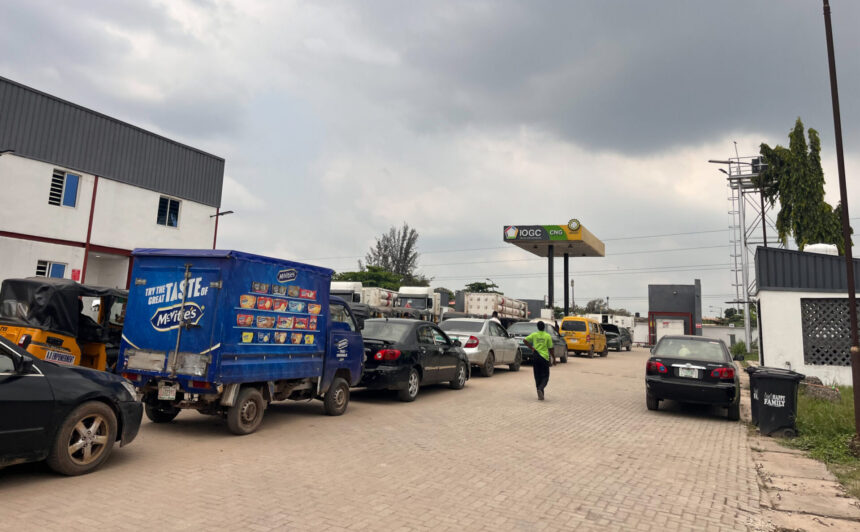
Observations by TheCable at CNG refuelling stations in Lagos and Ogun states show that the alternative fuel sells for about N380 per kilogramme.
For transport operators who have switched, the lower price of CNG is translating into reduced operating expenses and, in some cases, cheaper fares for passengers.
However, long queues at stations and the high cost of converting vehicles continue to pose challenges to wider adoption.
‘DELAY CAUSED BY LONG QUEUES AFFECT MY JOB’

Speaking to TheCable, Lawal Adeyinka, chairman of the transport park at China Town, Ojota, Lagos, said the CNG had helped him reduce his petrol expenses and offer passengers lower fares.
Adeyinka operates between China Town and Adeniji in Lagos but sometimes travels to Magboro, Ogun state, to refill his gas when supplies are unavailable in Lagos.
He said gas of about N6,000 could power his bus for three trips, compared with the N45,000 he previously spent on petrol for four trips.
“CNG is economical. I believe the amount I spend on buying CNG is not high. The cost I charge my passengers for transportation is very low,” he said.
The park chairman said he charges passengers N500, while other operators on similar routes charge between N700 and N1,000.
He, however, identified the time spent queuing at CNG stations as a major challenge, saying the delays affect the number of trips drivers could make in a day.
“It does affect my job. You know time is money, so it affects my job,” Adeyinka said.
“If the CNG stations are everywhere like petrol stations, I feel the transport fare will be much lower because drivers would get the gas in time.”

Lukman Kareem, another commercial driver operating between Mowe in Ogun state and Lagos, said he switched to CNG because petrol had become too expensive to sustain his business.

He said he previously spent about N25,000 on petrol for a trip between Mowe and Lagos and made as many as three trips daily, taking his petrol expenses to about N75,000.
With CNG, Kareem said he now spends about N10,000 per trip.
“CNG pays me. The money I save from buying petrol is what I use to sustain and take care of my family,” he said.
‘CONVERSION COST CHASING MOST DRIVERS AWAY’


While the lower running costs have encouraged more drivers to adopt CNG, the expense of converting vehicles remains a major barrier for some operators.
Kareem said the cost of converting his vehicle was N900,000 when he made the switch but had since risen to about N1.35 million.
“The money to convert is what is chasing most of the bus drivers away,” he added.
Ebube, a commercial driver who operates between Berger and Ajah in Lagos and also undertakes interstate trips, said he began using CNG about three months ago after observing the savings made by colleagues who had converted their vehicles.
Ebube said he previously spent at least N50,000 on petrol for two trips between Berger and Ajah in a day.
With CNG, he now spends about N15,000 for the same number of trips.


He said the lower fuel costs had also given him room to charge passengers less on some routes without undermining his earnings.
However, Ebube identified access to CNG stations as the biggest drawback, saying drivers sometimes spend two to three hours waiting to refill their vehicles.
“We always have to queue. At times, it will take us two or three hours before we can fill our gas,” he said.
“The government should help us create more gas stations so that we won’t just be in the queue for a long time.”
Kunle, another transporter, said CNG remains cheaper despite the long waiting time at stations.
“The issue is that the gas stations are not everywhere yet, and it causes long queues. We usually spend two to three hours in the queue. We sleep over sometimes at gas stations, but it still pays,” he said.
Another driver, who identified himself as Oloba, said the queues sometimes prevent transporters from filling their cylinders even after spending several hours at a station.
“Sometimes, if trucks come to fill, they don’t attend to us. But if trucks don’t come, we spend about one hour and thirty minutes,” Oloba said.
‘INVESTMENT, GAS SUPPLY KEY TO EXPANDING CNG ACCESS’

Dayo Ayoade, an energy law expert, said the high cost of establishing CNG refuelling stations is discouraging investment in the sector.
He said setting up the facilities requires substantial capital for storage systems and safety equipment, much of which has to be imported.
According to Ayoade, foreign exchange (FX) volatility and high borrowing costs further increase the financial burden on investors, who have to recover dollar-denominated investments in naira.
The energy law expert also identified unreliable gas supply as a major constraint, noting that CNG stations require regular deliveries of natural gas, often through pipelines.
“We have the issues of demand and supply mismatch because if you want to convert lots of vehicles to use gas and you don’t have sufficient infrastructure to do that conversion, that becomes a bit of a problem,” Ayoade added.
“Investors face regulatory and commercial uncertainty. They have to acquire land, they have to acquire access to gas supply, and nobody knows how much demand there will actually be, how the pricing will be, and how the general populace would respond.”
To address the challenges, he called for improved financing arrangements and investment incentives, including tax relief, long-term funding and a one-stop approval process for investors.
The expert also recommended public-private partnerships to reduce the cost of entering the sector and encourage private investment in refuelling infrastructure.
Ayoade said expansion should initially focus on high-demand urban centres and major transport corridors before extending to areas with lower demand.
He added that investment in gas pipelines, compression facilities and refuelling stations should be coordinated with the expansion of vehicle conversion services to prevent supply and infrastructure gaps.
“Government should address both. You don’t want to grow one, and then the others are lagging. It will become disjointed, and the bottlenecks will remain with us,” the energy expert said.
On August 27, 2026, Tinubu ordered the rollout of an additional 500 CNG refuelling stations nationwide.
He said the federal government is currently financing more than 100 gas projects, including 15 CNG mother stations and 86 daughter stations.
The president said the federal and state governments have agreed to set up a joint committee to “begin implementing these measures immediately”.
Source: The Cable
Stay ahead with the latest updates!
Join The Podium Media on WhatsApp for real-time news alerts, breaking stories, and exclusive content delivered straight to your phone. Don’t miss a headline — subscribe now!
Chat with Us on WhatsApp