



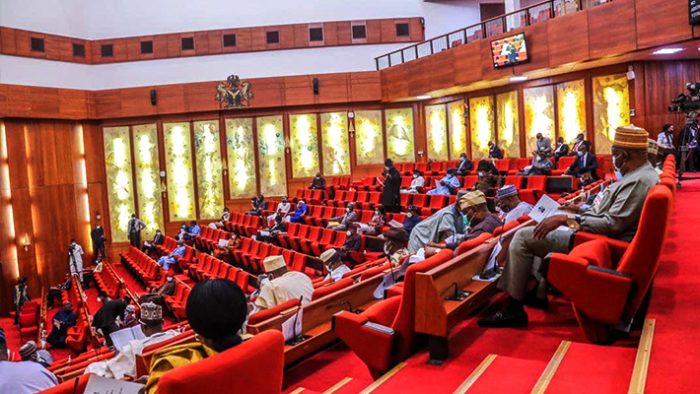
The House of Representatives on Wednesday stepped down a bill seeking to prohibit the production, importation, distribution, sale and consumption of unbranded and unfortified edible oils in Nigeria following extensive debate among lawmakers over its potential impact on public health, existing regulatory frameworks and rural livelihoods.
The proposed legislation, sponsored by the member representing Ehime/Mbano/Ihitte Uboma/Obowo Federal Constituency of Imo State, Chike Okafor, was presented for second reading during plenary but was deferred after members raised concerns over its provisions and the inadequate circulation of copies of the bill.
Leading the debate, Okafor said the bill was designed to address growing public health risks associated with the widespread consumption of unbranded and unfortified cooking oils across the country.

He said available statistics indicated that about 67 per cent of Nigerians consume unbranded edible oils, while only 31 per cent of edible oils circulating in the country are fortified.
Citing a report by the World Health Organisation (WHO), the lawmaker said food fortification remains “a proven, cost-effective strategy to address micronutrient deficiencies and improve public health.”
According to him, “the bill prohibits the production, importation, distribution and sale of unfortified and unbranded edible oils, while also mandating collaboration among research institutes, universities and state ministries to improve seedlings and establish cooking oil processing mills through public-private partnerships.”
Okafor explained that the proposed legislation also provides penalties, including terms of imprisonment for offenders, while allowing a transition period for existing producers and businesses to comply with the new requirements.
“This is a matter of life and death. It is a call to protect the health of Nigerians,” he said.
However, opposition to the bill emerged during the debate, with some lawmakers warning that its implementation could adversely affect thousands of small-scale producers, particularly in rural communities where locally processed palm oil is a major source of income.
The member representing Ihiala Federal Constituency of Anambra State, Paschal Agbodike, urged the House to exercise caution, arguing that the bill could threaten the livelihoods of local palm oil producers.
“This bill is not okay. Many of my people are into the production of palm oil locally. We must be careful about the laws we are trying to make because the livelihood of people in the rural areas, like my people, is very important,” he said.
Also opposing the bill, the member representing Karu/Keffi/Kokona Federal Constituency of Nasarawa State, Gaza Gbefwi, argued that the National Agency for Food and Drug Administration and Control already possesses the statutory powers to regulate edible oils and other food products.
“I do not think we need to over-legislate. Instead of trying to overdo things, we should strengthen existing laws and oversight. We already have NAFDAC and the Standards Organisation of Nigeria. If there are gaps in the Acts establishing these agencies, we can call for amendments,” he said.
His position was supported by the member representing Epe Federal Constituency of Lagos State, Wale Raji, who cautioned against what he described as the unnecessary proliferation of laws.
According to him, “NAFDAC is already regulating food and drugs. Let us look at the laws establishing NAFDAC, because their mandate already covers what this bill is trying to achieve.”
Backing the proposed legislation, however, the member representing Jibia/Kaita Federal Constituency of Katsina State, Sada Soli, maintained that the bill complements rather than duplicates the responsibilities of NAFDAC.

“The bill is mindful of NAFDAC. This legislation is trying to improve an existing framework, and this is not harmful. This bill is not against the local production of palm oil,” he said.
As the debate progressed, the member representing Orhionmwon/Uhunmwonde Federal Constituency of Edo State, Billy Osawaru, observed that many lawmakers had not received copies of the bill, making it difficult for them to make informed contributions.
He argued that members could not meaningfully debate legislation without first studying its detailed provisions.
Following the interventions, Okafor appealed to the Deputy Speaker, Benjamin Kalu, who presided over the session, to step down the bill until another legislative day to allow for wider circulation and further consultations to address concerns raised by members.
The Deputy Speaker granted the request.
The proposed legislation comes amid growing concerns over food safety and nutrition in Nigeria. Health experts have consistently advocated the fortification of staple foods, including edible oils, with essential micronutrients such as vitamin A to combat nutritional deficiencies, particularly among children and pregnant women.
Nigeria already operates mandatory food fortification programmes for selected food products, while NAFDAC and the Standards Organisation of Nigeria are responsible for regulating food quality, safety standards and compliance.
However, the prevalence of unbranded and informally processed edible oils, especially in open markets, has continued to generate debate over the effectiveness of existing regulatory measures and the need for stronger enforcement.
Stay ahead with the latest updates!
Join The Podium Media on WhatsApp for real-time news alerts, breaking stories, and exclusive content delivered straight to your phone. Don’t miss a headline — subscribe now!
Chat with Us on WhatsApp