




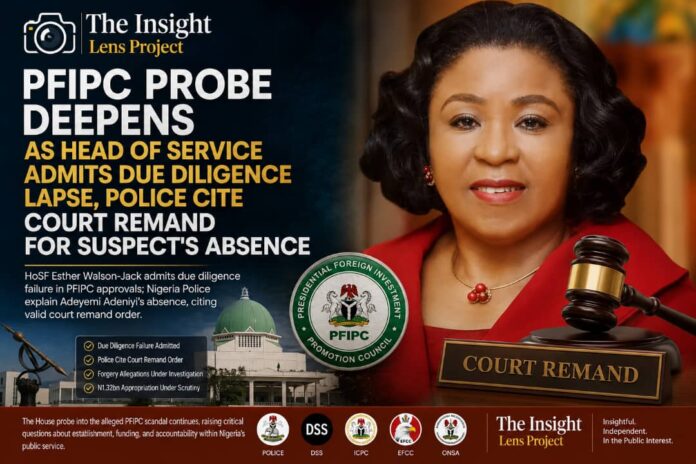
The House of Representatives’ investigation into the alleged Presidential Foreign Investment Promotion Council (PFIPC) gathered momentum on Wednesday as the Head of the Civil Service of the Federation (HoSF), Esther Walson-Jack, acknowledged that her office failed to carry out sufficient due diligence before approving the council’s proposed staffing structure and recruitment waiver. At the same hearing, the Nigeria Police Force explained that Adeyemi Adeniyi, who claims to be the Director-General of the PFIPC, could not be produced before the committee because he is being held in custody under a valid court remand order.
Appearing before the House Ad Hoc Committee investigating the legality of the PFIPC and the ₦1.32 billion appropriated to it in the 2026 Appropriation Act, Walson-Jack admitted that stronger verification procedures could have detected the allegedly forged documents submitted to her office. She said the Office of the Head of the Civil Service acted after receiving what appeared to be the PFIPC’s establishment documents and an appointment letter presented by Adeniyi, alongside representations made on behalf of the organisation.
The Head of Service said the approvals were granted based on the documents presented but acknowledged that her office ought to have independently verified their authenticity through the appropriate government channels before granting official approvals. She accepted responsibility for the institutional lapse in the verification process, while making it clear that the failure was administrative rather than an admission of criminal wrongdoing. She also pledged to strengthen internal verification procedures to prevent similar incidents in the future.

Her testimony has drawn attention to wider concerns about administrative controls within the federal public service. Ordinarily, documents relating to the establishment of a federal agency or the appointment of its chief executive should be independently verified through official government records and relevant authorities before any administrative approvals are granted. The apparent failure to detect the alleged forged documents before official approvals were issued has exposed weaknesses in existing institutional verification mechanisms.
The controversy has also placed the Office of the Chief of Staff to the President under public scrutiny after Adeniyi reportedly claimed that his appointment letter was signed by Chief of Staff Femi Gbajabiamila. The Presidency has categorically denied the claim, maintaining that the appointment letter is forged. The alleged forgery has since become part of ongoing investigations by security and law enforcement agencies. As of Wednesday, no court had made any finding of criminal liability against Adeniyi or any other individual connected with the matter.
Meanwhile, the Chairman of the House Ad Hoc Committee, Yusuf Gagdi, informed lawmakers that the Inspector-General of Police had written to explain why Adeniyi was not produced before the committee. According to the letter, Adeniyi remains in lawful police custody pursuant to a subsisting court remand order while investigations into allegations of conspiracy, forgery, and impersonation continue. Gagdi said the committee made the police’s explanation public to dispel any impression that the suspect had ignored the lawmakers’ summons.
The police further stated that producing Adeniyi before the committee would require judicial authorisation because he is being detained under an existing court order. They stressed that releasing him without the court’s approval would amount to a violation of the remand order. The committee accepted the explanation and reiterated that it would not interfere with either the ongoing police investigation or the judicial process, in line with the constitutional principle of separation of powers.
Gagdi also commended the collaboration between the Nigeria Police Force and other agencies involved in the investigation, including the Department of State Services (DSS), the Independent Corrupt Practices and Other Related Offences Commission (ICPC), the Economic and Financial Crimes Commission (EFCC), and the Office of the National Security Adviser (ONSA). He said the committee would continue to engage the relevant institutions as its investigation progresses.
At the centre of the investigation are fundamental questions about whether the PFIPC was ever lawfully established, how it allegedly secured office space within the Federal Secretariat, and how ₦1.32 billion was included for it in the 2026 Appropriation Act despite claims that it has no legal status as a federal government agency. The outcome of both the legislative inquiry and the criminal investigation is expected to determine whether there were systemic failures, administrative negligence, or criminal acts, and could lead to significant reforms in document authentication, inter-agency verification, and accountability within Nigeria’s public service.
Adebamiwa Olugbenga Michael is a Lagos-based journalist, political economy and policy analyst, and publisher of TheInsightLensProject.com, delivering data-driven open-source intelligence insights on Nigeria, Africa, and global affairs.
Stay ahead with the latest updates!
Join The Podium Media on WhatsApp for real-time news alerts, breaking stories, and exclusive content delivered straight to your phone. Don’t miss a headline — subscribe now!
Chat with Us on WhatsApp