



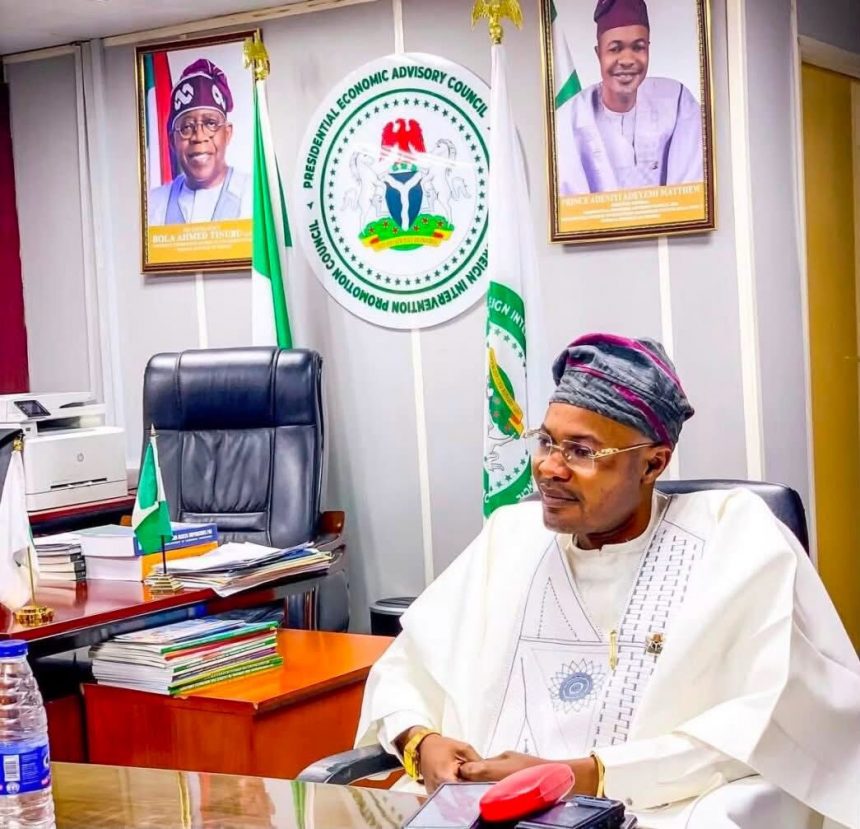
There are gaps in the press release here…
https://x.com/aonanuga1956/status/2072389161945071776?s=20
The statement explains the alleged impersonation case, but it does not answer the central public-finance question raised by the budget record.

The official Budget Office publication lists a 2026 Presidency MDA line, code 0111062001, for the “Presidential Economic Advisory Council/Presidential Foreign Intervention Promotion Council”. The allocation shown is N1.303bn, comprising N802.98m for personnel, N200.0m for overhead, and N300m for capital. The Budget Office published the Appropriation Bill details in January 2026, and the President assented to the 2026 Appropriation Bill in April 2026. (Budget Office of the Federation)
The material gaps
1. No explanation for the MDA code and named budget line
The release calls the agency fictitious, yet does not explain why an apparently specific MDA code, institutional name and appropriation line appeared in the Presidency schedule. This is more than a reference in a speech or an unofficial website. It is a structured budget classification.
The unanswered question is straightforward: who created, submitted, validated and retained code 0111062001 in the budget process?
2. The timing creates a serious accountability gap
The statement says the Chief of Staff’s office raised the alarm in October 2025 and that the Police arrested the alleged impostor on October 27, 2025. Yet the 2026 Appropriation Bill was published in January 2026, after those events. (Budget Office of the Federation)
The release does not explain why an agency said to have been identified as fictitious in October 2025 still appeared in the budget submitted and published months later.
That is perhaps the most significant omission.
3. No distinction between “no funds transferred” and “no appropriation existed”
The statement says no government money was transferred into the alleged CBN account opened by the accused. That may be relevant to the criminal allegations, but it does not resolve the budget issue.
A budget appropriation is different from a transfer into a particular bank account. The real questions are:
- Was the N1.303bn line appropriated?
- Was any warrant issued against it?
- Was any cash-backed release made?
- Was any personnel payroll generated?
- Were contracts, commitments or procurement plans initiated?
- Was the allocation vired, frozen, returned or reassigned?
The statement addresses only one possible account. It does not address the appropriation itself.
4. No explanation for the personnel allocation
The line includes about N803m for personnel. Personnel votes ordinarily imply an approved staffing structure, payroll basis or at least a planned establishment.
The release should explain:
- Whether any staff were formally captured under the MDA;
- Whether salary payments were processed;
- Which office held the personnel records;
- Whether the personnel provision was a budgeting error, duplication, placeholder or unauthorised insertion.
This is especially important because the statement says the entity was non-existent.
5. No explanation for capital and overhead provisions
The allocation also includes N200m overhead and N300m capital. Those categories normally require some programme, operational plan, project or procurement rationale.
The release does not state what the N300m capital provision was intended to fund, who proposed it, whether there were project codes, or whether any procurement process began.
6. Silence on the executive and legislative trail
An appropriation line does not emerge from nowhere. It typically passes through multiple institutional gates:
- MDA budget submission;
- Budget Office review;
- Executive budget proposal;
- National Assembly consideration and amendment;
- Presidential assent;
- Implementation controls by the Budget Office, Office of the Accountant-General and Treasury systems.
The State House statement does not identify where the control failure occurred. It does not say whether the line was in the Executive proposal, inserted or adjusted during legislative review, or retained through reconciliation.
The President’s own April statement said MDAs were expected to use appropriated resources transparently and efficiently, with emphasis on value for money. (State House Abuja)
7. No disclosure of a corrective action
If the agency is fictitious, a complete response should state what has happened to the line item:
- Has the MDA code been deactivated?
- Has the appropriation been cancelled or reallocated through a supplementary or virement process?
- Have all releases been blocked?
- Has the Budget Office been directed to investigate?
- Has the Office of the Accountant-General been directed to confirm whether payments occurred?
- Has the National Assembly been formally notified?
Without this, the public is left with denial but no institutional remedy.
8. The statement risks narrowing a system issue into an individual criminal case
The alleged conduct of the named individual may properly be before the courts. But the budget entry raises a separate governance question: how did a supposedly non-existent entity acquire an MDA identity and a N1.303bn appropriation within the federal budget architecture?
That question is not sub judice merely because an individual criminal prosecution is pending. The administrative provenance, budget-control trail and remedial steps can be explained without prejudicing a criminal case.
The more credible official response
A stronger State House response would have said:
The Presidency confirms that a line item bearing code 0111062001 and the name Presidential Economic Advisory Council/Presidential Foreign Intervention Promotion Council appeared in the 2026 Appropriation Act. The entity is not a validly constituted federal agency and no authorised appointment was issued for its purported Director-General.
The Presidency has directed the Budget Office, the Office of the Accountant-General and relevant security agencies to establish the origin, approval trail, releases, payroll status, procurement commitments and any associated bank accounts linked to the budget line.
Pending the outcome, all releases and transactions against the code have been suspended. The findings and corrective action will be made public.

CLOSE:
That would separate the alleged criminality from the larger governance failure, which is what the public needs explained.
The question is not about whether an individual forged an appointment letter, that is a serious issue. It is about whether Nigeria’s budget architecture allowed a non-existent entity to be assigned a code, funded on paper and carried through the appropriation process without an effective control intervention.
Segun Showunmi
“Is this really the life we are living in this country?” As the Yoruba would ask, Ṣé ayé lè jẹ́ yìí?

I could cry just reading this.
A nation that treats accountability as optional will always struggle to achieve consequential outcomes. We waste the time of generations and then celebrate pedestrian accomplishments as though we are still emerging from the age of rudimentary governance.
What troubles me most is not even the allegation itself. It is the apparent absence of institutional outrage.
In serious countries, the mere appearance of such allegations would trigger immediate action. A special investigative panel would be constituted. Questions would be asked.
How was the budget line created? Who approved it? Through what process did it pass scrutiny? How was office space allocated within the Federal Secretariat? Who signed the relevant documents? Who supervised the process? Who benefited?
The objective would not be noise or public spectacle. The objective would be to establish facts, identify failures, and impose consequences where necessary.

Instead, we often drift from scandal to scandal with little sense of urgency, as though the erosion of public trust carries no cost.
This is why institutions matter. This is why accountability matters. This is why consequences matter.
No nation can sustainably develop when impunity becomes routine and oversight becomes performative.
Sometimes it takes all the grace of the Holy Spirit not to lose one’s mind watching the same patterns repeat themselves while the country continues to pay the price.
A society rises when wrongdoing is investigated, truth is established, and responsibility is enforced not when citizens simply move on to the next outrage.
Otunba Segun Showunmi.
The Alternative.
Stay ahead with the latest updates!
Join The Podium Media on WhatsApp for real-time news alerts, breaking stories, and exclusive content delivered straight to your phone. Don’t miss a headline — subscribe now!
Chat with Us on WhatsApp