



Founder and Managing Director of Makaya Consult FZE, Olawale Opayinka, has disclosed that he was brought in as far back as 2011 to develop…
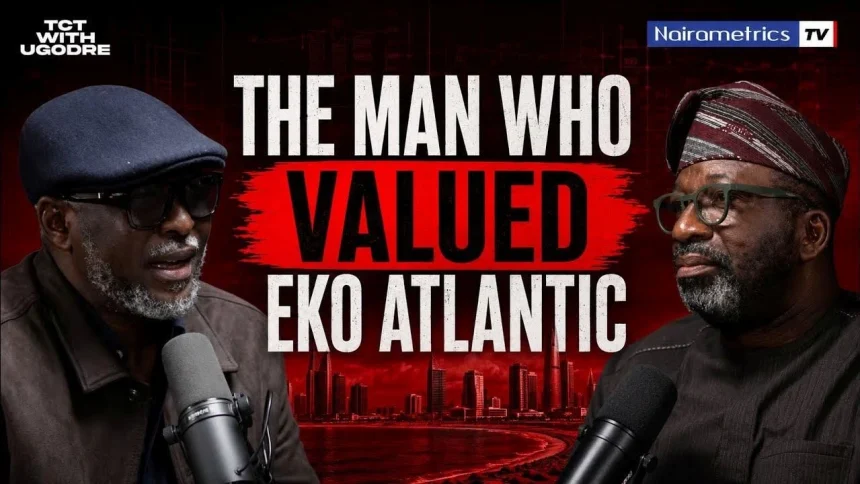
Founder and Managing Director of Makaya Consult FZE, Olawale Opayinka, has disclosed that he was brought in as far back as 2011 to develop the financial model for Eko Atlantic City, at a time when the now iconic Lagos development was still an expanse of ocean encroaching on the mainland.
Opayinka, who trained in actuarial science and has spent over 15 years embedded in the Eko Atlantic project, made the disclosure while speaking on The Coffee Table podcast, hosted by Ugodre Obi-Chukwu.

Eko Atlantic City is a massive, planned modern coastal city built on 10 million square meters of land reclaimed from the Atlantic Ocean adjacent to Victoria Island in Lagos, Nigeria.
What they are saying
Recalling how he approached the challenge of modelling a city that did not yet exist, Opayinka explained that his actuarial training equipped him to quantify uncertainty and project long-term outcomes.
- “That discipline then meant that we have the capacity to make financial sense of the future. So, that’s at the heart of what we are, what we do. We make financial sense of the future. We put numbers on abstract things,” he said.
He noted that he trained in the actuarial profession and sat professional exams with the Institute of Actuaries, though he clarified he is not a fellow of the institute.
He later became the first Black consultant to set up an actuarial consulting firm in the United Kingdom, working with the UK’s Financial Services Authority (now the FCA) around the year 2000.
Nigeria’s population could hit 1.2 billion in 50 years
Speaking on Nigeria’s demographic trajectory, Opayinka — who described demographics as central to actuarial work — said the country’s population has quadrupled over the last 50 years, from around 65 million in 1976 to roughly 240 million today.
Projecting the same growth rate forward, he argued that conventional estimates undersell the scale of what is coming.
- “When I sit and tell you today that in the next 50 years, our population is likely to be 830 million, between 830 million at the low end to 1.2 billion at the other end… I’m actually on the low side of that range,” he said, adding that he expects the true figure to land between one billion and 1.2 billion.
Lagos could double in 15 years, warns of infrastructure strain
Opayinka also cautioned that Lagos, currently home to an estimated 20 million people, could see that number double within 15 years, creating enormous strain on infrastructure.
- “If you think that Lagos is overpopulated today, imagine that in 15 years’ time, that number doubles. That means in 15 years’ time, you must double Lekki, Ikeja. You must create another Lagos,” he said, warning that while digital infrastructure could scale quickly, physical and social infrastructure — including schools — would struggle to keep pace.
He described this looming pressure as both “a bigger crisis” and “a big opportunity” for entrepreneurs and policymakers alike.
Nigeria as “The freest nation on earth“
On entrepreneurship, Opayinka described Nigeria as uniquely permissive compared to other countries, crediting this freedom for enabling ventures ranging from street trading to billion-dollar refineries.
- “We’re the freest nation on earth… In Nigeria, up till this year, you get born and you know you’re going to die. But you may not pay taxes,” he said, adding that the environment allows individuals to build refineries, banks or informal businesses with few barriers.
He argued this same freedom means Nigerians have little basis to blame external circumstances for their economic condition, using the example of a hairdresser earning far more than a salaried worker to illustrate how informal enterprise can generate outsized returns.
Opayinka also shared a personal framework for Nigeria’s social structure, proposing that the population be viewed in four life-stage groups — ages 0-25 for education, 25-50 for industry-driving work, 50-75 for experienced deployment, and above 75 as elder statesmen he termed “the Gray Panthers.”
He suggested this generational grouping could help foster national unity by giving citizens a shared identity beyond ethnic or economic divisions, contrasting Nigeria’s fragmentation with the common values he said underpinned Singapore’s development under Lee Kuan Yew.
Get up to speed
According to data compiled by Estate Intel, Eko Atlantic led Lagos’ luxury residential market recording a 59.5% sales growth rate over the last five years.

The report highlighted that prime Lagos luxury residential assets delivered strong sales price growth in naira by an average of 38%–60% annually over the past five-year period.
While Eko Atlantic topped the list, other prime areas also posted impressive gains.
Ikoyi followed closely at 58.14%, reflecting its enduring appeal among affluent buyers, while Banana Island recorded 55.30% growth, driven by its scarce waterfront properties and high-end residences.
What you should know
In a metrics carried out by Nairametrics, Eko Atlantic claimed the top spot among 10 most expensive areas for 2-bedroom shortlets in Lagos.

The city has an average daily rate of N325,000 for a 2-bedroom shortlet apartment in Lagos in 2025. The city’s master-planned design, modern infrastructure, and towering residential complexes continue to position it as the most premium address in the state.
Built on reclaimed land along the Atlantic Ocean, Eko Atlantic offers advanced drainage systems, 24/7 security, and professionally managed facilities, making it especially attractive to high-net-worth individuals, expatriates, and corporate tenants seeking exclusivity and convenience.
Stay ahead with the latest updates!
Join The Podium Media on WhatsApp for real-time news alerts, breaking stories, and exclusive content delivered straight to your phone. Don’t miss a headline — subscribe now!
Chat with Us on WhatsApp