



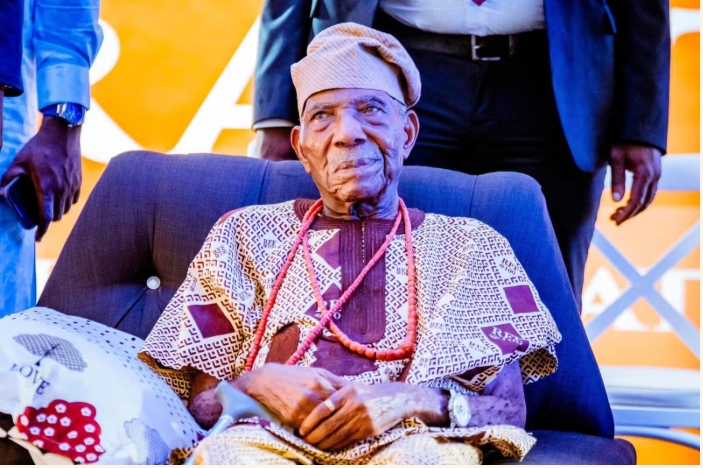
Reuben Fasoranti had a childhood dream of becoming a medical doctor. But he grew up in a tiny village in Uso, Owo, under British colonial rule, where schools were neither adequately staffed nor equipped to teach science. Even switching to a better school in Ondo, a larger city, could not save his dream. Only teachers for commercial and art courses were available. With the setback, Fasoranti adjusted his interest and decided to become a teacher to fix the system.
Fasoranti went on to establish and head multiple schools that are, to this day, considered among the best in the country, producing a governor and numerous leaders.
He died on Tuesday at 100, and even leaders who never stepped into his classroom spoke about the lessons he taught them.


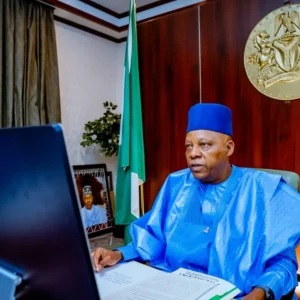
President Bola Tinubu said he would miss his “voice of wisdom, moral authority, and fatherly counsel”. Former President Olusegun Obasanjo said Fasoranti always offered him wise words with dignity, despite their political disagreement. Former Vice-President Atiku Abubakar said the late centenarian’s legacy “towers above any title or office”.
Fasoranti was born on May 11, 1926, just 12 years after Lord Frederick Lugard amalgamated the northern and southern protectorates to form Nigeria. For over seven decades, he marched for the country’s independence, held political office, was imprisoned by a military junta, and marched again to save the country’s democracy and restore civilian rule. He was also an ardent disciple of Obafemi Awolowo, the former premier of Nigeria’s now-defunct Western Region. He remained a resolute “Awoist”, upholding his interpretation of federalism and restructuring until his last breath. Fasoranti fought for the unity of Afenifere, a Yoruba social-cultural group he co-founded, even when it seemed pointless.

He was raised in Uso, in present-day Ondo state, but his family originated from Akure. Fasoranti’s grandfather left his hometown a couple of generations earlier after being denied the Odopetu chieftaincy title he was entitled to. He was headed for Owo metropolis initially but decided to settle in the hinterland instead.
“From there, he begot my father and my father begot me; and from there, my father moved to Ayede/Ogbese, and that is the story,” Fasoranti told Punch in 2020.
After primary and secondary education at both St. Andrews Primary School in Owo and Ondo Boys’ High School, Fasoranti headed to Yaba Higher College, now Yaba College of Technology, in Lagos. He moved to University College in Ibadan, now the University of Ibadan (UI), where he studied geography.

He started his teaching career at Ondo Boys’ High School, his alma mater, where his medicine dream was crushed by a lack of science teachers. Soon, he travelled abroad, first to pursue a postgraduate diploma in education at the University of Hull in the UK. Then he earned a master’s in education administration and school management at Macquarie University, Sydney, Australia.
He returned to the country and founded Anglican Grammar School, Iju/Itaogbolu, Akure, in 1957. He served as the school’s principal for 14 years before it was taken over by the state government in 1972.
Fasoranti also served as principal at Iwo Baptist School in Osun, Olivet Baptist School in Oyo, and finally at Christ’s School, Ado Ekiti, where Kayode Fayemi, former governor of Ekiti, was one of his students.
He later established Omolere Nursery and Primary School and Akure High School. He also founded St. Frances’ Academy, Igoba, Akure, which was named in honour of his wife, whom he married in 1955 and lost in 1991.
BECOMING AN ‘AWOIST’
Fasoranti became interested in politics early on and, like most young people of his day, was swept up in Awolowo’s ideas. He joined the Action Group (AG).
Fasoranti grew closer to the former premier of the Western Region through Adekunle Ajasin, a fellow teacher and long-term associate.
“When I was teaching in Anglican Grammar School, Iju-Itaogbolu, I was fascinated by his ideas. He would come there to campaign, and I attended all those rallies. As a young man, I was fascinated, and I decided to be a disciple of Awolowo and joined the Action Group,” Fasoranti told Vanguard in 2011.

“When I joined the Action Group and Papa Awolowo was coming here, he would meet Ajasin and his associates in my compound here (in Akure). So Chief Ajasin knew me intimately, and I think he was so interested in me so much that he devoted a whole page to me in his book.”

WORKED AS COUNCILLOR ‘FOR FREE’
Fasoranti’s popularity within AG was stratospheric, and within a short while he ran for a councillorship post and won. He juggled the political office with his job as a school principal and claimed he did the former for free.
“When I was a councillor, I was also a school principal, and I did not take anything from the council. I was doing it for free because I had a job,” he told Vanguard in 2019.

“There was passion to serve the people. But the whole thing has changed; today everything is monetised, and you see people earning fat allowances. It appears money has taken control, and there is nothing we could do about it except a miracle happens.”
Fasoranti’s integrity and transparency as a government official also extended to his tenure as Ondo commissioner for finance during the aborted Second Republic. Adekunle Ajasin was elected governor under the newly formed United Party of Nigeria (UPN), and he appointed Fasoranti as commissioner.
In 2018, Oluwafumilayo, Fasoranti’s daughter, recounted how her father was strict about using his official car for personal use.
“What I noticed then whenever I came home was that the official vehicle that took him to work came at 7 am; returned at 3.30pm after their exco meeting,” she said.
“The driver would later return the vehicle to the office. I told him that the official car should be in his care at home, but he said it was only for official duty. That is not happening now because once a public office holder gets an official car, it belongs to him or her.”
JAILED BY BUHARI’S JUNTA, AND HIS DAUGHTER DIED WHILE HE WAS IN PRISON

Before the Second Republic ended, a military junta led by former President Muhammadu Buhari seized power. Fasoranti was among the government officials who were summarily imprisoned.
While in prison, one of Fasoranti’s daughters died, and he was only allowed a few hours to visit his family before he was returned to jail.
“My father was first put in Owo prison; later, he was moved to Ado Ekiti. We resigned ourselves to fate then because there was nothing we could do because Muhammadu Buhari was in government at the time. Everybody was in fear because we never knew what would happen,” Oluwafunmilayo, one of Fasoranti’s daughters, said.
“Even whenever anybody was arrested, the family wouldn’t know where the person was being taken to. The only thing that affected us much then was my sister’s death. She died at the time my father was in detention. I was the only one with her in the hospital in England. The news of her death was broken to him when he was in detention.
“They sent for him to be brought home to tell him what happened. The news affected him, and after a few hours, the soldiers who brought him took him back to the prison. He returned the same day. It affected us a lot. My mother was worried because she lost her first daughter, and her husband was in detention. It was painful, but we thank God.”
STRUGGLE FOR DEMOCRACY WITH NADECO AND AFENIFERE

During decades of military dictatorship, Fasoranti joined the defunct National Democratic Coalition (NADECO), an advocacy group that called for Nigeria’s return to democracy.
He was prominent among the chieftains calling for the actualisation of the annulled June 12, 1993, presidential election, which Moshood Abiola was widely believed to have won. Members of the group were arrested and tortured by the military government headed by Sani Abacha during the struggle.
Fasoranti, alongside Abraham Adesanya, Bola Ige, Ayo Adebanjo, and Olu Falae, founded Afenifere as a political party in 1993. The group later shifted from a political party to a Yoruba socio-cultural platform, and its manifesto was subsumed into the Alliance for Democracy (AD) in 1999.
Fasoranti took over as the Afenifere leader in 2008 after Abraham Adesanya’s death. As he aged, his tenure as group leader was marked by internal divisions.
Fasoranti never remarried after his wife’s death in 1991. The couple had five children; only three survived him. Funke Olakunrin, one of their daughters, was murdered by gunmen along the Benin-Ore road in 2019.
Stay ahead with the latest updates!
Join The Podium Media on WhatsApp for real-time news alerts, breaking stories, and exclusive content delivered straight to your phone. Don’t miss a headline — subscribe now!
Chat with Us on WhatsApp