



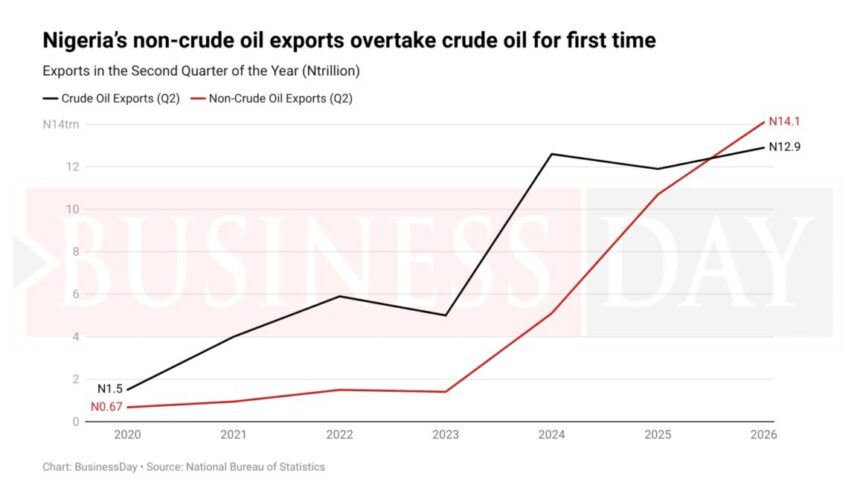
Nigeria’s earnings from non-crude oil exports overtook crude oil exports for the first time on record in the second quarter of 2026, according to Foreign Trade in Goods statistics released by the National Bureau of Statistics (NBS) in what economists have named “a point of inflexion in Nigeria’s trade history.”
Non-crude oil exports totalled N14.11 trillion in the April-to-June quarter, against N12.91 trillion in crude oil exports, NBS data show. Crude’s share of total exports fell below 50 percent for the first time since 2008, when comparable NBS data began.
The statistics office defines crude oil as “naturally occurring, unrefined petroleum products composed of hydrocarbon deposits and other organic materials” and classifies “non-crude oil” as other petroleum products, including mineral fuels like natural gas, fuel, and bituminous coal, raw material goods, agricultural goods, solid minerals, energy goods and manufactured goods.

Exports of kerosene jet fuel, natural gas, urea and “other petroleum gases in gaseous state” together generated N9.7 trillion, accounting for about 70 percent of all non-crude oil exports. Exports of solid minerals also rose 90 percent during this time, reaching N146.91 billion.
Of the non-crude oil export figures, non-oil products accounted for N3.7 trillion.
Total trade for the quarter was N41.44 trillion. Merchandise exports rose 18.8 percent year-on-year to N27.02 trillion, while imports fell 12.6 percent to N14.42 trillion, widening the trade surplus to N12.60 trillion from N6.26 trillion in the same quarter of 2025, the data show.
The Dangote factor
The shift in export composition tracks the ramp-up of the 700,000 barrels per day mega Dangote refinery, whose petroleum-product output has increasingly displaced imported fuel while adding to the country’s export volumes.
The refinery has been a major beneficiary of the Middle East war-driven disruption in refined-product markets.
The US Energy Information Administration (EIA) reported that Nigerian seaborne petroleum-product exports averaged 350,000 barrels a day (bpd) in the second quarter of 2026, versus 46,000 bpd in 2023, according to market intelligence company Vortexa.
EIA traced the second expansion in Nigerian shipments to Dangote completing maintenance and increasing capacity in February, coinciding with supply constraints around the Strait of Hormuz, where roughly a quarter of global oil shipments pass through.
The refinery, which has maintained a production capacity of 700,000 bpd over the last three months, according to Aliko Dangote, its chairman, is the only producer and supplier of jet fuel in Nigeria.
In August, the company displaced the United States to become the largest supplier of jet fuel to Europe, after supplying more than 400,000 tonnes of the product in July for the second consecutive month in 2026, according to a BusinessDay report. In June, it exported 466,000 tonnes, approximately 20 percent of the continent’s total jet fuel imports.
“The refinery has continued to expand exports of diesel, gasoline and other refined petroleum products to destinations across Europe, Africa and other international markets, further strengthening Nigeria’s position as a net exporter of high-value petroleum products,” said David Bird, chief executive officer of the Dangote Petroleum Refinery and Petrochemicals.
Amid this, imports of crude oil continued to rise in the second quarter of the year, reaching N786 billion, a signal of continued crude purchases for domestic refining.
The Dangote refinery disclosed in May that it imported 40.4 million barrels of crude worth $4.48 billion in May and June 2026.
The Iran war factor
The windfall was not exclusive to refined petroleum. Urea exports during the second quarter rose to N2.1 trillion, despite not appearing at all among the top five export products in the same period in 2025.

Gideon Negedu, former executive secretary of the Fertilisers Producers Suppliers Association of Nigeria (FEPSAN), explained that Nigeria is expected to see a jump in earnings from urea exports as global demand for the commodity has surged since the Iran war.
“For our local urea industry, the current surge in demand is a boon,” Negedu said in an interview with BusinessDay.
Prices have also soared. The International Food Policy Research Institute (IFPRI) reported that world urea prices roughly doubled within weeks after the effective closure of Hormuz in late February.
By April, its analysis found urea prices were approximately twice their pre-war level.

Double-edged sword
The oil windfall and price shock that followed have proven to be a double-edged sword for the nation’s economy, especially its industrial sector.
Businesses that depend on petroleum products to run have had to put up with skyrocketing oil prices that have eaten into their margins and stymied productivity. There has been no buffer.
“Exports out of Nigeria may not be as competitive compared with exports out of countries that are a bit more resilient in the face of the energy price shock,” said Ayo Teriba, an economist and chief executive of Economic Associates (EA).
Exports of agricultural goods declined 36 percent to N802.99 billion, and the value of manufactured goods exports stood at N393.03 billion, marking a 51 percent decrease from the second quarter of 2025.
“Our industrial sector is still dependent on petroleum products. The cost of energy, the cost of transport. The energy that they use, and the cost of distributing the food inward from the ports to the farms and factories, and outward from the farms and factories to the ports, you know, is killing,” he said.
Teriba said Nigeria could maintain the momentum over the next ten years if it scales up production and refining capacity across its economy.

Where the goods went
India was Nigeria’s largest export destination in the quarter at N3.29 trillion, or 12.2 percent of total exports, with non-crude products, mainly refined fuels, accounting for more than two-thirds of that total, according to NBS country-level data.
Spain accounted for N1.98 trillion, the Netherlands, N1.90 trillion, the United States, N1.73 trillion and Togo at N1.50 trillion rounded out the top five destinations. Togo’s exports to Nigeria were overwhelmingly non-crude, at N1.35 trillion of N1.50 trillion, consistent with the country’s role as a West African transshipment hub.
Within Africa, Togo, South Africa and Côte d’Ivoire were Nigeria’s top three export destinations, together accounting for 61 percent of the continent’s export total, while Libya, Ghana and Angola were the largest African sources of imports, according to the data.
Stay ahead with the latest updates!
Join The Podium Media on WhatsApp for real-time news alerts, breaking stories, and exclusive content delivered straight to your phone. Don’t miss a headline — subscribe now!
Chat with Us on WhatsApp