


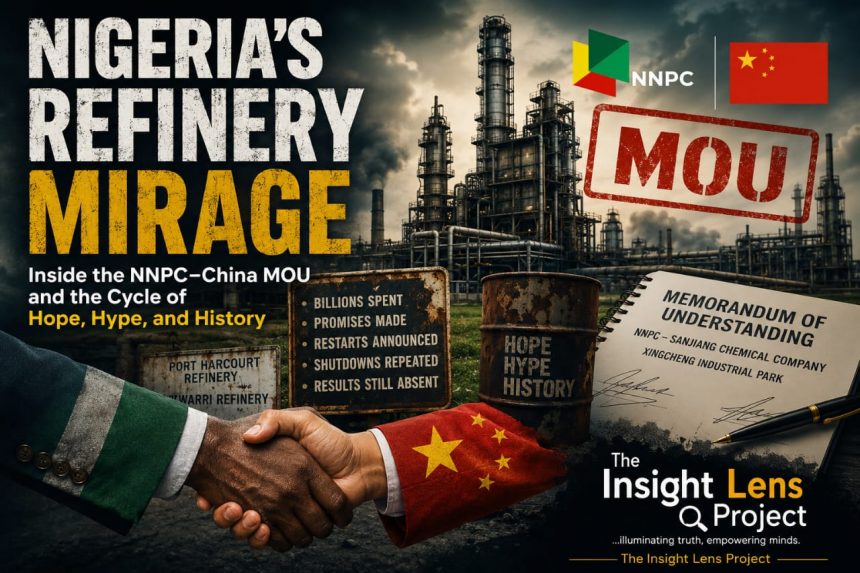
The Memorandum of Understanding signed on April 30, 2026, in Jiaxing, China, between the Nigerian National Petroleum Company Limited (NNPC) and two Chinese firms, Sanjiang Chemical Company and Xingcheng Industrial Park has been presented as another decisive step toward reviving Nigeria’s long-dormant state refineries. Signed by NNPC’s Group CEO Bashir Bayo Ojulari after months of engagements, the agreement covers the Port Harcourt and Warri refineries, facilities that together represent more than 300,000 barrels per day of nominal refining capacity and decades of deferred expectations. Yet beneath the diplomatic language and carefully staged optimism lies a harder question, is this a genuine structural shift, or simply another phase in Nigeria’s long-running refinery illusion?
To understand the weight of this moment, it is necessary to place it within the full history of attempted revival. The Port Harcourt refinery rehabilitation was approved in 2021 at an estimated $1.5 billion, while Warri’s upgrade was valued at roughly $897 million, both awarded to foreign engineering firms tasked with restoring functionality to assets that have spent most of the last two decades operating below capacity or not at all. Despite these investments, both facilities remain unreliable, with the Port Harcourt refinery briefly restarting in late 2024 before shutting down again due to operational and financial complications. What is being announced in 2026, therefore, is not a first attempt, but a corrective layer placed on top of previous corrections that have already consumed billions of dollars.
The financial backdrop is even more sobering. Over the past decade and a half, Nigeria has reportedly spent in excess of ₦11 trillion (around $25 billion) on refinery rehabilitation, turnaround maintenance, and operational sustenance across its state-owned facilities. Between 2023 and 2024 alone, trillions of naira were again deployed, yet the refineries continued to operate at a loss or remain largely idle. Even NNPC leadership has admitted that these investments produced “monumental waste,” a rare moment of institutional candour that underscores the scale of failure. The uncomfortable implication is that Nigeria is not simply restarting refineries, it is restarting a cycle of spending that has already failed repeatedly under different administrations and contractors.

Against this backdrop, the identity of the new partners becomes central to the credibility of the entire arrangement. Sanjiang Chemical Company is an integrated petrochemical operator with strengths in chemical processing, not a globally recognised crude oil refinery operator at the scale of Port Harcourt or Warri. Xingcheng Industrial Park, meanwhile, is fundamentally an industrial infrastructure and park development firm, not an oil refining or downstream energy specialist. Neither company has a widely documented track record of operating or rehabilitating complex, high-capacity crude refineries in challenging environments comparable to Nigeria’s Niger Delta. This does not disqualify them from participation, but it does intensify the burden of proof placed on NNPC to demonstrate why these partners were selected and how their technical competence was independently verified.
Equally important is the legal nature of what has been signed. The agreement is a Memorandum of Understanding, not a binding contract. It establishes intent, cooperation frameworks, and a roadmap for further negotiations, but it does not allocate funding obligations, enforce performance deliverables, or guarantee execution timelines. Nigeria’s infrastructure history is littered with similar MOUs that generated headlines but collapsed in the transition from diplomacy to implementation. The risk, therefore, is not in the signing itself, but in mistaking symbolic alignment for operational certainty.
At the centre of the new strategy is the Technical Equity Partnership model, which seeks to tie investor returns to refinery performance rather than fixed contractor payments. In theory, this corrects one of the most persistent distortions in Nigeria’s previous turnaround maintenance regime, where contractors were paid regardless of output. But the model raises unresolved structural questions. If equity stakes are granted in assets built with public funds, the arrangement edges toward partial privatisation without the transparency or competitive process typically associated with asset divestiture. More importantly, equity alone does not resolve Nigeria’s deeper constraints, crude supply reliability, pipeline security, governance inefficiencies, and the chronic instability of operational maintenance systems.
The ghost of recent history still looms large over any optimism. The Port Harcourt refinery’s much-celebrated restart in 2024 lasted only a short period before it was shut down again for further assessment. Observers noted that production performance during its brief operation raised questions about whether it was functioning at full refining capacity or merely blending intermediate products. This pattern, announcements of revival followed by short-lived operations and quiet shutdowns has become so familiar that it now defines public perception of Nigeria’s refining sector more than any official statement can override. It is this accumulated history, more than any technical argument, that now shapes national scepticism.
The broader economic stakes, however, remain undeniable. Nigeria continues to spend billions of dollars annually importing refined petroleum products despite being a major crude exporter, placing sustained pressure on foreign exchange reserves and the naira. Functional domestic refining would not only reduce import dependence but also reshape the macroeconomic balance of energy pricing, industrial competitiveness, and fiscal stability. Beyond economics, there is also a security dimension, revitalised industrial activity in the Niger Delta could help address long-standing grievances tied to unemployment and resource exclusion. Yet these potential gains are contingent on execution, not announcements.
Geopolitically, the deal reflects Nigeria’s deepening reliance on Chinese industrial partnerships at a time when Western participation in large-scale state energy infrastructure has diminished. This is consistent with broader African trends in infrastructure financing, where China has positioned itself as a primary partner through long-term industrial engagement models. But such relationships are rarely neutral. They raise long-term questions about asset control, revenue sharing, and strategic influence over critical energy infrastructure, especially if equity participation expands over time.
Ultimately, the NNPC–China MOU sits at the intersection of necessity and recurring experience. It signals a recognition that previous models have failed, and that a new incentive structure is required to break the cycle of wasted maintenance and non-performing assets. Yet it also inherits the credibility burden of every failed refinery rehabilitation that came before it. Nigeria is not short of plans, partnerships, or promises in its downstream oil sector, it is short of sustained execution.
The verdict, therefore, is neither celebration nor dismissal. The agreement is a policy adjustment worth acknowledging, but not yet a transformation worth believing. Until Nigerians see independently verified technical capacity, transparent financial terms, and sustained refinery output beyond symbolic restarts, this MOU will remain what most refinery announcements in Nigeria have become, a well-documented expression of intent trapped in a long history of unrealised industrial ambition.
Adebamiwa Olugbenga Michael is a Lagos-based journalist, political economy and policy analyst, and publisher of TheInsightLensProject.com, delivering data-driven open-source intelligence insights on Nigeria, Africa, and global affairs.
Stay ahead with the latest updates!
Join The Podium Media on WhatsApp for real-time news alerts, breaking stories, and exclusive content delivered straight to your phone. Don’t miss a headline — subscribe now!
Chat with Us on WhatsApp