




Income-tax charges at 41 listed companies rose 71% in the first nine months of the year, roughly double the pace of profits, as a new tax law, an oil acquisition and a recovery at MTN Nigeria lifted bills.
Forty-one companies on the Nigerian Exchange booked N4.52 trillion in income-tax expense for the nine months to September, up from N2.65 trillion a year earlier.
Their combined pre-tax profit rose 36%, to N11.88 trillion. So the slice going to tax rose too: the group’s effective tax rate climbed to 38.1% from 30.3%.

The jump lands in the first year of the Nigeria Tax Act 2025, which took effect Jan. 1. The act left the 30% headline company tax rate untouched. Instead, it set a 15% floor on the effective tax rate of large companies and replaced a cluster of earmarked levies with a single 4% development levy on profits.
The new law explains only part of the increase, a Nairametrics analysis of the companies’ unaudited results shows. Higher profits account for about N947 billion of the N1.87 trillion rise. Higher tax rates account for the rest, and most of that came from one oil producer’s acquisition, not from the act.
Oil, a telecom giant and cement carry the bill
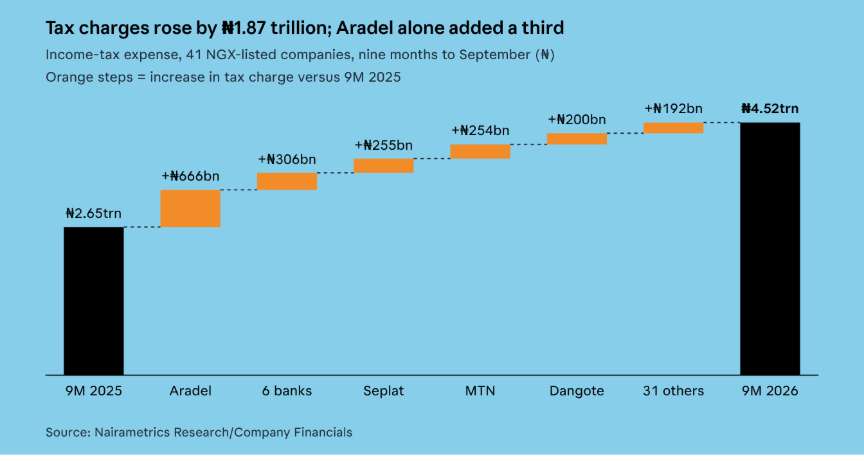
Aradel Holdings alone added N666 billion. Its tax expense rose to N721.4 billion from N55.6 billion after it began consolidating ND Western and Renaissance Africa Energy, which own the onshore oil assets it bought. Those fields pay hydrocarbon tax. Aradel’s revenue grew more than sevenfold, to N3.95 trillion.
- Seplat Energy remains the single largest taxpayer in the group, with a N987.1 billion charge, up from N732.4 billion. Its rate actually fell, to 74% from 83%. Seplat said most of its onshore assets moved to the Petroleum Industry Act’s 60% hydrocarbon tax, from 85% under the old petroleum profits tax. Its pre-tax profit rose 53%, which more than offset the lower rate.
- MTN Nigeria’s charge rose 68%, to N630.5 billion, on a 59% jump in pre-tax profit. Dangote Cement’s charge rose 67%, to N497.7 billion, and its rate rose to 33.8% from 28.6%. Those figures cover the cement maker’s whole group, including its operations elsewhere in Africa.
Leave out the three oil producers, and the picture is more modest. Tax at the other 38 companies rose 51%, to N2.82 trillion, while their profits rose 29%. Their effective rate rose to 28.8% from 24.6%. That 4.2-point gap, worth about N412 billion, is the most the new law could explain, and it also includes one-off items.
Banks feel the new floor
The clearest fingerprints of the new law are on bank earnings.
Six lenders and holding companies booked N1.06 trillion in tax, up 40.5%, while their pre-tax profit rose 15.9%. Their combined effective rate rose to 26.4% from 21.8%. Banks have long paid less than the 30% headline rate, because much of their income, such as interest on some government securities, has been exempt. The 15% minimum rate puts a floor under that.
- Zenith Bank shows how fast that can bite. Its pre-tax profit edged up 1.2%, to N928.8 billion. Its tax charge jumped 65%, to N253 billion, and net profit fell 11.6%, to N675.8 billion. The charge includes N65.9 billion of minimum tax, the top-up the new law requires, and a N9.9 billion development levy. It also includes N89.9 billion to cover tax under-provided in an earlier period, which has nothing to do with the act. Zenith’s effective rate rose to 27.2% from 16.7%.
- At Guaranty Trust Holding Co., pre-tax profit slipped 2.3%, to N879.9 billion. Tax rose 32%, to N265.3 billion, so net profit fell 12.2%, to N614.6 billion. Its rate rose to 30.2% from 22.3%, including an N18.3 billion top-up for prior-year tax. Access Holdings said in its accounts that it is now subject to the 15% minimum; its rate rose to 28.9% from 27.4%.
- Not every bank paid a higher rate. First HoldCo’s charge rose 54%, to N166.6 billion, but its pre-tax profit rose 61%, so its rate slipped to 18.3%. Sterling Financial’s rate nearly doubled, to 22.5%, even though last year’s charge included a N350 million windfall levy that does not recur this year.
A 4% levy that costs more than it replaced
For manufacturers, the act’s main cost is the development levy. It charges 4% of assessable profit and replaces the 3% tertiary education tax and smaller levies for IT development, science and engineering infrastructure and the police trust fund.
In the filings, the new levy is costing more than the old ones:
| Company | Development levy, 9M 2026 | Levies it replaced, 9M 2025 |
| Seplat Energy | N77.4bn | N27.0bn |
| Lafarge Africa (HBM) | N17.8bn | N10.5bn |
| BUA Cement | N13.4bn | N6.2bn |
- BUA Cement also shed a N2.5 billion minimum tax it paid last year. The act abolished the old minimum tax, which was based on turnover, and replaced it with the 15% floor on profits.
- The headline 30% rate is unchanged, so for most manufacturers the act moved effective rates by less than four percentage points, and some not at all. Seven consumer-goods makers booked N254.2 billion in tax, up 47%, on a 24% rise in pre-tax profit. Nestlé Nigeria’s rate rose to 46.7% from 43.4%. International Breweries’ rate rose to 39.7% from 22.1%, and its net profit fell 6% even though pre-tax profit grew 22%.
The floor has not caught everyone yet. BUA Foods booked N30.1 billion in tax on N480.5 billion of pre-tax profit, a rate of 6.3%. Its earnings release doesn’t say how the 15% minimum applies to it.
The cash is still catching up
Cash payments rose even faster than the charges, but they mostly settle last year’s bills.
- Thirty companies that report cash taxes for both periods paid N3.02 trillion in the nine months, up 85% from N1.64 trillion. Nigerian companies settle a year’s tax after it closes, so most of that cash cleared 2025 profits under the old law. The act’s real cash bill arrives in 2027.
- Three companies account for most of the rise. Aradel paid N690.3 billion, against N40 billion a year earlier. MTN Nigeria paid N295.4 billion, against N21.5 billion, after paying little in 2025 following its 2024 loss. Seplat paid N685.8 billion, or $501.9 million, which it said was 34% of its pre-tax operating cash flow. Leave those three out, and cash taxes rose 46%.
Banks paid N960.2 billion, up just 12.6%. GTCO paid N349.4 billion, up 41%, and Stanbic IBTC more than doubled its payments, to N172.1 billion. Zenith paid N223.3 billion, down from N311.6 billion, even as its charge rose 65%.
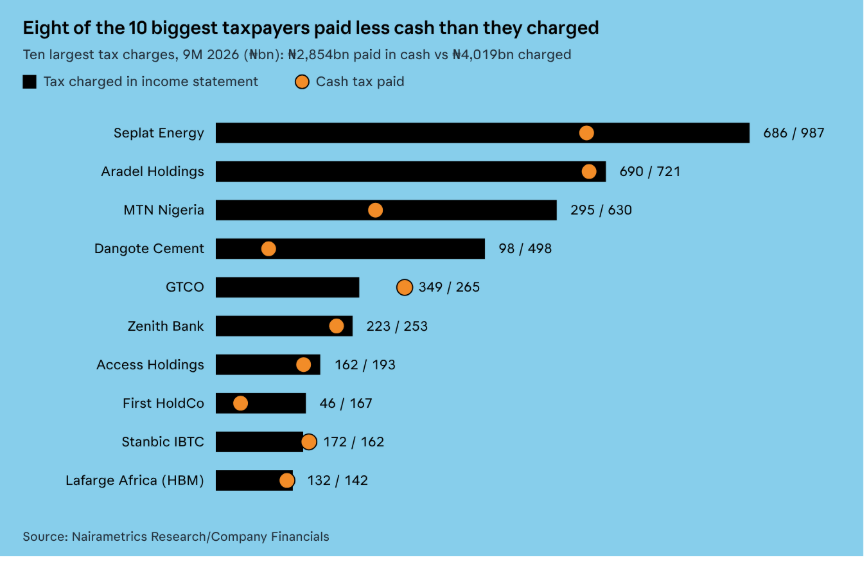
The gap between what companies charge and what they pay is where next year’s bills sit. The 30 companies paid out 69% of what they charged. First HoldCo paid N45.9 billion against a N166.6 billion charge.
Dangote Cement paid N97.7 billion, down from N115.4 billion, against a N497.7 billion group charge. Guinness Nigeria charged N21 billion and paid less than N100 million. Part of such gaps is deferred tax, which may never fall due in cash. Much of the rest is 2026 tax, owed under the new rules and payable next year.

The bill that comes due in 2027
For investors, the act’s first-year message is that profit growth no longer passes through to shareholders one for one. Zenith and GTCO both reported lower net profit on flat pre-tax earnings.
For the government, the bigger cash payoff is still ahead: the 2026 charges booked under the new rules will mostly be paid next year.
The nine-month figures are unaudited, and companies estimate interim tax at their expected full-year rate, so charges may still shift by December.
Stay ahead with the latest updates!
Join The Podium Media on WhatsApp for real-time news alerts, breaking stories, and exclusive content delivered straight to your phone. Don’t miss a headline — subscribe now!
Chat with Us on WhatsApp