



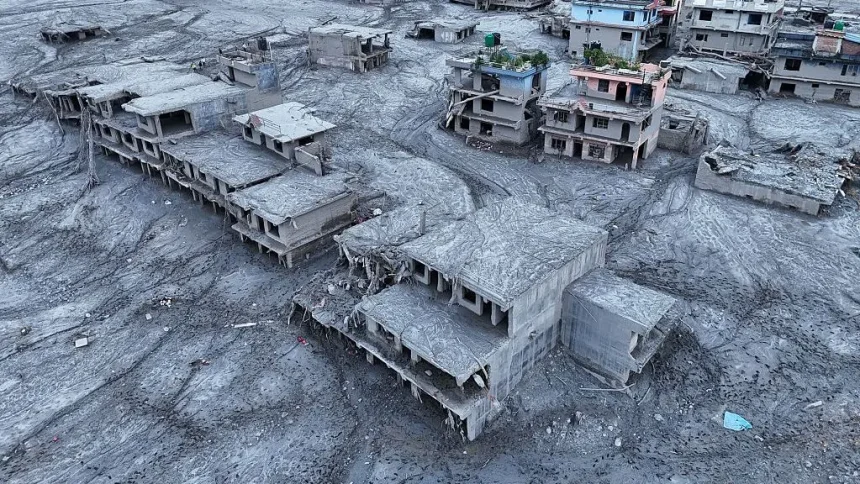
- At least 734 people have died and more than 2,400 people are missing in Nepal, local officials say, after flash floods on Wednesday
- In Tibet, the official death toll is 16, with 546 reported to be missing, according to Chinese state media.
- Rescue efforts continue on the Nepal-Tibet border – 320 foreign nationals are among the missing, Nepal’s tourism board says
- Information is more tightly controlled by the Chinese authorities and it has been harder to assess the scale of the disaster in Tibet
- Levels at a lake formed after the floods – which had prompted safety concerns over fears it could overflow – are now receding, Chinese officials say
- 0:33 Trishuli river in Nepal swells after heavy rain. 00:00:33, play video Trishuli river in Nepal swells after heavy rain
- 1:46 Families face agonising search for missing loved ones. 00:01:46, play video Families face agonising search for missing loved ones
- 0:47 Army rescues survivors from tunnel. 00:00:47, play video Army rescues survivors from tunnel
- 0:55 ‘We were home when flood hit’: Man searches for wife and child. 00:00:55, play video ‘We were home when flood hit’: Man searches for wife and child
- 0:23 Dramatic drone footage captures Himalayas glacier collapse. 00:00:23, play video Dramatic drone footage captures Himalayas glacier collapse
- 1:07 China censors videos showing deadly flash floods in Tibet. 00:01:07, play video China censors videos showing deadly flash floods in Tibet
- 0:54 Chinese state television shows Tibetan rescue operation. 00:00:54, play video Chinese state television shows Tibetan rescue operation
- 0:41 Hardest-hit areas turned into ‘swampland’, says minister. 00:00:41, play video Hardest-hit areas turned into ‘swampland’, says minister
- 0:54 Son of missing parents trying to stay positive during difficult times. 00:00:54, play video Son of missing parents trying to stay positive during difficult times
- 0:17 ‘Stranded people only reachable by helicopter’ 00:00:17, play video ‘Stranded people only reachable by helicopter’
- 0:40 ‘Really emotional’ to see affected areas washed away. 00:00:40, play video ‘Really emotional’ to see affected areas washed away
- 0:24 Pedestrian river crossing shakes violently. 00:00:24, play video Pedestrian river crossing shakes violently
- 0:28 ‘My wife, mum, brother and uncle are missing’ 00:00:28, play video ‘My wife, mum, brother and uncle are missing’
- 0:18 Huge boulder rolls down river. 00:00:18, play video Huge boulder rolls down river
- 0:51 Worker films moment he escapes torrent. 00:00:51, play video Worker films moment he escapes torrent
- 1:16 ‘We want them home’: Daughters of missing couple. 00:01:16, play video ‘We want them home’: Daughters of missing couple
- 0:58 Powerful torrent sweeps away car 00:00:58, play video Powerful torrent sweeps away car
- 0:34 Dam under construction destroyed in flood. 00:00:34, play video Dam under construction destroyed in flood
- 0:27 Mud fills buildings and roads in Nepal. 00:00:27, play video Mud fills buildings and roads in Nepal
- 0:24 Man rescued from rooftop by helicopter. 00:00:24, play video Man rescued from rooftop by helicopter
Live Reporting
Nearly 20,000 security forces deployed in rescue efforts – the latest figures
As we reported a short while ago, Nepal’s disaster agency says the death toll in the country has jumped to 734, up from the 675 reported yesterday.
In the last hour, Nepal’s Police also reported that 734 bodies have been recovered.
It also shared the following figures:
- Missing: 2,498
- Rescued: 8,186
- Injured: 242 (includes some who have been discharged)
- Security forces deployed: 19,895
If you’re just joining us, here is what you need to know as rescue operations in the Nepal-Tibet border area hit by a deadly flash flood enters the fifth day:
- Officials in Nepal say 734 people have been confirmed dead following flash floods on Wednesday, up from the 675 reported yesterday evening
- Chinese state media report that the death toll in Tibet has risen to 16 – here’s why it has been harder to assess the scale of the disaster in Tibet
- Nepal counts more than 2,400 people missing while China has reported 546 missing, including 261 foreign nationals
- Aid has been arriving, but rough terrain and rains are making delivery extremely difficult, according to the UN
- Rescuers in Nepal working through the night on Saturday are battling adverse weather in their efforts to reach workers trapped in hydroelectric tunnels in flood hit areas
- Nepal’s disaster response agency has received reports of a flood level increase near the Bhote Koshi River, one of the two rivers through which the initial debris flow travelled on Wednesday. It has asked people to stay alert in areas around the river
No survivors found so far at Tibet border
As we reported earlier, authorities in China say 16 people have been confirmed dead and more than 540 remain missing in Tibet.

Chinese state media said that among the 546 people missing after Wednesday’s landslide, 261 are foreigners from 23 countries – including 15 British nationals.
Search and rescue teams are still combing through the mud and debris at the border but have so far found no survivors.
Gyirong Port is the main crossing point for tourists trekking from Kathmandu to the sacred Mount Kailish in Tibet.
Meanwhile the danger posed by a lake which formed amid the landslide debris appears to have subsided for now, however authorities say there is still a continued risk of further mudslides and have set up monitoring stations to alert rescue teams along the border.
Rain complicates rescue as aid pours in
The forecast suggests the rain will continue until at least Monday, adding to an already challenging search and rescue operation.
Many remain trapped in hydropower tunnels in northern Nepal, and thick mud is blocking rescuers from entering them.
India and China have both sent experts to help. With hundreds of foreign nationals missing, aid is continuing to pour in.
The United States has pledged $3.6m in humanitarian assistance, while the United Kingdom has sent a rapid deployment team to Nepal to support British nationals.
This is Nepal’s worst disaster in more than a decade. Scientists believe the flash flood was triggered by a “glacial collapse”, when all or part of a glacier disintegrates, and led to “catastrophic impacts downstream”.
Despite the scale of the disaster, thousands of people have been rescued.
But as the search enters a fifth day, many of the families we meet tell us they’re preparing for the worst.
Death toll rises to 734 in Nepal
The death toll in Nepal has risen to 734, the country’s disaster management agency says.
Terrain making aid delivery ‘extremely difficult’, UN says
Aid is arriving but it is proving difficult to reach the people affected, United Nations resident coordinator in Nepal Lila Pieters Yahia tells the BBC.

The UN coordinator says both Indian and Chinese rescue teams that arrived yesterday were working to provide extra support.
“But it’s difficult to bring it to reach the people because the access is extremely difficult,” Yahia says.
The government has begun “airlifting everything” by helicopter, and using drones to deliver the aid more effectively is being discussed within the government, the official adds.
“The weather is not helping us,” Yahia adds.

As we reported earlier, a rainfall warning is in effect in the disaster zone until Monday.
Global warming has led to accelerated melting of Himalayas’ glaciers
How much of a role climate change played in the collapse of the glacier that caused this devastating flood might be known if there are focused studies in the days to come.
But what we already know is that global warming has led to accelerated melting of Himalayas’ glaciers, icefields, snowpacks and permafrost.
Scientists say thinning and retreating of glaciers can not only cause their collapse but can also rapidly fill up glacial lakes that can then burst out causing floods.
They say ice and snow buttress mountain slopes – just like cement keeps buildings intact. When they fast melt, then mountains destabilise and we see increased incidents of rockfalls, landslides, avalanches and debris floods – as we are seeing in the Hindu Kush Himalayan region.
Because of warming, experts say, higher parts of mountains now also see rains instead of snow that can also make them unstable.

A study by the International Centre for Integrated Mountain Development released in March showed that ice loss rates in the region have doubled since 2000.
Yellow rain warnings over flood-hit area until at least Monday
Heavy rain since the flash flooding first hit on Wednesday has made search and rescue efforts more challenging, authorities say.
And the forecast for the area suggests the wet weather will continue.
The Nepalese Department of Hydrology and Meteorology has issued yellow rain warnings for the area lasting until at least Monday, advising people to stay updated.
That’s the lowest of the three warnings the agency issues – below amber and red – and is fairly typical for the area. But it will likely further hamper efforts on the ground.
Drone video captures moment of glacier collapse
BBC Verify has authenticated two videos which show the moment of a glacier collapse in the Himalayas which triggered the deadly Nepal-Tibet floods.
The videos, filmed by a drone and posted to the Chinese social media platform Xiaohongshu, capture the landslide near the Langtang Lirung peak, more than 7,200m (23,600ft) above sea level.
Plumes of dust can be seen rising into the air near the snow-covered mountains.
The location of the clips match the direction of the floodwater which surged down the Trishuli river, devastating villages and communities along its way.
‘Families should not be left without answers’
Chinese state media is reporting that there are six Australians among the 261 foreign nationals identified as missing on the Chinese side of the border between Nepal and Tibet.
I am trying to establish whether the Australian government believes that those six are among the total of 41 citizens unaccounted for (the national broadcaster the ABC says it understands this has risen to 42 but I have not yet verified this).
One of those missing is Sumi Adhikari from Sydney. This morning I’ve been in touch with her husband Nava Pandey, who has travelled to Nepal to try and help locate her.
He is asking for “close coordination between the Nepalese and Chinese authorities”.
“We respectfully call upon the Chinese government and local authorities to release all available verified information, provide regular updates about the search efforts and establish direct communication with the affected families,” Pandey says.
“Families should not be left without answers during such a critical time.”
As I mentioned in a post yesterday, also missing from the same tour group is Reshma Patel from Newcastle in New South Wales.
Her husband Bhavin Patel has also flown to Nepal and in a statement says that phone data had led him to believe his wife had crossed into Tibet.
“We respectfully appeal to Australia, Nepal and China for urgent coordination and continued search efforts in the Gyirong area,” he wrote.
“Our family is desperately seeking assistance to locate her”.
Chinese state media: 261 foreigners among missing in Tibet
According to Chinese state broadcaster CCTV, among the 546 missing people in the Tibet flood, 261 are foreigners from 23 countries.
Chinese authorities have notified their embassies and consulates in China, CCTV reports.
Fifteen British nationals are among the missing in Tibet, according to the report.
Nepalese authorities have already reported that 33 British nationals are missing. Several of them are thought to have been making their way across the border to Tibet, so it is unclear how many of the 15 British nationals reported as missing by Chinese authorities are included in the figure reported by Nepal.
Here is a further breakdown of missing foreigners on the Tibet side, according to Chinese state media: three Malaysians, 104 Nepalis, 49 Indians, four South Africans, two Irish nationals, two Estonians, three Germans, three Russians, two French nationals, one Finn, two Dutch nationals, 33 Latvians, one Lithuanian, one Portuguese national, one Ukrainian, one Spaniard, one Hungarian, six Canadians, 18 Americans, six Australians and two New Zealanders.
The information on the missing people came from a joint investigation and collaboration with multiple agencies including foreign affairs, public security, culture and tourism and emergency management.
In pictures: Rescue efforts continue in Nepal and Tibet
Members of the military and police are among those who are continuing to search for the hundreds of people still missing in both countries.
Death count in Tibet rises to 16
Previously officials had said seven people had died.
At a news conference in Gyirong County, officials said the mudslide had caused significant casualties at the Gyirong border port.
Nepal’s disaster response agency warns of flood level increase
Nepal’s National Disaster Risk Reduction and Management Authority (NDRRMA) says it has received reports of a flood level increase near the Bhote Koshi River.
This was one of two rivers through which powerful flood water and debris travelled on Wednesday, rushing past popular tourist and pilgrim towns in northern Nepal.
The NDRRMA says people should stay alert in the areas around the river.
What caused the landslide?
Initial reports of an earthquake on the Nepal-Tibet border led many to believe that a tremor had caused a landslide, which in turn caused the devastating floods early on Wednesday.
However, the US Geological Survey (USGS) later confirmed the disaster was caused by a “glacial collapse”, which is when a glacier or part of a glacier disintegrates.
The impact of the collapsed glacier hitting the bottom of a valley was so powerful that it registered a magnitude of 5.2, according to the agency, causing “subsequent catastrophic impacts downstream”.
Powerful floodwaters and debris travelled some 62 miles (100km) downstream from the Trishuli and Bhote Koshi Rivers, the USGS said, careering through towns popular with mountaineering tourists and pilgrims in northern Nepal.
The International Centre for Integrated Mountain Development (ICIDMOD) has warned secondary flooding could occur in the coming days as a result of debris that washed into the river systems.
The ICIDMOD said they were assessing whether the Trishuli River had been temporarily blocked in narrow sections. If this is the case, it is at risk of forming a landslide dam and a second flood.
US pledges $3.6m in aid
The US will be providing $3.6m (£2.6m) in humanitarian assistance, including up to three months of emergency food assistance to 10,000 households affected by the floods, the State Department says.
“Our embassies in Nepal and China are working closely to assist Americans and support disaster relief efforts.”
Rescuers battle adverse weather in effort to reach workers trapped in hydroelectric tunnels
Throughout Saturday, Nepalese energy minister Biraj Bhakta Shrestha provided updates on rescue efforts at hydroelectric facilities in the flood-hit area.
At the Trishuli-3 ‘A’ hydropower site rescuers have managed to drill a hole into one of the facility’s cable tunnels.
He says an initial inspection reveals no debris inside, but no communication has been established with anyone inside.
The hope is that rescuers will be able to make a hole big enough for a person to enter, which may allow rescuers to access the site’s main tunnel.
In his most recent update, he says rescuers would try and work through the night, but that there is a risk their efforts could be impacted and even suspended “for some time as water flow is increasing due to continuous rain”.
Earlier in the day, he said rescue efforts were also continuing at another hydroelectic facility, Trishuli-3 ‘B’.
Specialist teams from China and India have joined Nepalese rescuers for search and rescue efforts linked to a number of hydroelectric sites in the area.
More than 250 foreign nationals rescued, Nepal Tourism Board says
In its most recent update, the Nepal Tourism Board said that 261 foreign nationals have been rescued while 320 are unaccounted for.
Officials have provided this breakdown showing how many people from each country have been rescued:
- Belgium – 1
- Bulgaria – 1
- China – 40
- Germany – 4
- India – 167
- Italy – 2
- Malta – 4
- Oman – 1
- Portugal – 1
- Russia – 2
- Spain – 2
- Switzerland – 2
- Turkey -2
- Ukraine – 8
- US – 3
- Unidentified – 21
Source: BBC
Stay ahead with the latest updates!
Join The Podium Media on WhatsApp for real-time news alerts, breaking stories, and exclusive content delivered straight to your phone. Don’t miss a headline — subscribe now!
Chat with Us on WhatsApp