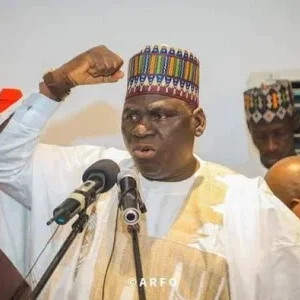





Chairman of THISDAY and Arise Media Group, Prince Nduka Obaigbena, has urged political leaders preparing for the 2027 general elections to focus their campaigns on policies, programmes and concrete solutions to Nigeria’s challenges rather than resorting to personal attacks, character assassination and smear campaigns.
Obaigbena made the call on Thursday during a panel discussion at the centenary celebration of the Daily Times of Nigeria, held at the THISDAY DOME in Abuja.
The event, themed “Honouring the Past, Shaping the Future,” brought together prominent Nigerians, media practitioners, business leaders, policymakers and other stakeholders to celebrate the history of one of Nigeria’s oldest newspapers while reflecting on the future of journalism and nation-building.

The occasion also featured the unveiling of the Nigerian Grand Book and the recognition of Nigerians who have made significant contributions to the development and advancement of the country.
Obaigbena participated in a panel session alongside former Managing Director of the Daily Times, Dr. Yemi Ogunbiyi, and business executive, Mustafa Chike-Obi.
Speaking on the 2027 elections, Obaigbena said Nigerians deserved a political campaign season centred on substantive issues capable of helping citizens make informed decisions about who should govern the country.
He challenged presidential candidates and other political leaders to explain their policy positions and provide alternative solutions to the economic, security and social challenges confronting Nigerians.
“I believe I should implore our leaders to fight the election on policies. Should we have subsidy or should we not? Let us debate it,” he said.
The media executive argued that important national questions should become the focus of political campaigns, rather than personal disagreements between candidates.
He identified issues such as exchange-rate management, taxation, inequality and insecurity as areas requiring serious public debate ahead of the 2027 elections.
“Should we go back to the command-and-control exchange rates, or should we allow the markets? Should we have tax reforms such that we can equalise the gaps between the rich and the poor?” he asked.
He also challenged political leaders to present clear and practical proposals for tackling insecurity, including the controversial question of state police.
“How do we deal with insecurity? Is state police an answer? What does Abubakar Atiku think? What does Peter Obi think? Let us debate our future on policies,” Obaigbena said.
He cautioned politicians against returning to what he described as an era of smear campaigns, stressing that the electorate needed to understand the policy alternatives being offered by political parties and candidates.
“Let us not return to any smear campaign. Let us domesticate our fight in Nigeria and debate policies that affect people especially poverty, hardship. What is your alternative?” he said.
Obaigbena also spoke about the transformation of the media industry, particularly the impact of digital technology on how news is produced, distributed and consumed.

According to him, technological advancement has fundamentally altered the methods of news distribution and expanded the number of people who can participate in the information ecosystem.
However, he maintained that the core principles and responsibilities of journalism had remained unchanged.
“Journalism remains the same yesterday, today and tomorrow. The forms of distribution have changed. The audiences have expanded as distribution is now in individual hands. That’s what technology has done,” he said.
He further urged the Nigerian media to demand presidential debates ahead of the 2027 elections, arguing that citizens deserved the opportunity to hear directly from those seeking the nation’s highest political office.

“We want to hear from them. We want to see the debates. The media must insist on it because the Nigerian people need it,” he stated.
The event also provided an opportunity for President Bola Tinubu to highlight the importance of a free press, national memory and institutional continuity in Nigeria’s development.
Represented by the Secretary to the Government of the Federation, Senator George Akume, the president described the media as indispensable to democratic governance because of its responsibility to inform citizens, hold public officials accountable and preserve the nation’s historical record.
Tinubu described the centenary of the Daily Times, which he referred to as the “flagstaff of Nigerian journalism,” as more than a celebration of longevity.
According to him, the newspaper’s 100-year journey represented endurance, relevance and institutional resilience.
“For a century, the Daily Times has not only reported the Nigerian story; it has been an important part of the history of our country,” the president said.

He noted that the newspaper had documented major periods in Nigeria’s history, including the colonial era, the struggle for independence, nation-building and the development of contemporary democracy.
Through its reporting, he said, the Daily Times had captured important personalities, events and national debates that contributed to shaping Nigeria’s collective identity.
Tinubu stressed the importance of preserving historical records, warning that nations that fail to learn from their past risk repeating previous mistakes.
“A nation that forgets its history is at risk of repeating its mistakes. But a nation that understands its history can draw wisdom from its successes, learn from its setbacks and confidently design its future,” he said.
The president connected the importance of historical continuity with his administration’s economic reform agenda, arguing that the reforms were designed not merely to change existing policies but to alter Nigeria’s long-term economic trajectory.
He said the government’s reform programme was aimed at creating a stronger fiscal foundation, building a more productive economy, strengthening institutions, attracting investment, improving infrastructure and expanding opportunities for young Nigerians.
Tinubu also endorsed the Nigerian Grand Book unveiled during the event, describing it as an important contribution to the preservation of Nigeria’s institutional memory.
He said the publication would enable Nigerians to document and tell their own story while helping future generations understand the country’s resilience, creativity, sacrifices and potential.
The president further stressed the importance of national identity and social inclusion, arguing that Nigeria’s diversity should be regarded as an asset rather than a source of division.
“Our diversity is one of Nigeria’s greatest assets, and our history provides us with countless examples of what Nigerians can accomplish when our differences are transformed into strength rather than division,” he said.
Tinubu urged Nigerians to look beyond immediate challenges and consider the type of nation they wanted to build over the next 100 years.
He also drew attention to Nigeria’s projected population growth, noting that the country’s population could reach approximately 450 million by 2050, with significant implications for food security, water supply, infrastructure and human development.
He said the Renewed Hope Agenda was consequently focused on creating an economy capable of generating opportunities, reducing dependency, strengthening infrastructure and connecting communities and markets.
In his keynote address, former President of the African Development Bank, Dr. Akinwumi Adesina, highlighted the importance of education to Nigeria’s long-term development.
Adesina, who served as Nigeria’s Minister of Agriculture and Rural Development from 2011 to 2015 and later headed the African Development Bank from 2015 to 2025, described the Nigerian Education Loan Fund (NELFUND) as one of the most consequential initiatives for expanding access to tertiary education in the country.
According to him, the initiative could help remove financial barriers that prevent qualified Nigerians from pursuing higher education.
“The NELFUND is one of the most consequential initiatives in Nigeria’s history for expanding access to tertiary education,” Adesina said.
He argued that reducing financial barriers to higher education would advance the principle that no qualified Nigerian should be denied the opportunity to study because of financial circumstances.
Adesina commended President Tinubu for championing the initiative, stressing that investment in education and young people amounted to an investment in Nigeria’s human capital and future prosperity.
In his keynote, titled “Daily Times at 100: Lessons in Nation Building,” he said nation-building was not the responsibility of a single individual, administration or generation.
Rather, he described it as a continuous process that requires successive generations to build on existing institutions, preserve useful legacies and introduce reforms capable of responding to changing national realities.
The centenary celebration therefore combined reflections on Nigeria’s media history with discussions about democracy, economic reform, education, institutional development and the country’s future.
The call by Obaigbena for issue-based campaigns comes as political activities and preparations for the 2027 elections continue to gather momentum, with Nigerians expected to increasingly demand clear answers from political aspirants on how they intend to address poverty, insecurity, economic hardship, unemployment and other pressing national concerns.
Stay ahead with the latest updates!
Join The Podium Media on WhatsApp for real-time news alerts, breaking stories, and exclusive content delivered straight to your phone. Don’t miss a headline — subscribe now!
Chat with Us on WhatsApp