
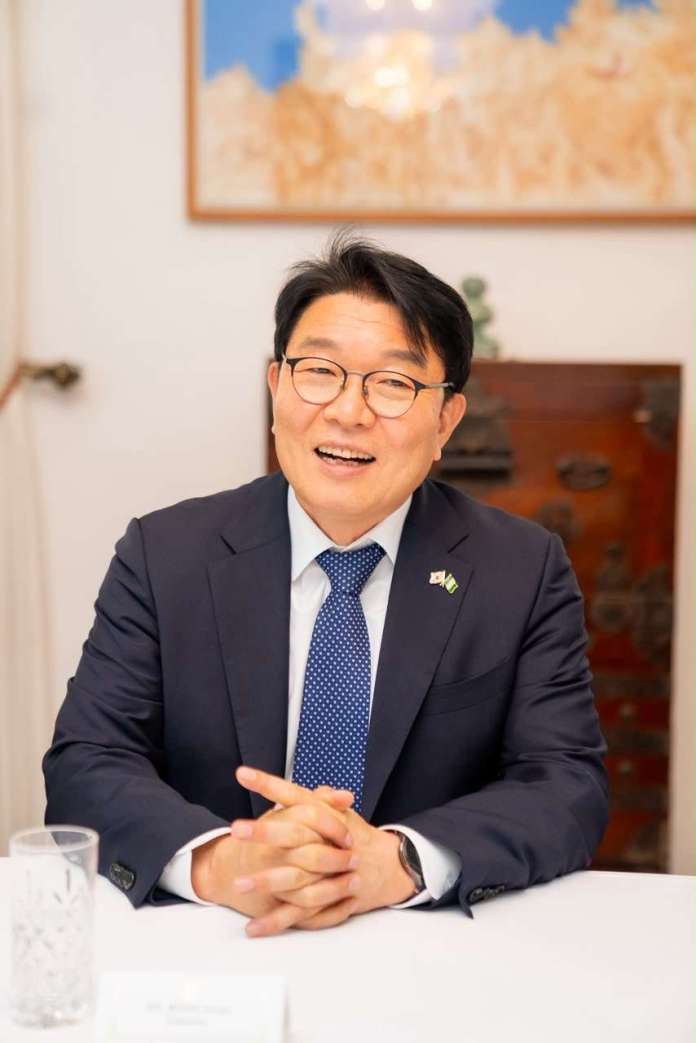
South Korea has urged Nigeria to restructure its trade relationship by shifting from crude oil exports and imports of manufactured goods to local production, technology transfer and investment in agriculture and industry.
Korean Ambassador to Nigeria, Jeong Yo-an, made the call on Wednesday in Abuja, saying the existing trade pattern has limited the potential of a bilateral relationship worth about $1.1 billion in 2025.
“Today, Nigeria sells us mostly oil and gas. Korea sells mostly cars, electronics and machinery. We can do much more than that,” he said.

Jeong identified local assembly, agricultural machinery production, digital skills, maritime services and emerging industries as priority areas for stronger cooperation.
He also urged Nigeria to ratify the double taxation agreement signed by both countries in 2006, saying the 20-year delay is affecting investor confidence.
He said predictable policies on foreign exchange, customs and taxation are necessary to attract long-term investments.
The ambassador cited involvement of Korean companies in major Nigerian projects, including Daewoo Engineering and Construction’s work on the Nigeria LNG Train Seven project and the Indorama fertiliser plant. He also named Samsung, LG, Hyundai and Solpia among companies working with Nigerian partners.
He encouraged Nigerian businesses to use the Korea Trade-Investment Promotion Agency, KOTRA, office in Lagos to link with Korean firms.
The beauty and cosmetics industry, he added, offers prospects for local distribution, employment and partnerships, with Korean manufacturers expected at the Beauty West Africa exhibition on November 13.
On development cooperation, Jeong said about 2,000 Nigerian government officials have received training in South Korea through the Korea International Cooperation Agency, KOICA.
He said KOICA’s Smart School project, implemented with the Universal Basic Education Commission, has reached about 8,000 pupils and trained more than 300 teachers and administrators.
He highlighted the Abuja Centre for Entrepreneurship, being developed with SMEDAN and UNDP, whose groundbreaking took place in September. The facility will provide entrepreneurship training, mentorship and connections to finance and markets.
He said Nigerian institutions will operate the centre, while a Training of Trainers programme will build local capacity.
“A building alone does not create entrepreneurs,” he said, stressing need to connect start-ups with investors and markets.
KOICA is also working with FAO on agricultural initiatives for green jobs for youths.
Other cooperation areas include digital development, postgraduate scholarships and fellowships in IT, public administration and health. The Nigeria-Korea Information Access Centre established in Abuja in 2025 is expected to strengthen digital literacy.

Future partnerships will emphasise private companies, start-ups and innovators, particularly in AI, digital content and technology-based entrepreneurship.
“The key word is not ‘copy’. The key word is ‘adapt’. Nigeria will write its own story. Korea is ready to share what we have learned,” he said.
On diplomatic relations, Jeong cited the 2024 Korea-Africa Summit in Seoul and the first Korea-Africa Foreign Ministers’ Meeting in June as milestones.
He said South Korea welcomed Nigeria’s offer to host the seventh session of the Nigeria-Korea Joint Commission in Abuja.
He disclosed that South Korea is working towards expanding Official Development Assistance to $10 billion by 2030 and providing $14 billion in export financing to support Korean companies in Africa. It also plans to host the second Korea-Africa Summit in 2029.
Cultural exchanges remain important, he said, noting more than 300,000 people have participated in programmes by the Korean Cultural Centre Nigeria.
This year’s Korean Film Festival attracted about 1,000 participants, while the K-pop Festival in Lagos drew over 400 young people. The 14th Korean Ambassador’s Cup Taekwondo Championship in Abuja attracted about 350 athletes.
He said the embassy plans to expand cultural activities to more cities and universities and promote joint film and music productions, disclosing that Nigerian creators have already produced two Korean-Nigerian drama productions.
He pledged to support opportunities for Nigerian journalists to visit South Korea through media exchange programmes.
The ambassador, a former military officer who served 36 years before joining diplomatic service, said he would focus on practical results.

“The army taught me one simple lesson: trust is built when you keep your word. That is how I want to work in Nigeria – with more results,” he said.
Stay ahead with the latest updates!
Join The Podium Media on WhatsApp for real-time news alerts, breaking stories, and exclusive content delivered straight to your phone. Don’t miss a headline — subscribe now!
Chat with Us on WhatsApp