




Four years after Nigeria tightened its anti-gas flaring laws, a PREMIUM TIMES investigation finds weak enforcement, rising methane emissions, with oil-producing communities paying severely for these.
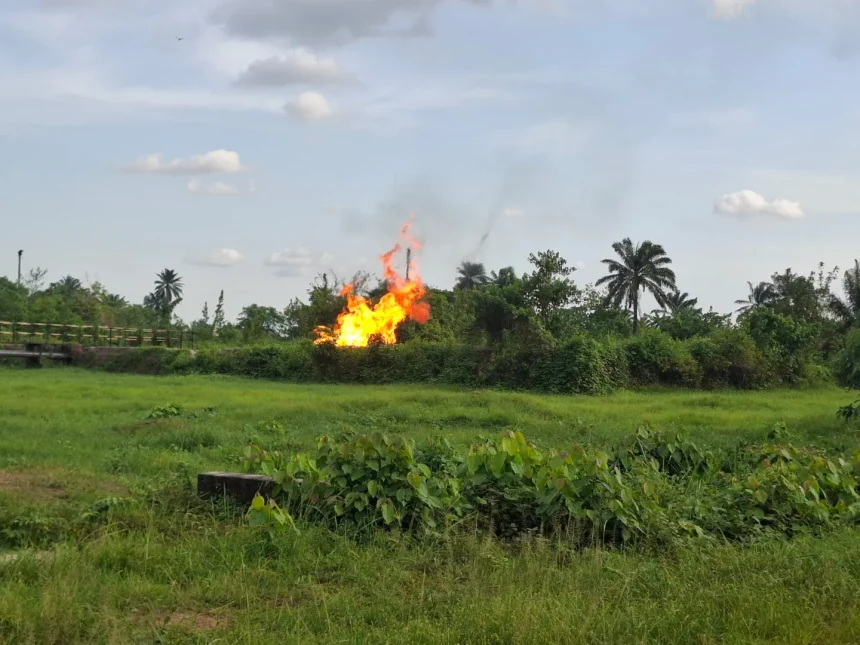
For decades, the orange glow from gas flares has lit up the skies of Umuechem in Etche Local Government Area of Rivers State long after sunset.
For 65-year-old Rose Ordu, the flames are more than a permanent feature of the landscape; they have become part of her daily struggle.
Standing on her cassava and vegetable farm in April, Ms Ordu pointed to crops she said no longer grow as they once did. Her farmland, located a few hundred metres from an oil facility operated by Heirs Energies under Oil Mining Lease (OML) 17, has supported her family for years. She says harvests have steadily declined.

“When I plant vegetables, they don’t grow well because of the heat from the flare. They wither quickly. Even when I apply fertiliser, they are still unhealthy.”

She questioned why the gas continues to burn while the community remains without electricity for over three years. “They should convert it to electricity instead of wasting it,” she said.
A PREMIUM TIMES analysis of Google Earth imagery showed the nearest residential building to be 328 metres from the flare facility.

Ms Ordu’s experience mirrors complaints heard in many oil-producing communities, where residents say gas flaring has become a permanent feature of life despite repeated government promises to end the practice.
The law that promised reform
Gas flaring has long symbolised the environmental cost of oil production in Nigeria. Besides wasting valuable natural gas, the practice releases carbon dioxide, methane and other pollutants that contribute to climate change.
The Petroleum Industry Act (PIA), signed into law in August 2021, was expected to mark a turning point.
Section 108 of the Act required companies producing natural gas within 12 months of the law’s effective date to submit Flare Elimination and Monetisation Plans (FEMP), outlining how they would end flaring and commercialise gas.
In 2023, the regulator, the Nigerian Upstream Petroleum Regulatory Commission (NUPRC), strengthened those obligations through the Gas Flaring, Venting and Methane Emissions (Prevention of Waste and Pollution) Regulations.
The regulations require operators to prepare methane emissions inventories, keep daily records of gas flaring and venting, implement Leak Detection and Repair programmes, report fugitive methane emissions and sign binding Milestone Development Agreements with the regulator.
Taken together, the Act and the regulations created what appeared to be one of the continent’s most ambitious legal frameworks for reducing gas flaring and methane emissions.
However, a PREMIUM TIMES investigation found that while the legal framework imposes detailed compliance obligations on oil and gas producers, the enforcement remains weak.
Gas flaring and methane emissions continue in many oil-producing communities with little evidence that the promised reforms have translated into meaningful environmental protection.
What PREMIUM TIMES found
Over three months, PREMIUM TIMES visited oil-producing communities in Rivers and Akwa Ibom states where residents live close to facilities operated by Heirs Energies, Aradel Holdings, Sterling Oil Exploration and Energy Production Company (SEEPCO) and Frontier Oil.

This newspaper analysed gas-flaring data published by the NUPRC, Nigeria Extractive Industries Transparency Initiative (NEITI), and National Oil Spill Detection and Response Agency (NOSDRA). It also reviewed the PIA and its implementing regulations, examined sustainability reports and methane disclosures, and sent detailed media enquiries to the companies and the regulator.
The investigation found that Nigeria’s legal framework for ending routine gas flaring has, to a greater extent, remained unenforced.
Although operators are legally required to eliminate flaring and implement methane-reduction measures, flare volumes rose at several oil assets after the regulations took effect.
Some companies failed to disclose key environmental records requested by PREMIUM TIMES, including their FEMP, methane inventories and implementation milestones. One operator admitted it had not complied with two major regulatory requirements, yet faced no known sanction.

For many host communities, the promise of reform exists only on paper.
Communities still waiting
About 25 kilometres from Umuechem, another flare stack burns day and night in Mbodo, Ikwerre Local Government Area of Rivers, where Heirs Energies also operates within OML 17.

Residents say prolonged exposure has become part of daily life. “The impact is obvious on our roofing sheets,” said Emechukwu Handsome, secretary of the Mbodo Group Host Communities Development Trust. “Because of our closeness to the flare site, our roofs deteriorate faster.”
He also recalled a medical outreach organised by Heirs Energies that produced an unexpected outcome.

“We set aside one day for eye examinations because we thought only a few people would come. The turnout was more than three times what we expected, and many people could not be attended to,” he said.
At the community’s primary health centre, health workers told PREMIUM TIMES that itchy eyes, chest pain, skin rashes and malaria are among the recurring complaints they receive. They did not directly attribute the illnesses to gas flaring.

Yet, a growing body of scientific evidence lends weight to the concerns repeatedly raised by host communities.
A study published by the National Library of Medicine identified eye irritation and chest pain among the most frequently reported health conditions in communities exposed to gas flaring in the Niger Delta. Another study published in the West African Journal of Medicine found significantly higher rates of chest pain, breathing difficulties, skin irritation and eye irritation among people living close to flare sites than those residing farther away.
While the studies do not conclude that every illness reported by residents is caused solely by gas flaring, they strengthen scientific concern that prolonged exposure to emissions from flare sites poses substantial public health risks, particularly where communities are located close to active flare stacks.
Climate pledges, rising emissions
Heirs Energies says on its website that it is reducing greenhouse gas emissions through gas commercialisation, off-gas utilisation and the gradual elimination of routine gas flaring in line with Nigeria’s climate objectives.
Government data reviewed by PREMIUM TIMES tells a different story.
An analysis of NEITI’s 2022 Oil and Gas Industry Report and the NUPRC’s 2023 and 2024 Annual Financial and Operational Performance Reports shows that gas flaring from OML 17 increased in each of the two years following 2022.
The sharpest increase occurred in 2024, when flare volumes rose by 140.3 per cent compared with 2023, despite the regulatory requirement for operators to implement flare-elimination measures.

The company’s position among Nigeria’s highest flaring operators also worsened. In 2023, Heirs Energies ranked 16th out of 45 reporting companies. By 2024, it ranked ninth among 46 operators.


Methane emissions present an equally troubling picture.
According to NEITI’s latest published methane inventory, covering 2023, Heirs Energies reported 217.36 million kilogrammes of methane emissions, the second-highest volume recorded by any reporting operator in the country. Only Mobil Producing Nigeria, which operates four producing oil mining leases, reported a higher figure. Heirs Energies operates a single producing asset.
On 22 June, PREMIUM TIMES sent a detailed media enquiry to the company’s Assistant Vice President for External and Government Relations, Chidimma Ugbojiaku, requesting its flare data, methane inventory, Flare Elimination and Monetisation Plan, Milestone Development Agreement with the NUPRC and details of its environmental compliance between 2021 and May 2026.
After receiving no response, this newspaper sent a reminder on 26 July. Four days later, Ms Ugbojiaku acknowledged the enquiry and said the company would respond. As of the time of filing this report, no response had been received.
Law with clear obligations
The Gas Flaring, Venting and Methane Emissions (Prevention of Waste and Pollution) Regulations, 2023 impose some of Nigeria’s most stringent environmental obligations on oil and gas producers.
Every producer of natural gas is required to submit FEMP to the NUPRC, detailing how gas flaring will be phased out, associated gas commercialised and greenhouse gas emissions reduced.
The regulations also require operators to execute a Milestone Development Agreement with the Commission, maintain daily records of gas flared and vented, submit monthly reports within 21 days after the end of each month, establish methane-monitoring systems and implement Leak Detection and Repair (LDAR) programmes to detect and fix methane leaks.

The objective was to move Nigeria beyond collecting flare penalties to compelling operators to end routine gas flaring.
But government data analysed by PREMIUM TIMES shows that the regulatory ambition has not translated into measurable reductions at several producing assets. In many host communities, flare stacks continue to burn while operators publicly promote their environmental credentials.
Invisible threat
Unlike the flames that dominate the horizon, methane cannot be seen by the naked eye. It often escapes through leaking valves, ageing pipelines, faulty compressors, and inefficient gas flaring and venting, which is the release of gas into the atmosphere without burning. Although flaring converts much of the gas into carbon dioxide, incomplete combustion allows methane to escape into the atmosphere.
Ndifreke Ekpo, a lecturer in environmental toxicology at the University of Uyo, told PREMIUM TIMES that methane emissions pose a serious challenge due to their potency.

“It is a very powerful greenhouse gas and also contributes to atmospheric chemical reactions that open holes in the ozone layer,” he said.
Although emissions may originate from individual oil-producing communities, Mr Ekpo said their impact extends far beyond local boundaries.
“The atmosphere is constantly moving. Greenhouse gases released in one location eventually become part of the global atmosphere.”
Scientists estimate that over 20 years, methane traps more than 80 times as much heat as carbon dioxide, making it one of the most significant drivers of near-term global warming.
Aradel: Sustainability claims meet questions on the ground
Hours from Port Harcourt, two flare stacks burn continuously over Ogbele community in Ahoada East Local Government Area of Rivers State, where Aradel Holdings operates Oil Mining Lease (OML) 54. Here, Aradel produces oil and gas and runs a refinery.
According to Aradel’s 2025 annual report, the “Ogbele field asset has sustained over 20 years of continuous production and remains the cornerstone of the company’s production base.”
The report states that the refinery within the asset has grown into a three-train facility with a capacity of 11,000 barrels of oil per day.
Residents who spoke to PREMIUM TIMES said the flares are responsible for persistent heat, skin irritation and breathing difficulties they experience.
Government records show Aradel is not among Nigeria’s largest gas-flaring operators. However, an analysis of NUPRC annual reports indicates that the volume of gas flared from OML 54 increased in each of the years following the introduction of the Gas Flaring, Venting and Methane Emissions (Prevention of Waste and Pollution) Regulations, 2023.

The company’s methane disclosures raise concern.
NEITI’s oil and gas reports reviewed by PREMIUM TIMES show Aradel reported exactly 133.52 million kilogrammes of methane emissions in both 2022 and 2023, an identical figure in successive years.
The newspaper requested an explanation for the identical methane values; copies of the company’s FEMP; evidence of regulatory approval; its Milestone Development Agreement with the NUPRC; details of methane-reduction projects; Leak Detection and Repair programmes; environmental monitoring reports; and monthly gas-flaring logs submitted to the regulator since January 2024.
Aradel had yet to provide a written response to the PREMIUM TIMES request as of the time of filing this report.
On 7 August, Aradel initiated a virtual meeting with a PREMIUM TIMES reporter. The meeting included the company’s Media and Public Relations Lead, Victoria Humphrey, the company’s Communication Strategist, Edafe Onoriode, and the General Manager, Sub-Saharan Opportunities, Tunde Odeyemi.
Mr Odeyemi said the company does not have a FEMP because the company had ended routine flaring since 2012. When PREMIUM TIMES insisted that it had seen gas burning day and night from the company’s two flare stacks within its Ogbele field, Mr Odeyemi said it was only a “technical flare that happens anywhere in the world”.
When PREMIUM TIMES referenced Aradel’s 2025 annual report, where it committed to eliminating routine flaring by 2026/2027, and requested the section of the Prevention of Waste and Pollution regulation that exempted some companies from submitting FEMP, the company ended the meeting with a promise to furnish PREMIUM TIMES with a detailed response to the enquiry in writing before the end of the day.
However, despite several reminders, Aradel has yet to respond to the enquiry.

The absence of a substantive response contrasts with Aradel’s public sustainability commitments.
In its 2024 Sustainability Report, the company said it had maintained leadership in eliminating routine gas flaring at Ogbele since 2012. It also stated that it was “poised to achieve a significant milestone by eliminating routine gas flaring at our refinery by the fourth quarter of 2025.”
However, when PREMIUM TIMES visited Ogbele in July, gas was still being burnt from the company’s two active flare stacks.
Aradel’s latest annual report appears to reflect a revised timeline. Rather than reporting the elimination of routine flaring, the company says it is investing in gas commercialisation projects expected to eliminate routine flaring across all its production hubs between 2026 and 2027.
Sterling Oil: Climate commitments in the mix of unanswered questions
About 15 kilometres from Ogbele, another gas flare burns continuously in Abua/Odual Local Government Area of Rivers.
Residents of the nearby Egbolom community told PREMIUM TIMES the heat becomes more intense after sunset.

“The nights are the worst,” one resident said. “You struggle to sleep because of the heat.” Others complained of recurring skin irritation and discomfort, especially during the dry season.
The facility causing the flare is operated by Sterling Oil, one of Nigeria’s largest upstream oil producers.
Assessing the company’s flaring performance, however, proved difficult.
Unlike some operators, publicly available government reports do not disaggregate Sterling Oil’s gas-flaring volumes by individual asset, limiting independent checks.
To address that gap, PREMIUM TIMES analysed data from the NOSDRA Gas Flare Tracker, which uses satellite observations to detect active flare sites through radiant heat signatures.
Although the platform does not estimate flare volumes with the precision of production records, it provides an independent indicator of flare activity over time.
The analysis found no evidence that flaring declined after 2024, the period during which operators were expected to begin implementing approved FEMP.

A similar trend emerged about 200 kilometres away in Eastern Obolo Local Government Area of Akwa Ibom State, where Sterling Oil operates the Utapate field.

Commercial production at the field began in 2024, yet satellite data reviewed by PREMIUM TIMES indicates that flare activity increased sharply.
Gas flared in the area rose from 4.9 million standard cubic feet (MSCF) in 2024 to eight million MSCF in 2025. By the end of May 2026, 7.2 million MSCF had already been flared, suggesting the annual figure could surpass the previous year’s total if the trend continued.
The increase occurred despite regulations requiring operators to progressively eliminate routine gas flaring.

Corporate pledges, limited transparency, and a disturbing environmental record
PREMIUM TIMES sought Sterling Oil’s response to these findings.
On 21 June, the newspaper sent to the company a media enquiry requesting its greenhouse gas emissions data, methane inventories, Flare Elimination and Monetisation Plan, evidence of regulatory approval, Milestone Development Agreement and information on measures taken to reduce emissions and monitor environmental impacts in host communities.
After receiving no response, PREMIUM TIMES sent a reminder on 26 July and made repeated attempts to obtain comments through the company’s media representative in Akwa Ibom, Aniekeme Finbarr.
No response has been received as of the time of this report. The silence contrasts with the company’s public sustainability commitments.
On its website, Sterling Oil says it is committed to minimising the environmental impact of its operations through responsible energy use, emissions reduction, and greater reliance on low-carbon energy sources.
However, without access to the company’s emissions data and regulatory compliance records, those commitments cannot be independently assessed.
The lack of transparency is particularly significant given Sterling Oil’s recent environmental record.
In June 2025, one of its host communities filed a lawsuit against the company over alleged environmental degradation from vented gas emissions and other pollution.
Earlier in April that year, PREMIUM TIMES reported that the Akwa Ibom State Government issued an ultimatum to the company over alleged unlawful land encroachment and blockage of waterways.
Earlier this year, PREMIUM TIMES reported that residents living near one of the company’s flare sites complained of intense heat and pollution, with some families abandoning their homes. Media reports also documented concerns by civil society organisations about prolonged oil spills in host communities.
Questions have also been raised about the company’s implementation of the PIA.
PREMIUM TIMES reported that although the law required operators to establish functional Host Community Development Trusts within a year of the Act coming into force in 2021, Sterling Oil only unveiled a comprehensive needs assessment for its Akwa Ibom host communities in June 2026.
To environmental advocates, the delayed assessment and the company’s limited public disclosure on environmental compliance reinforce concerns about transparency and regulatory accountability.
Among the four companies investigated, only Frontier Oil, operated by Savannah Energy, provided a substantive response.
‘Silence fuels climate denial’
Environmental advocates say the refusal of Heirs Energies, Aradel and Sterling Oil to disclose information on methane emissions and compliance with anti-gas flaring regulations undermines public accountability.
The coordinator of the Peace Point Development Foundation, Umo Isuaikoh, said the companies’ silence was inconsistent with the transparency expected of firms operating in communities affected by oil pollution.
“Methane emissions and gas flaring are matters of public interest. Companies extracting public resources have a duty to disclose the environmental impact of their operations and what they are doing to reduce it,” he said.
Mr Isuaikoh said withholding emissions and compliance records makes it difficult for communities, regulators and investors to independently assess whether operators are meeting their legal obligations.
According to him, the lack of disclosure reinforces “a culture of climate denial.”
“Climate denial is not only about rejecting climate science. It also includes withholding information that enables the public to understand pollution and hold polluters accountable.”
Frontier Oil opens its books
Unlike the other companies investigated, Frontier Oil Limited provided a detailed response to PREMIUM TIMES’ enquiries.
The response offered a rare insight into how one operator manages gas flaring and methane emissions. It also exposed gaps in regulatory enforcement.
Frontier Oil operates the Uquo field in Akwa Ibom State, where gas is flared in Edo and Uqua Isidoho communities in Esit Eket Local Government Area.

Residents said the flare has affected farming. Friday Edoho, whose farm is located near the facility, said excessive heat has reduced cassava yields, worsening the economic hardship his family faces.

Conflicting flare data
Frontier Oil told PREMIUM TIMES its gas flaring declined steadily between 2021 and 2024, but government records present a different picture.
An analysis of NEITI oil and gas reports, together with NUPRC operational reports, shows that flare volumes fell in 2023 but rose in 2024 by 59.4 per cent compared to the previous year, when operators were expected to be implementing flare-reduction measures.

The company’s methane emissions followed a different trend. Reported emissions peaked at 40.95 million kilogrammes in 2022 before declining in subsequent years.

Frontier Oil attributed the spike in flare volumes to unusually high associated gas production from a new oil well, which exceeded the processing capacity of its compressors and resulted in increased flaring. The company said compressor upgrades, lower production, and improved maintenance subsequently reduced emissions.
Startling admission
Frontier Oil also acknowledged that it failed to submit fugitive methane emission reports required under the Gas Flaring, Venting and Methane Emissions Regulations between 2021 and May 2026. According to the company, despite the non-compliance, the NUPRC neither issued a notice of violation nor imposed any sanction.
The regulations required operators to submit a Flare Elimination and Monetisation Plan within six months of the regulations being signed in May 2023.
Frontier Oil said it submitted its plan in 2025, about two years after the deadline, and that it has yet to receive approval from the NUPRC. As a result, the company said it has not executed the mandatory Milestone Development Agreement.
It also told PREMIUM TIMES it received no penalty or regulatory directive over the late submission or its failure to file fugitive methane emission reports.
Bigger accountability question
Across Umuechem, Mbodo, Ogbele, Abua/Odual, Eastern Obolo and Esit Eket, residents described similar concerns, including excessive heat, declining farm yields and suspected health effects connected to gas flaring.
Government data reviewed by PREMIUM TIMES also shows that flare volumes increased at several producing assets during the period operators were expected to reduce routine flaring.
Three companies, Heirs Energies, Aradel Holdings and Sterling Oil, failed to provide key environmental records requested by this newspaper. Frontier Oil responded, but its disclosures revealed some apparent regulatory non-compliance that attracted no known enforcement action.
Overall, the findings in this story point to a question bigger than the conduct of individual oil companies. If operators can miss statutory deadlines, fail to submit mandatory environmental reports, and continue to increase gas flaring without any known regulatory consequences, where has Nigeria’s enforcement system failed?
Part Two of this investigation examines the role of the NUPRC and the federal government, uncovering how regulatory delays, weak oversight and poor enforcement have undermined one of Nigeria’s most ambitious environmental laws.
This story is supported by the Centre for Journalism Innovation and Development (CJID).
Source: PremiumTimes
Stay ahead with the latest updates!
Join The Podium Media on WhatsApp for real-time news alerts, breaking stories, and exclusive content delivered straight to your phone. Don’t miss a headline — subscribe now!
Chat with Us on WhatsApp