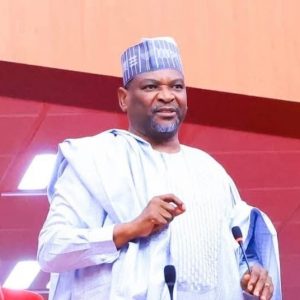



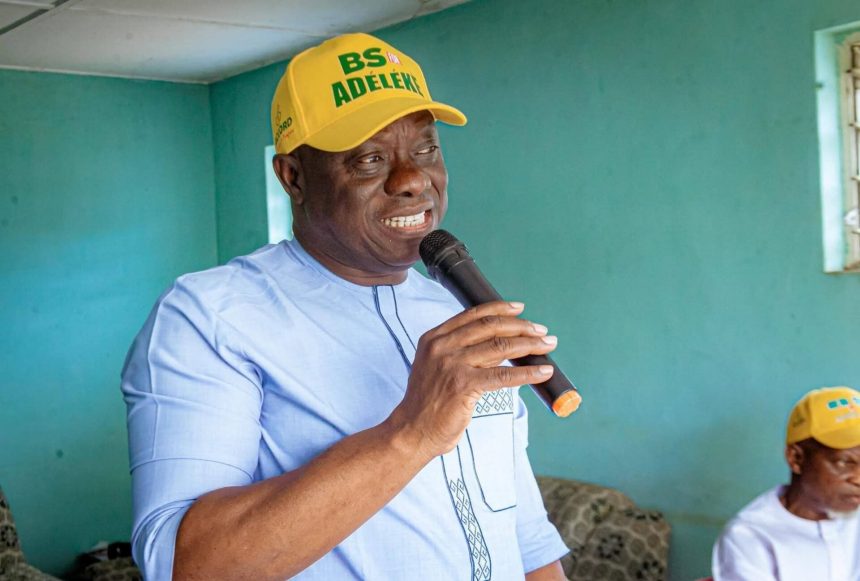
Bamidele Salam, a member of the house of representatives and chairman of the committee on public accounts, represents the Ede north/Ede south/Egbedore/Ejigbo federal constituency of Osun state. The ranking lawmaker recently defected from the Peoples Democratic Party (PDP) to Accord.
In this interview with TheCable’s SAMUEL AKPAN, Salam says the Accord has inherited the grassroots strength of the PDP, expressing confidence that Ademola Adeleke, Osun governor, will secure re-election, and warning that any attempt to manipulate the upcoming governorship poll will be resisted.
The lawmaker also claims that local government funds in Osun are being controlled by individuals he describes as illegal occupants of council offices, insisting the situation violates constitutional provisions and court rulings.

TheCable: You recently joined Ademola Adeleke, Osun governor, in Accord. How popular is the party in the state?

Salam: The popularity of the party can be gauged by the popularity of the legacy party, that is, the Peoples Democratic Party (PDP), where we were before we moved to the Accord.
So, if you know the PDP’s strength in Osun state a couple of months ago, you can gauge how strong the Accord is in Osun because we moved the whole PDP structure into the Accord when the PDP’s crisis was becoming intractable. And then, coupled with the fact that we have a governor who has been in office for three years and has won the hearts of the average man and woman of Osun state. He is well-loved and well-accepted.
That rubs off, of course, automatically on the political party, which is the Accord party. The Accord party is the leading political party in Osun state, the most acceptable and influential in all units, wards, and local governments of Osun state.
TheCable: Can the governor defeat Bola Oyebamiji, APC’s candidate, given that it is an off-cycle election and the fear of federal might?
Salam: The governor is going to emerge victorious for so many reasons. I just told you one of the reasons: he has performed well in office. He is well-loved by the people. The electorate has made him their candidate of choice in this election. In several polls, including some conducted by agents of the opposition political party, it has been shown that the governor is well-loved.
Now, when you talk about the concentration of federal forces, I understand what you mean, and I know that there are precedents to the effect. In an off-cycle election, there are usually attempts to manipulate and muzzle the opposition. But I want to assure you that in Osun state, even if there are plans to muzzle the Accord or to play us out of a fair contest, it will not work because we are also on top of the game. We are well prepared.
The people of Osun are also very enlightened. In 2014, when Aregbesola contested against the PDP candidate, it was perceived that federal might would be deployed. But the people stood their ground to make sure that they not only voted, but ensured their votes counted.
The same thing will happen in Osun state. The people of Osun will make sure that they not only vote but that their votes are counted, and that any attempt to rig the election, oppress the people, or subject the process to unfair interference will be resisted. So, I am confident that we will win the election, and all these fears about the federal might coming from somewhere to influence the election will eventually be seen to have fizzled out.
TheCable: What is the status of the LGA allocations in Osun? Has the FG released the funds?

Salam: The money has not been released. The funds are being pilfered by individuals illegally occupying the positions of local government chairmen, vice-chairmen, and councillors in Osun state. It is so unfortunate. This violates the clear provisions of section 7 of the Nigerian constitution, which stipulates that local government administration will be administered by a law made by the house of assembly.
It also breaches the direct pronouncement of the Supreme Court of Nigeria on the autonomy of local government. We see a situation where members of the APC, aided by the Nigerian police, seized local government structures in the state. Local government workers are not even allowed to do their work.
They have usurped the powers of local government treasurers, directors of finance, and directors of personnel management. They appointed themselves to manage the local government affairs, pilfering some of the funds in collaboration with a commercial bank. It’s a matter before the court.

People whose purported tenure had been truncated by the pronouncement of a federal high court and the court of appeal, and who didn’t approach the supreme court to seek relief, have consistently violated the clear terms of those pronouncements to continue to pretend to be local government chairmen and councillors.
TheCable: How has the governor been managing the affairs of the state, especially at the local government level?
Salam: It has actually been very challenging, but because the governor does not want to leave important things undone, the state government has been the one paying the salaries of workers at the local government level, including pensions of retirees from its meagre resources.
It strains the state government and delays the execution of critical projects. But as I said, the governor is focused and determined, doesn’t want a situation where, as a result of power play and oppressive tendencies, the poor man who works at the local government level will not be able to cater for his family.

TheCable: Do you see the opposition defeating the president and the All Progressives Congress (APC) in 2027?
Salam: Well, I will not be able to respond to that question for two reasons. The first reason is that even though the Accord is in opposition, my governor has endorsed the president for a second term.
The second reason he told us, and we agreed with, is that the president is historically from Osun state. He’s regarded as one of us.
But let me say a few things about the opposition in Nigeria. It is such an unfortunate time in Nigeria for two reasons. The first reason is that the opposition itself has not learned from history to harness its resources and pursue the common goal of providing a better alternative to the government in power.
One would have expected a sense of commitment and organisation by key players in the opposition. But they have subjected themselves to manipulation and inducement by the government in power. Whenever individuals attempt to cause problems, a closer look often reveals external influence. That is unfortunate.
I want to advise the president and the ruling party to tread carefully because there is a soul of democracy, and that soul is in multiplicity.

When there are no choices for people to make, you create tensions in the system. And I think that whatever the president and the APC are doing that may harm the growth of opposition and oppress free choices, should be re-examined and looked at. Yes, at times these things are perceptions, but perceptions are key in governance.
The opposition has to get its act together, act more responsibly, and be more patriotic. They have to keep their eye on the ball and on the goal.
When the APC was formed, key leaders made sacrifices to wrestle power from the PDP. I expect the same thing from the opposition. If the opposition really intends to oust the ruling party, there should be a lot of sacrifice.
There should be retrospection and less desperation. They should be concerned about building democracy and strengthening the fabric of our nationhood.
TheCable: What are the biggest obstacles the public accounts commitee (PAC) faces in enforcing accountability among MDAs?

Salam: There are multiple challenges. I know some of the committees face some similar challenges, but ours is a peculiar committee. The committee reviews the auditor-general for the federation’s reports and ensures adherence to financial regulations in the administration of public funds. It’s a constitutional committee.
One of the challenges we have is the lateness of submission of reports from the office of the auditor-general for the federation. We just received the auditor-general’s report for the federation for the year 2023.
When we attend conferences such as the West African Association of Public Accounts Committee (WAAPAC), African Organisation of Public Accounts Committees (AFROPAC), and compare notes, we discover that even smaller countries that do not have much focus on the global economic world are doing much better.
Many of them have dealt with 2025 reports. The fact that we were able to get 2023 was a result of several pushes by this committee for the auditor-general for the federation and the accountant-general of the federation to do the needful.
So, when reports come in late, they take away from the substance of the issues identified. In some cases, the persons identified have retired, moved from the ministry, or are even late. In some cases, the records and the documents are no longer there.
So you have quite a lot of problems coming with that. The second is the implementation of the committee’s recommendations. Yes, there had been problems even with the committees before now, where the public accounts committee failed to lay reports before the plenary for recommendation.
To the glory of God, the 10th assembly broke that record. We have been able to lay reports before the plenary. The reports were considered. But the implementation of the report, again, goes back to the executive, ironically.
In some other countries, there are judicial structures. There are public accounts committee tribunals in some countries where the public accounts committee’s reports are sent to ensure the implementation is not delayed. And then, finally, there is a lack of cooperation by key elements in ministries, departments, and agencies of government.
A review of the records shows numerous letters from MDAs requesting the rescheduling of appearances, extensions for document submissions, and, in some cases, outright evasion, with claims that summons were not received. Some major government institutions are not cooperating with the committee, which is unacceptable.
For example, the issue of the Central Bank of Nigeria, which had to come before the plenary of the house of representatives, is there. We have written letters to the CBN for documents. We have queried them on the non-rendition of accounts.
We have queried them on non-remittance of operating surpluses, contrary to the provisions of the Fiscal Responsibility Act and other laws. But all they keep doing is writing letters and asking for more time. When they submit one document, by the time you analyse it, you find gaps in it. They come back and apologise, saying it was an error.
So when you spend so much time on only one agency on one matter, fatigue sets in, and you do not reach a logical conclusion on the matter. And if you don’t reach a logical conclusion, there is no way you can make recommendations to forestall the gaps the auditor-general identified.
The same thing with the NNPC. You have seen the running battle between our colleague in the senate and the NNPC. We have written several letters to the NNPC management, demanding responses to the audit queries of 2020 and 2021. The report identified issues with the NNPC that require answers.
TheCable: What is the solution? Does the committee need more power?

Salam: The parliament has enough powers, as far as I am concerned. I am not sure there is a need for any further power. But we may need to tinker with some of our laws.
For example, some of the auditor-general’s reports contain allegations that agencies make payments without payment vouchers and supporting documents running into billions of naira. The report is submitted late to parliament, often arriving three years behind schedule. MDAs also fail to submit documents on time.
In Ghana and some other jurisdictions, there is a limitation by virtue of the law on how long it can take you to produce a document that the auditor asks for.
If you don’t produce that document within a space of 21 days or three months, you are statute-barred from producing the document. If you know that the law does not allow you to produce documents whenever you sleep and you wake up, you’ll be more accountable and intentional about it. So we may need to amend the law in that direction.
Our procurement laws require review. Some of the problems arising from these violations stem from the Procurement Act, particularly lengthy procurement timelines. There are abandoned projects across the country. We are currently investigating several agencies, including the National Library of Nigeria and the CBN, over projects initiated 10 to 15 years ago that remain uncompleted.
Targeted interventions are needed in those areas. Parliament has enough powers to tackle corruption, accountability lapses, and the failure to render accounts, but these powers are rarely used.
TheCable: Why does the parliament rarely use that power? Is it a lack of political will?
Salam: Probably the parliament is also trying carefully not to be seen as disrupting the system, or for whatever reason. I don’t want to make a speculation, but I know the parliament has powers that it has not used at all or has not used very effectively in the course of its legislative functions.
I think it’s just for us to develop more political will, like you said, to strengthen the respect for parliament. The parliament anywhere in the world is a very important institution, but nobody will give you that regard or respect à la carte.
TheCable: What is responsible for the delay for the auditor-general to present its report to the parliament?

One issue is capacity. I think the auditor-general needs to develop more capacity, but another very fundamental one is that the office of the auditor-general for the federation, even though a creation of the Nigerian constitution, has not had its own enabling law that will spell out so many things about its structures, composition, finance, and general management.
In other words, today, the auditor- general for the federation cannot recruit staff by himself. He needs to make recourse to the Federal Civil Service Commission for recruitment, and he works with anyone recruited for him.
So, the auditor-general’s office, even though it has some degree of independence by virtue of the constitution in terms of appointment and removal, lacks operational independence. It was in this light that the audit bill had always been coming in and out of every assembly. Now the 10th assembly has also passed the audit bill, waiting for harmonisation and presidential assent.
Again, I will shock you. Nigeria is the only country among its peers that lacks this legal framework for the office of the auditor-general for the federation, a supreme audit institution. That’s one problem. Then there’s the issue of capacity — they need more training, more equipment, and more funding.
They are dealing with thousands of issues and agencies. They need to be well-equipped to surf through all the accounts. And then the one that has to do with the account of the federation itself rests squarely with the accountant general for the federation.
And I want to tell you that the last time the Federation of Nigeria’s account was audited was in 2021. That’s the report that you have. The auditing of the federation account itself will also come up with excuses for the delays.
When the accountant-general does not produce the accounts for the auditor-general to audit, there is nothing for him to work with. So it’s a whole lot of issues that have led to those delays. We are trying to break them.
We are working to ensure that relevant government institutions, including the accountant-general and the auditor-general, address these issues. However, it reflects poorly on the country that prospective investors cannot readily access the federation’s audited accounts. This information is essential for making informed investment decisions. I’m not sure many countries operate this way.
TheCable: Under your chairmanship, the PAC recovered billions of naira from oil and gas companies. What is the exact figure?
Salam: I know it’s about 200 billion naira from different sources. The biggest of the recoveries was the one from the auditor-general’s report in 2021, where the auditor-general identified so many oil and gas-related companies in default in the payment of all royalty, concessional rentals, gas-flaring penalties, running into several billions of naira and brought the report before us, upon which we activated the powers of the committee to investigate.
In the course of the investigation, we engaged with some of these oil companies, who were made to enter into an undertaking to remit such monies within a specific period. But even that, not up to 60 percent of those oil companies have complied.
Another issue concerns Remita, a collection agent for the federal government. Investigations revealed that it failed to remit funds collected on behalf of the government. While about five banks have refunded the amounts involved, Remita, operated by SystemSpecs Nigeria Limited, has yet to comply with a legislative directive to repay nearly N800 billion owed to the federal government.
In fact, the amount is closer to N1 trillion, based on available evidence. The funds, collected since 2015, have not been remitted. The matter is also under investigation by the Revenue Mobilisation Allocation and Fiscal Commission and other relevant government agencies.
Source: The Cable
Stay ahead with the latest updates!
Join The Podium Media on WhatsApp for real-time news alerts, breaking stories, and exclusive content delivered straight to your phone. Don’t miss a headline — subscribe now!
Chat with Us on WhatsApp