




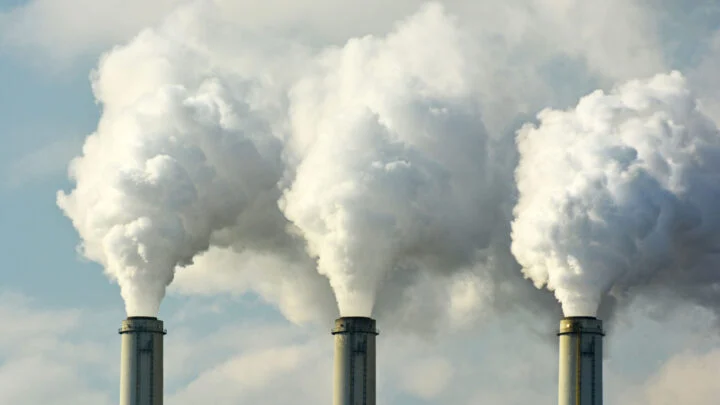
With every tonne of greenhouse gas released into the atmosphere, the risks of floods, extreme heat and sea level rise become more severe for Nigeria. Yet, the emissions footprint of most oil and gas companies remains unknown, with little publicly available data to measure their contribution to the climate crisis.
Oil and gas operations release greenhouse gases such as methane (CH₄) and carbon dioxide (CO₂). Although carbon dioxide is the most abundant greenhouse gas from fossil fuels, methane has been found to be far more potent, trapping about 80 times more heat than CO₂ over 20 years.
TheCable had previously analysed the Nigeria Extractive Industries Transparency Initiative’s (NEITI) greenhouse gas emissions report for 2022 and 2023, which showed that only 15 of the 62 oil and gas companies disclosed theirs.

The finding exposes a major transparency gap in Nigeria’s extractive sector at a time the country is pursuing a 29 percent emissions reduction target by 2030 under its updated Nationally Determined Contribution (NDC) and a net-zero emissions goal by 2060.
Among the 47 companies that did not disclose their emissions data to NEITI were Aiteo, First E&P, Oando, Walter Smith and Energia, some of Nigeria’s notable indigenous oil producers.
The disclosure gap persists despite the Petroleum Industry Act (PIA) 2021, which introduced environmental obligations for petroleum operators.
Nigeria’s oil and gas sector accounts for a substantial share of the country’s greenhouse gas emissions through gas flaring, methane leaks, fuel combustion and other operational activities.
With the devastating impact of oil exploration on communities in the Niger Delta, including the recent gas leak in the Bille community, Rivers state, it is only fitting that oil firms are transparent about their environmental footprint by disclosing their greenhouse gas emissions to NEITI.
Without reliable company-level emissions data, regulators cannot accurately monitor progress towards national climate targets, while investors, host communities, and the public have limited information to assess companies’ environmental performance.
In this report, TheCable analysed five of these oil companies that did not disclose their emissions data to NEITI.
FIVE OIL FIRMS THAT FAILED TO DISCLOSE THEIR EMISSIONS

- Nembe E&P (formally Aiteo E&P)
Among the 47 oil companies that did not disclose greenhouse gas emissions to NEITI is Nembe Eastern Exploration and Production (formally Aiteo E&P), one of Nigeria’s largest indigenous upstream operators.
The company operates Oil Mining Lease (OML) 29 and the Nembe Creek Trunk Line (NCTL), a strategic crude oil export pipeline with 11 oil fields covering about 983 square kilometres in parts of Bayelsa, Rivers and Delta states in Nigeria’s Niger Delta region.
The firm produces about 150 barrels of crude oil per day, equivalent to about 23,850 litres daily.
Given the scale of its operations and repeated reports of oil leaks linked to its assets, Nembe E&P did not submit its emissions report to NEITI for the 2022 and 2023 reporting years.
Meanwhile, the Nigerian Upstream Petroleum Regulatory Commission (NUPRC) in 2024 reported gas flaring activities on Nembe’s assets.
The firm says it is committed to sustainable development, according to information published on its website and reviewed by TheCable.
“Our goal is to do our part to protect the health and safety of our employees and customers and to preserve and protect the environment in the communities in which we work and live,” the company said on its website.
Although the company positions itself as “The Future of Energy”, it did not set out a detailed energy transition roadmap, decarbonisation strategy or timeline for reducing emissions.
Aiteo’s failure to disclose its emissions to NEITI despite its production capacity, sustainability commitments and gas flaring activities means there is no public record of the volume of greenhouse gases it released during the reporting period.
Without such data, it is difficult to assess the company’s emissions profile or hold it accountable for its contribution to climate change.
TheCable contacted the firm to understand why it did not disclose its emissions but did not receive any response.
- First E&P
First Exploration & Petroleum Development Company (First E&P) is an indigenous Nigerian upstream oil and gas company founded in 2011.
The company operates PML 53 and 54 (formerly OML 83 and 85) in partnership with the Nigerian National Petroleum Company (NNPC) Limited and has increased production through the Anyala and Madu fields offshore in Bayelsa state.
Besides operating the Anyala and Madu fields, FIRST E&P also owns stakes in several other oil and gas licences, including PPLs 276 and 277, PML 53, and, through its shareholding in West African Exploration & Production (WAEP), OMLs 71 and 72.
In 2024, FIRST E&P said it had produced and exported more than 50 million barrels of crude oil, equivalent to nearly eight billion litres, while the Anyala and Madu fields produce about 57,000 to 60,000 barrels of crude oil daily.
In 2024, NUPRC recorded gas flaring from FIRST E&P’s operations.
Although FIRST E&P said it had reduced routine gas flaring at the Anyala and Madu fields by 96 percent and had committed to achieving low-carbon status by 2030, net-zero Scope 1 and 2 emissions by 2045, and net-zero Scope 3 emissions by 2060, the company also did not disclose its greenhouse gas emissions to NEITI.
Scope 1 emissions are released directly from a company’s operations, Scope 2 emissions come from the electricity and energy it purchases, while Scope 3 emissions are generated across its value chain, including when customers use its products.

Likewise, TheCable didn’t receive any response when it contacted the firm.
- Oando Plc
Oando Plc is one of Nigeria’s largest indigenous energy companies, operating the oil mining leases 60 and 63 in the Niger Delta.
In 2024, the firm completed the acquisition of the Nigerian Agip Oil Company (NAOC) from Eni, significantly expanding its upstream portfolio.
After acquiring NAOC, Oando said its production capacity increased to about 100,000 barrels of oil equivalent per day (boepd), equivalent to 15.9 million litres of oil.
In its 2024 Annual Financial and Operational Performance Report, the NUPRC recorded gas flaring from Oando’s upstream operations.
Although Oando publishes annual sustainability reports and has committed to achieving net-zero Scope 1 and Scope 2 operational emissions by 2040, the company did not disclose its greenhouse gas emissions to NEITI for the 2022 and 2023 reporting years.
Idongesit Edet, assistant manager, public relations and internal communications at Oando, told TheCable that the company had no objection to providing the requested information but needed more time to retrieve the relevant records and obtain the necessary approvals.
Edet also requested an extension, noting that the period in question predated Oando’s recent acquisition and would require access to legacy information.
TheCable granted the requested extension, but Oando did not respond even after the extended deadline had elapsed.

- Walter Smith Petroman Oil Limited
Waltersmith Petroman Oil Limited is an indigenous Nigerian exploration and production company. It became wholly Nigerian-owned in 2001 and was awarded the Ibigwe Field in Petroleum Mining Lease (PML) 16 (formerly OML 16) in Imo state.
Waltersmith operates Nigeria’s first privately-owned operational modular refinery with an initial refining capacity of 5,000 barrels of crude oil per day.
The oil company said it produces up to 10,000 barrels of oil per day and has produced over 14 million barrels cumulatively from the field.
Waltersmith publishes annual sustainability reports, which it says are central to its operations, with commitments to reduce carbon emissions, expand cleaner energy projects, and align with national and international sustainability standards.
However, it did not submit emissions data to NEITI, leaving the climate impact of its operations outside the public reporting framework.
Like other companies, TheCable did not receive any response from the firm.
- Energia Limited
Energia Limited is an indigenous Nigerian exploration and production company that operates the Ebendo Field in PML 56 located in Delta state.
The company produces about 10,000 barrels of oil per day (bpd), equivalent to 1.59 million litres of crude oil.
NUPRC also recorded gas flaring from Energia’s operations in its 2024 report.
However, the company also did not disclose its greenhouse gas emissions to NEITI, making it difficult to evaluate its contribution to Nigeria’s emissions profile or track progress towards national climate commitments.

TheCable wrote to Energia to get its reaction, but the company did not respond.
‘EMISSIONS DISCLOSURE GAPS COULD DERAIL NIGERIA’S NET ZERO AMBITION’
Nigeria has pledged to achieve net-zero emissions by 2060. At the 2021 UN Climate Change Conference (COP26) in Glasgow, the country also committed to reducing greenhouse gas emissions, ending routine gas flaring by 2030, and transitioning to a low-carbon economy.
Net zero is the state in which the amount of greenhouse gases released into the atmosphere is balanced by an equivalent amount removed.
The country is also a signatory to the global methane pledge and has committed to end routine gas flaring by 2030.
In 2023, NUPRC reported that oil and gas firms operating in Nigeria flared about 183 billion standard cubic feet (SCF) of gas.
Tengi George-Ikoli, country manager of the Natural Resource Governance Institute (NRGI), said the continued non-compliance of oil firms could hamper Nigeria’s commitment to achieve net-zero emissions.
“You can’t regulate or reduce what you don’t measure. Without company-level emissions data, the government can’t set baselines, track progress, or target the worst offenders for flaring and methane leaks,” George-Ikoli told TheCable.
She noted that the disclosure gap also creates an accountability imbalance, as reporting companies face scrutiny while non-reporting operators remain out of public view.
According to her, NRGI, alongside NEITI and Policy and Legal Support Initiative (PLSI), recently convened a technical session with companies that disclosed and those that failed to disclose emissions data to review challenges around corporate accountability.
She noted that NRGI is developing an emissions monitoring and accountability tool that uses NEITI’s emissions data to make information more accessible.
George-Ikoli called for amendments to the Petroleum Industry Act (PIA) 2021 and the Nigeria Extractive Industries Transparency Initiative (NEITI) Act to make annual, independently verified emissions reporting mandatory for oil and gas companies.
This report was supported by the Centre for Journalism Innovation and Development (CJID) as part of the Deepening Methane Emissions Transparency Initiative-Stream II, through funding support by the Natural Resource Governance Institute (NRGI).
Source: TheCable
Stay ahead with the latest updates!
Join The Podium Media on WhatsApp for real-time news alerts, breaking stories, and exclusive content delivered straight to your phone. Don’t miss a headline — subscribe now!
Chat with Us on WhatsApp