


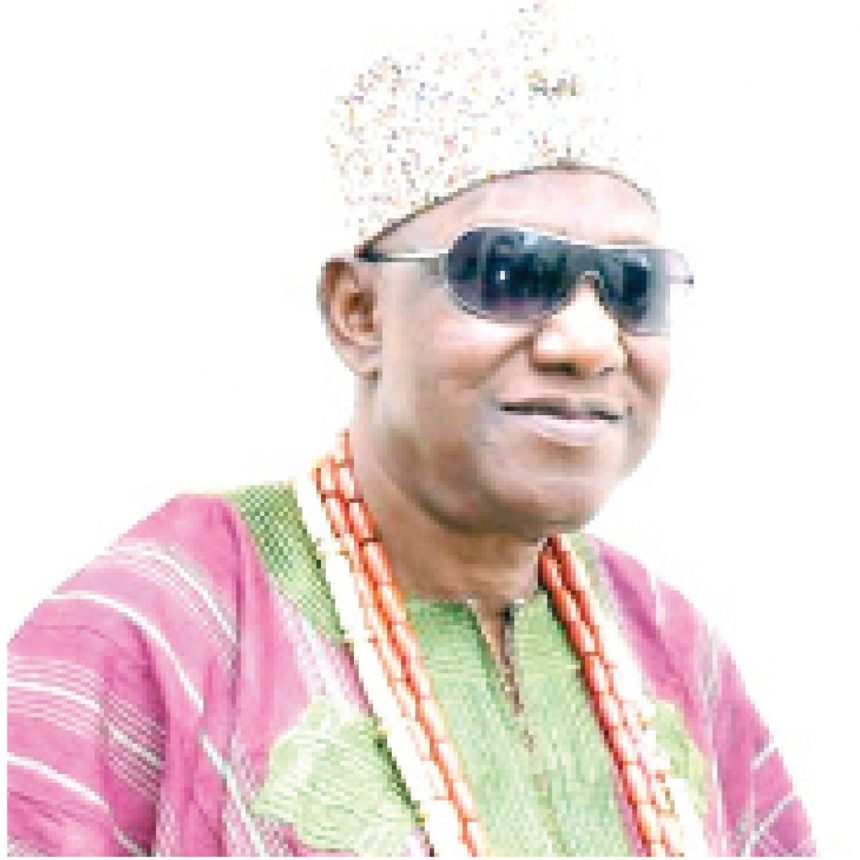
His Royal Majesty, Oba (Dr) Oluwole Olufaderin Adetimehin, is the Jegun of Ile Oluji, the paramount ruler of the community. The former president of the Chartered Insurance Institute of Nigeria (CIIN), in this interview, takes Akin Adewakun through his childhood and boardroom -to-the -palace journey. Excerpts:
WHO exactly is Oba Adetimehin?
Let me start by saying I’m from a very humble beginning. I was born into a polygamous setting, and talking about my childhood, I will say I was fortunate to have had a good upbringing. I started my elementary school, going about with one of my uncles who was a trained teacher, which really gave me the opportunity to learn the art and science of living an independent life. As a teacher’s boy, living in teachers’ quarters, we had our daily routines that most of our peers were not exposed to. In fact, that kind of disposition was more of an elitist thing among our peers; since most of them were children of peasant farmers. Their parents never went to school, just like mine, too. I had uncles, junior brothers to my late father, who had the privilege of being educated, and that made the difference, because even in school, teachers’ boys or girls were seen differently, because the general belief was always that they had inculcated very good upbringing in the Teachers’ Quarters, because we had a daily routine. When you woke up in the morning, you had to clean the house, make breakfast, get prepared for school, go to school, come back from school, do your lessons, prepare the supper, and after that, do your school assignment. That was the routine we grew up with at that time as teachers’ boys.

Tell us more of those experiences as a ‘teacher’s boy’?
I was always following my uncle to wherever he was posted. Even when he went for the returned course at the Teachers’Training College, I had to stay with one of his friends. When he finished his return course, we started moving again. In fact, at a time, the job took us out of Ondo State. We went as far as Ogun State, then. His posting after his return course was in Abeokuta, Ogun State, that was after my Primary Two. By the time I was going to Primary Three, I had already left the comfort and confines of my birthplace and that of my parents. That really gave me an exposure that people of my age, my classmates, were not exposed to. From Abeokuta, I gained adminssion to Lisabi Grammar School, where I had my secondary education. It was a co-education school, where we had the opportunity of doing Typing, Shorthand, Accounting, Business Studies, Social Studies and later General Science.
What were those memorable moments in your secondary days that you still recollect till date?
I think that was in 1970, because I finished my secondary school in 1970, at a very good age. Unfortunately, that was the year we first had exam leakages in WAEC. So our school certificate results came out late, and because of the leakage and malpractices, the results were given some special attention. Most of us leaving the secondary school at that time, never had the best of result. So the first thing I did, after leaving the school, was to rewrite some papers.
And what were your plans after you had rewritten the papers?
Like everybody at that time, I started looking for a teaching job. Unfortunately, I had difficulty securing a job because I was smallish. I later took up teaching for a while, and, along the line, got admission into the Produce Inspection College in Ibadan, and the course duration was 18 months. But, I never the school, despite it being rated very highly.
Why?
You know as small as I was then, I felt disgusted with the kind of uniform they were using, despite the fact that things had really improved by the time I was joining then. Prior to my joining the school, they used to put on short knickers with red tie and helmet. So, from Day One, I never liked the place. So that influenced my working hard to make up for those papers I didn’t have good grades in back then in secondary school. Before we left the training school, I had passed my make-up papers. In October, I had to come back to Ibadan again for my GCE A’Levels. I wrote three papers, and passed those papers, which qualified me straight away for direct admission. I got the result, and started shuttling between Benin and University of Lagos to obtain late forms, and good enough I got admitted to the University of Lagos to study Insurance and Actuarial Science, and we happened to be the first set of insurance graduates in Nigeria.
And what was the experience like being pioneer graduates of Insurance?
Interesting! Then Insurance, as a course, was just being introduced when we came in, and it was only University of Lagos that was offering a degree programme both in Insurance and Actuarial Science. Back at Unilag because the course was strange, people had their kind of impression of what the practice was then. They would describe practitioners as ‘people that go about in jackets, carrying bags and going from one place to the other to solicit for business’. By that they were referring to Insurance agents. So, we met such reactions and that kind of costly jokes. This therefore made us to put in extra efforts to distinguish ourselves, as graduates. We were determined not to make a mess of the programme because it was relatively new. We believed the Ministry of Education gave universities the opportunity to run this program so that our Insurance space could grow.
As a matter of fact, when we were graduating, about 20 of us, in the first set, were all given postgraduate scholarship to study up to PHD level because at that time they were planning to recruit university lecturers in the programme. They were also encouraging universities to start running such courses so that it wouldn’t be Unilag alone. So a number of us went for the postgraduate program but in my own case, I didn’t go, because I weighed it against the other options I had. I found myself in a position where I should be charting an education course for my siblings. If I had gone abroad for training, up to PHD level, they would have suffered in my absence. So my staying back paid off because I was able to map out career programmes for my junior ones, and, today, I thank God that in the family we were able to produce graduates and well-educated personalities.
What informed the choice of Insurance?
Initially, I was planning to go and read BSc Accounting, and they had almost admitted me into the University of Benin for BSc Accounting. But while I was searching for admission, I stumbled on an advert, a late admission advert from Unilag. I posted the advert, you know I was in Owo, to my big cousin in Ibadan, Dr. Akin Fagbamiye, now late. I asked him to go through the advert and advise me appropriately. He knew I was already chasing BSc Accounting. When Dr. Fagbamiye saw what I sent, he quickly advised that I would be better off reading the new course, since that would make me a pioneer, and that the opportunities would be there for me to make an impact. That was what informed my choosing the course.

Was there any moment of regret regarding this career choice?
Not really. For instance, it took me two years to become an Associate of the Chartered Insurance of London. So by the time the insurance industry was going to start its own institute in Nigeria, we were at the forefront. We were setting questions, we were grading exams, and doing all sorts because of our peculiar background.
What was the industry experience like?
After graduating, I was able to work with Hogg Robinson, one of the very few companies that took up the courage to start recruiting university graduates. Remember I told you that before I came to the industry, they were used to people coming in with professional qualifications, and people coming from abroad who had worked with insurance companies, and not professional qualification. Despite the fact that we were fewer than 20 that graduated, it was difficult for us to find jobs. There was that apathy in the industry then. They believed the industry was not consulted before they introduced the university program. So we found ourselves in that kind of dilemma. But, Hogg Robinson was one of the few companies that took up the courage to recruit university graduates. As a matter of fact, they recruited about four of us, and that was the beginning. And that was where I had my tutelage. I had the opportunity of working directly with the MD. My primary assignment was to develop new business for the company. So it was really an exposure for me, and that was where I developed the skill of developing business, winning clients, writing technical reports, and opening doors. As time went on, people began to realise that these university graduates had a lot to offer. The elderly ones began to consult us regarding how their own children could get admission into the University of Lagos to read Insurance. We took it as a challenge that we must make an impact that being university graduates you have been trained to a level in the society. Good gave us the confidence and wherewithal to be able to prove that without showing any form of ego.

So I grew up in the industry from being a Chief Examiner, developing people, becoming a member of the governing council of the institute, and started holding positions like Treasurers of council for many years, before I rose to become Deputy President, and later President of the Chartered Insurance Institute of Nigeria (CIIN), for two years, before setting up my own business in 2008.
And how would you describe the career?
It was quite fulfilling. I believe I have contributed my quota to the development of the industry. Just like week, the Nigerian Insurance Association conferred awards and recognitions on past leaders in the industry and I was on the list.
Do you still remember some of those pranks you used to play while growing up?
To be frank, I never had the opportunity to play pranks. I told you I was very small, while in school, so small our House Master, while in Secondary school, had to offer me the unusual protection. He moved me to his room, the House Master’s room and was sharing the room with him.
He moved my bed. So I had the unusual privilege. When he went out on weekends, all the meals that were for him automatically became extra rations for me. So that made me have many friends, including my seniors.

What was the first reaction when you were made the Jegun of Ile Oluji?
I believe we all have our different destinies. I would say my ascension to the throne of my forefathers was divine, and not man-made. People were saying it that this man never paraded himself as a prince. But even in the Insurance industry where I was operating, they were shocked. You know people apply ego when they say ‘I’m a prince, I’m this, I’m that’. But I never belonged to that class of people. But with some members of our profession that knew I was a prince, we had our peculiar way of exchanging banters. You know, in our community here, people from royal family normally describe themselves as Otunba, and we know ourselves. The way they greet you and warm up to you will reveal all that.
So at social functions, the traditional drummers, immediately they set their eyes on me, they changed the drumbeats, to show that one is from a royal house. Meanwhile, I’ve been very careful personality. When there is still a reigning king, our culture and tradition does not allow you flaunting such.
So, whenever I went on social engagement and traditional drummers began to praise, and attentions would be attracted, I would simply dip my hand into my pockets, give them money and disappear. But people from our immediate family, close relations and some friends, knew I had the royal blood, though many never knew.
So when the past Oba passed on, I started receiving phone calls. But since I ascended the throne, people who never knew, then, have known now. After all, a golden fish has no hiding place. But regardless of the fact that I’m from a royal and I have been a prince, while I was mapping out career for myself, Obaship was not part of the ambition.
But, why?
Then I was looking at the possibility of one’s movement being restricted, that one would be confined to the palace.
What was the culture shock when you first resumed as the Jegun of Ile Oluji?
First I believe I had imbibed the art and sciences of universality of management. I was coming from a corporate setup, where you assemble experts to pursue goals and objectives. At the traditional level I had thought my experiences in the corporate world would be of tremendous help to me. I thought I would be able to delegate authority to my council when I would not be available. But, I was shocked that you hardly can delegate too much of tradtion and culture, and my council would hardly have the need to meet, if I would not be around. And even if I have to go to the meeting of traditional council meeting in Akure, and tell my second -in -command to go ahead with our meeting, the thing is that whoever comes must still wait for Kabiyesi. It took me a while before I could adjust. Since I’ve come to understand the reason for this, I’ve learnt to adjust. Once the Kabiyesi makes a pronouncement, it becomes an authority. That was that kind of peculiar experience. But apart from that, I’ve developed the blueprint to operate, and that has guided my administration till date, and thank God we have completed a decade.
And how has it been?
We thank God, there has been landmark, there has been achievements, and I think the community people have been impressed by my kind of leadership. I always see this as a challenge to do more. And I’ve been very fortunate at the kind of support I’ve received in the annals of obaship in the community. But I know it can only be God.
Source: Nigerian Tribune
Stay ahead with the latest updates!
Join The Podium Media on WhatsApp for real-time news alerts, breaking stories, and exclusive content delivered straight to your phone. Don’t miss a headline — subscribe now!
Chat with Us on WhatsApp