




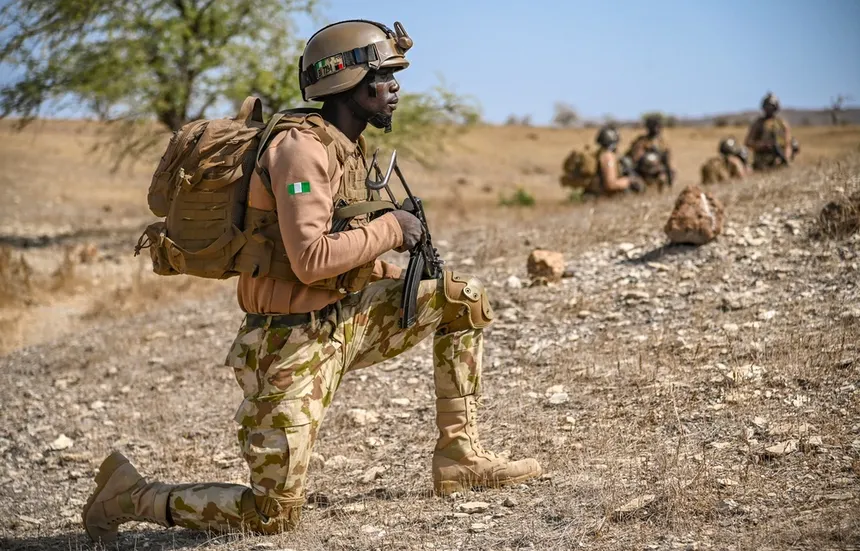
From cocaine corridors to counterterrorism defections, a quieter shift is redefining Nigeria’s role in global security.
Nigeria’s evolving security partnership with the United States is no longer defined by troop presence but by something less visible—and potentially more consequential: intelligence, information, and global integration.
While recent headlines have focused on the partial withdrawal of US troops, Thursday’s remarks by the Commander of US Africa Command (AFRICOM), Dagvin Anderson, reveal a deeper shift—one in which Nigeria is emerging as both a proving ground and a strategic node in a new model of counterterrorism and transnational security cooperation. Mr Anderson was speaking to journalists at a post-conference briefing following the African Chiefs of Defence (ACHOD) conference held in Luanda, Angola, between 30 June and 2 July.
At the centre of this shift is a simple idea. Security outcomes are increasingly driven not by force deployment alone, but by how effectively countries connect intelligence, act on information, and shape the operational environment.

Nowhere is this more evident than in how West Africa’s maritime domain is being woven into global enforcement networks. Mr Anderson, a general, pointed to a recent operation involving a massive cocaine shipment moving from South America along the West African coast, ultimately intercepted through coordinated international action. “I was able to coordinate through our interagency in the United States, through AFRICOM, and then notify some of the partners,” he said. “And eventually it was a Spanish ship that interdicted the ship that had 31 tons of cocaine on it, and it turns out it is the largest interdiction of drugs at sea that we’ve ever seen.”
This was not an isolated success. In September 2025, an AFRICOM-supported operation similarly led to the interdiction of 9.6 tonnes of cocaine off the West African coast on 22 September. Taken together, these incidents point to a pattern: the region is increasingly central to transatlantic narcotics flows—and to the coordinated efforts to disrupt them.
The implication is clear. West Africa—Nigeria included—is no longer a peripheral transit zone but a critical corridor in a hemispheric security system linking Africa, Europe, Latin America, and the United States. What enables these outcomes is not permanent foreign deployment, but intelligence sharing, real-time coordination, and pre-established partnerships.
Nigeria sits at the heart of this evolving model. Mr Anderson highlighted a recent joint effort in the Lake Chad Basin that targeted a senior ISIS figure tied not only to regional violence but to the group’s global network. “That operation in the Lake Chad Basin of Nigeria not only helped the countries in that immediate region; it also helps countries globally,” he said, noting that the individual was “responsible for much of their global operations, their global media, and their recruiting.”
In contrast to earlier eras of sustained external presence, US involvement in this case was deliberately limited. “We have withdrawn much of our forces that were just there for that operation,” Mr Anderson explained, “but are continuing the partnership that Nigeria has asked for to help continue with the intelligence sharing.”
This approach—short-duration kinetic support combined with longer-term intelligence integration—signals a shift in how security partnerships are structured. Nigeria is not merely hosting operations; it is increasingly executing them, with effects that extend beyond its borders.
Equally significant is what happens after such operations. According to Mr Anderson, Nigerian authorities have leveraged the information domain to amplify battlefield gains, contributing to increased defections among insurgents. “As they have talked about this in the information space and created that information environment, they have allowed—or had more defections or surrenders of ISIS followers in that northeastern area of Nigeria,” he said.
This reflects a more integrated model of counterterrorism—one that pairs military pressure with narrative shaping. Leadership losses are publicised, communication networks are disrupted, and the perception of insurgent viability is steadily eroded.
These dynamics are beginning to feed into rule-of-law processes, as surrenders transition into screening, detention, and, where applicable, prosecution. While gaps remain, the linkage between operational success and legal accountability marks an important, if gradual, institutional shift.
Taken together, these developments suggest that the most important change in Nigeria’s security landscape is not the visible drawdown of foreign troops, but the quieter consolidation of systems that enable Nigerian-led action—supported by intelligence, reinforced by information, and connected to global networks.
In that sense, the withdrawal narrative tells only part of the story. The more consequential reality is that Nigeria is becoming embedded in a new architecture of security—one where influence is exercised less through presence, and more through partnership.
Pearl Matibe is a Washington, D.C.-based geopolitical analyst and correspondent with expertise in foreign policy and international security, regularly covering the Pentagon and White House. Follow her on Twitter: @PearlMatibe.
Stay ahead with the latest updates!
Join The Podium Media on WhatsApp for real-time news alerts, breaking stories, and exclusive content delivered straight to your phone. Don’t miss a headline — subscribe now!
Chat with Us on WhatsApp