




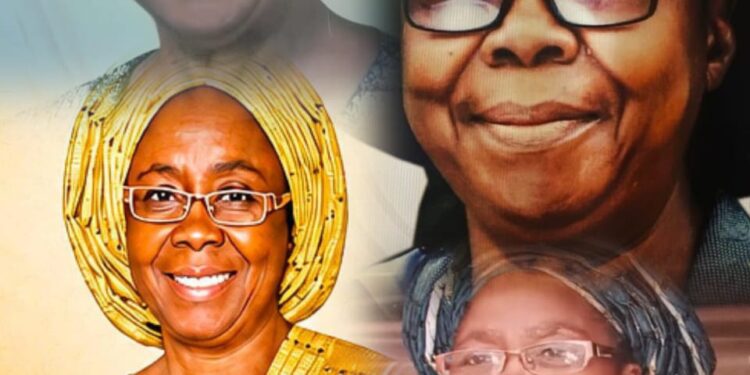
For a woman who lived much of her life away from the glare of public attention, the tributes that poured forth at the Service of Songs for Prof Mrs. Elizabeth Balogun, the departed wife of erstwhile Vice-Chancellor of the Federal University of Agriculture, Abeokuta(FUNAAB), Prof Olufemi Balogun on Monday were remarkably loud.
They came from university Vice-Chancellors and former Vice-Chancellors, senior academics, retired public officers, church leaders, traditional personalities, family members and a long list of people whose lives, in one way or another, had intersected with hers.
But perhaps the most striking testimony was not about what she did publicly. It was about what she quietly prevented from happening behind the scenes.

The incumbent Vice-Chancellor of FUNAAB, Prof Babatunde Kehinde, said the late Prof Mrs. Balogun had been a powerful stabilising force in the home of her husband particularly during the turbulent early months of the administration back then in 2007.
Prof Olufemi Balogun assumed office as the University’s fourth substantive Vice-Chancellor on May 24, 2007, with an ambitious reform agenda to rebuild the institution and reposition it for excellence.
That mission, Kehinde recalled, inevitably brought the former Vice-Chancellor into conflict with some interests within the university.
“He stepped on big toes,” was the essence of the recollection, but the wounds created by some of his decisions did not always translate into lasting hostility.
According to Kehinde, some of those who felt aggrieved by the former Vice-Chancellor would offer a remarkable consolation: rather than vent their spleen on him, they would ask others to “consider the grace of his wife.”
For Kehinde, that quiet grace was no small matter. His argument was that without the stabilising influence of Elizabeth Balogun at the homefront, the tensions surrounding the administration could have become much more explosive.
“FUNAAB would have gone up in flames,” he said in describing what might have happened without the calming influence she brought to the situation.
It was a testimony that captured one of the central themes of the evening: that Elizabeth Balogun’s greatest influence may not always have been visible in the positions she occupied or the accolades she received, but in the lives and institutions she quietly helped to steady.
And the gathering itself offered ample evidence of the breadth of that influence.
Among those present were the Chairman of the Police Service Commission and retired Deputy Inspector-General of Police, Hashimu Salihu Argungun; Apena of Egbaland, Chief Alani Bankole; former Deputy Governor of the Central Bank of Nigeria, Mrs Sarah Alade; serving and former Vice-Chancellors of several universities, many of whom were direct mentees of Prof Olufemi Balogun, as well as academics, professionals, friends and associates of the family.
Their presence transformed the Service of Songs into something beyond a farewell. It became a collective testimony to a life that had touched several generations.
Again and again, the description that surfaced was strikingly similar: “a saint in all ramifications.”
She was remembered as quiet, humble, unassuming, caring, deeply principled and devoted to God.

For a woman who served as a pastor in the Redeemed Christian Church of God, those descriptions were not presented merely as religious courtesy. They were backed by stories of a life of service and personal impact.
Minister-in-charge of the RCCG Peculiar People’s Province, Ibara GRA, Abeokuta, Pastor Paul Kuyoro who moderated the service, consequently turned the evening from a mere remembrance of the dead into a challenge to the living.
His subject was simple but searching: “What will be your legacy?”
Drawing from Hebrews 11:5, the Preacher pointed to Enoch, whose testimony was not self-generated but affirmed by God: Enoch, he said, had the testimony that he pleased God.

He also referred to Dorcas, also known as Tabitha, in the Book of Acts, whose death provoked such an outpouring of testimony from those whose lives she had touched that people sought her restoration back to life.
The point, he said, was that genuine legacy is not what people say about themselves but what remains in the lives of others.
Citing 2 Corinthians 5:10, he reminded the congregation that everyone would ultimately appear before the judgment seat of Christ, while drawing attention to the biblical assurance in Revelation 21 that people’s works follow them.
His message was therefore a challenge to everyone present: whatever people do on earth has consequences beyond this life. “It’s very important for us to leave behind legacies of love shown to people and recording impact in the lives of others,” he said.
He described Elizabeth Balogun as one of those whose life had already answered the question of legacy.
According to him, the numerous testimonies about her showed that she had touched lives across different spheres and left behind a model of what Christian living should represent.

The hallmark of good Christian living, he stressed, was the ability to lift others out of hopelessness.
He added that God intentionally positions people in one another’s lives so that, through their actions, they can reveal His nature and manifest His character.
But perhaps the most intimate portrait of the departed came from her eldest son, Mr Seyi Balogun, aka SB.
Reading his tribute, Seyi said he found comfort in the belief that God had a greater claim to his mother than the family ever did.
He described her as a God-fearing woman who devoted her life wholly to God and deliberately raised her children in the way of the Lord.
At home, he recalled, morning and evening family devotions were not optional. “They were the very foundation upon which our home was built,” he said.
But there was another dimension of his mother’s spirituality that remained particularly vivid in his memory.
He recalled that there were occasions when he had done something—or was merely contemplating doing something—that nobody else knew about, only for his mother to call him and tell him exactly what was in his heart. That, he noted, made him cautious.
He joked that he was always afraid of doing anything wrong because he knew God would reveal it to his mother.
Behind the humour, however, was a son’s profound testimony of a woman whose spiritual life was real enough to shape the atmosphere of her home.
Seyi also remembered her as a caring and loving mother and a wonderful wife to his father. And, confronted by the mystery of death, he admitted that there were things he might never fully understand.
“I do not understand, perhaps I will never understand,” he said in his tribute, “but I trust the God whom she taught me to trust.”
That perhaps captured the essence of the Service of Songs. The mourners came to grieve a wife, mother, grandmother, scholar, pastor and friend.
But as the testimonies accumulated, the gathering appeared to become less about the circumstances of her departure and more about the evidence of the life she left behind.
Elizabeth Balogun’s legacy, the tributes suggested, was not built on noise. It was built quietly—in a marriage, in a family, in a church, in the academic community, in friendships and in the lives of people who encountered her.
She did not need to occupy the centre of the stage to influence what happened on it. And in the end, the question posed by the Minister—“What will be your legacy?”—became more than the title of a funeral sermon.
It became the most fitting tribute to a woman whose life, according to those who knew her, had already supplied an answer.
Stay ahead with the latest updates!
Join The Podium Media on WhatsApp for real-time news alerts, breaking stories, and exclusive content delivered straight to your phone. Don’t miss a headline — subscribe now!
Chat with Us on WhatsApp