



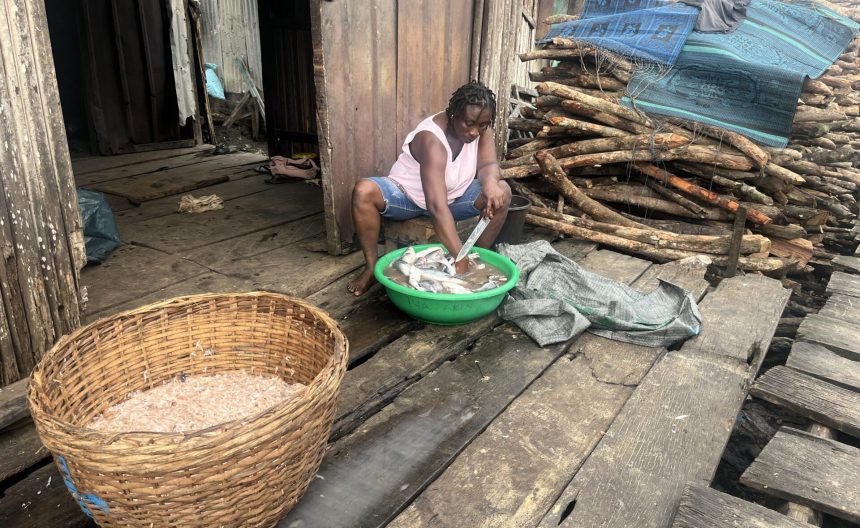
Times have changed, Alice Biobaku admitted unashamedly, her face aglow with ecstasy. A woman of few words, in her early 50s, she winked and giggled. Her dimples complemented the sparkle in her eyes. Biobaku stuttered again, “Times have really changed.” Once more, her countenance lit up like a young bride whose beautiful floral veil had just been lightly lifted by her groom.
She has lived in Ayetoro, a coastal community in the Ilaje Local Government Area of Ondo state, Nigeria, for most of her life. Living near the shores of the Atlantic Ocean, she has seen the good, bad and ugly – the times when the fish were plenty in the ocean; the lean seasons; and the bleak periods when the whole world seemed to have fallen apart, and she contemplated quitting fish trading. But she had no choice but to stay put until the storm passed.

In most rural coastal communities like Ayetoro, you are born a fisher first. Fishing is the lifeblood of the local economy. Your entire world revolves around the sea. When it roars, the community shudders; when it’s calm, the village booms.

As a young girl in Ayetoro, you learn how to prepare, smoke and trade fish from your mother’s kitchen. The boys follow their fathers to the sea to acquire the skills that would define the latter part of their adulthood. When the men bring home the catch, the women prepare, smoke and sell it in the market.
Biobaku relived the good days when fish were in abundance in the ocean. But the bountiful harvest came with physical and mental strain for the women at home. As soon as the boats docked in the evening, the harvest was dragged into the kitchen in large handwoven palm baskets and plastic bowls. Work began immediately. The seafood was separated: shrimp, crabs, and others on one side; fish on the other. They washed, removed the scales, carved, and placed them gently on the fire, while intermittently adjusting the wood to regulate the fire.

“It was a lot of processing, and you have no time to rest if you don’t want the fish to spoil. You can’t allow what the fishermen had toiled in the sea the whole day to bring home to waste. All hands must be on deck,” Biobaku said, taking in a deep breath. “We used to work overnight. As you are rushing to smoke the fish, the shrimp are already begging for your attention. You know these are aquatic animals that were caught either in the morning or afternoon and only get to the community in the evening.”
“At the end of the day, a lot of it still gets spoilt before they get to consumers, and there is nothing you can do to help it. You cannot go beyond your human capacity. You just have to bury the rotten fish to prevent the foul smell from taking over the community.
“If we had means to preserve the seafood immediately after it landed on the shore, we wouldn’t have to stress ourselves that much. We would have made more money when all catches are processed and sent to the market.”
HARD TO CATCH, HARDER TO KEEP

According to Ayodeji Arogunjo, manager of Johntop Foods, a local business in Ayetoro, fishermen bring up to two tonnes of fish, crayfish and prawns into the community weekly, with many of them wasting away.
But how would a local community speak about fish preservation when it has never been connected to the national electricity grid? Residents rely on fuel generators to power their homes, streets and businesses.
Ayetoro, a theocratic community at the edge of the Atlantic Ocean, nicknamed the “Happy City”, is trapped in a web of three unfolding crises: poor electricity access, a declining fish population and a perennial ocean surge that has buried a significant part of the community under water. In other words, fishers can hardly preserve the little they get from the water.
To reduce post-harvest losses, a couple of small and medium-sized enterprises (SMEs) bought large freezers to preserve seafood. Many residents couldn’t venture into the business because of the high cost of fuelling their generators and ensuring the freezers stay cold all the time.
Things, however, took a dark turn on May 29, 2023, when President Bola Tinubu, during his inaugural speech, announced the end of the fuel subsidy. The announcement signalled the end of the petrol subsidy regime, and the effect was immediate. Petrol prices doubled, transportation costs went up, food and commodity prices soared, and the cost of living rose sharply.
Business owners couldn’t afford the new fuel price; they tried, but it wasn’t sustainable. The freezers went dry. Residents lamented as more harvest perished. Yet, market demands for seafood kept mounting.

“Because of the nature of fish, it takes hours for it to get frozen. So, you have to power on the generator for at least 8 to 10 hours for the fish to freeze. Then again, when stocking the freezers, you must leave some space. Meanwhile, you have many fish on the floor to rescue,” said Feyintola Alebiosu, a 38-year-old fish trader in Ayetoro.

“We spent a huge amount of money on fuel when the subsidy was removed. Most of the time, you have to pour up to 30 litres of fuel into the generator. Aside from fuel, the generator breaks down quite often. You spend money on maintenance, buying spare parts and paying the mechanic fee as well. That’s why we keep up to two to three generators. Yet, transferring the high cost of business to consumers who are already feeling the brunt of the new policy could boomerang on us.”
Then, the business owners started looking for cheaper and sustainable alternatives; otherwise, more seafood would perish on the shore. Renewable energy was the best solution, but the majority couldn’t afford it.
“But to set up a solar system that can power freezers is capital intensive,” Alebiosu noted.
FIGHTING WASTE WITH CLEAN ENERGY

On July 26, 2025, luck smiled on Ayetoro when the Nigerian Conservation Foundation (NCF), a non-governmental organisation, donated two solar-powered freezers to the community. The set-up came with about 5-kilowatt lithium batteries and eight solar panels. The organisation said the solar technology project was initiated to provide clean energy in off-grid communities and help fishers preserve their catch for days, sell at better prices, and reduce the pressure to overexploit local waters.

“All the fishermen in the community came together and had a meeting where we concluded that we should hand over the freezers to the church, since the church owns the community. We assigned someone to be in charge,” Alebiosu said.
“The community subsidised it so that it will be affordable for the fishermen. Initially, we started charging N50 per kilo of fish. Now, we charge N100. The proceeds are channelled to the welfare of vulnerable community members, especially orphans, widows and persons with disabilities.”
With solar-powered freezers in Ayetoro, life became better for women like Biobaku. She now has more time for herself. She decides when to work and the pace. No panic, no rush.
“You can now see that times have changed and things have become better,” she said, smiling. “When I buy fish in excess, I smoke some and keep the rest in the solar freezer. I can even decide to sell them fresh later.”
In no time, the community realised the two freezers were not enough to cater to the volume of harvest that came in daily.

In February 2026, Johntop Foods, a local business outlet, also set up solar freezers to rescue the excess – two 719-litre freezers powered by 10-kilowatt lithium batteries and eight panels of 590 watts each. The owners also charged the fishermen N100 a kilo to store their fish.

Soon, the four freezers in the community with a combined capacity of storing 800 kilos of fish became insufficient.
While customers in urban cities like Lagos, Akure, Osun and Oyo were waiting for fresh supplies, Ayetoro fishers struggled to salvage the harvest on the ground.
“In Ayetoro, we need investment in large solar-powered cold rooms that can take up to three or four tonnes of fish. That will drastically reduce the losses. It will also create more job opportunities for the country’s teeming youth population who are unemployed,” Arogunjo said.
NIGERIA’S TROUBLING POST-HARVEST LOSSES

In February, Alexander Isong, president of the Organisation for Technology Advancement of Cold Chain in West Africa (OTACCWA), said Nigeria recorded between N3.5 trillion and N5 trillion in post-harvest losses in 2025.
“In 2025, Nigeria lost an estimated 30 to 40 million metric tonnes of food to post-harvest inefficiencies across major value chains, particularly tomatoes, vegetables, fruits, dairy, meat, fish and root crops,” Isong said.
“When such volumes are lost due to inadequate cold storage, poor logistics and weak infrastructure, the country is effectively losing gross domestic product that has already been created.”
Adegboyega Oyetola, minister of marine and blue economy, also stated that the country loses 420,000 tonnes of fish annually to post-harvest waste and warned that the losses are worsening the country’s fish supply deficit.
The minister said the country’s annual fish demand is more than 3.6 million metric tonnes, while domestic production is estimated at approximately 1.4 million metric tonnes for Nigeria’s population of over 200 million. Hence, the country imports $1 billion worth of fish yearly to bridge the gap.

In an interview with TheCable, Babatunde Emmanuel, professor of fish conservation, fishing gear, and crafts technology at the University of Lagos, said Nigeria needs more investment in solar-powered cold chains in rural communities, where most food is produced, so that it will be readily available in the market without a reduction in market value.
“Solar-powered cold storage in fishing communities directly tackles aquatic food spoilage,” the professor said.
“As we speak, Nigerians have no hope, as we cannot boast of 12 hours of uninterrupted electricity. So, the only way out is to rely on solar energy, which we are confident we can access as long as we can procure it. Environmentally, it is good, as it causes little or no problem. Renewable energy is the way forward, and if we can invest in this, it will surely boost our fish production and rural economy.”
REVIVING A COASTAL ECONOMY

Meanwhile, in Ayetoro, no one seems to be more excited about the introduction of solar technology into the fishing business than Kayode Ojonla, a fisherman with about three decades of experience scavenging the sea.
In his youthful years, when the sea supplied more than enough fish, there was no means of preservation. There were always leftovers; you either sold them at low prices or watched them spoil.
“With the solar freezers, our minds are now at rest. We make more money because we have nothing to fear, and you sell the fish at the right price,” he said convincingly.
“Now, people are building more houses and buying more boats for fishing and transport. Some marry additional wives and expand their household. It used to be difficult for us to send our children to private schools. We now pay as much as N300,000 as school fees in private schools. We can now easily send our children to higher institutions too.”
Alebiosu put in context: “The huge losses we incur from spoilt fish are enough to improve our economy and make our community prosperous if we get more investment in solar technology.”
For women like Biobaku who hold the value chain from the shore to the fish markets, it is a breath of fresh air.
This reporting was completed with the support of the Centre for Journalism Innovation and Development (CJID).
Stay ahead with the latest updates!
Join The Podium Media on WhatsApp for real-time news alerts, breaking stories, and exclusive content delivered straight to your phone. Don’t miss a headline — subscribe now!
Chat with Us on WhatsApp