




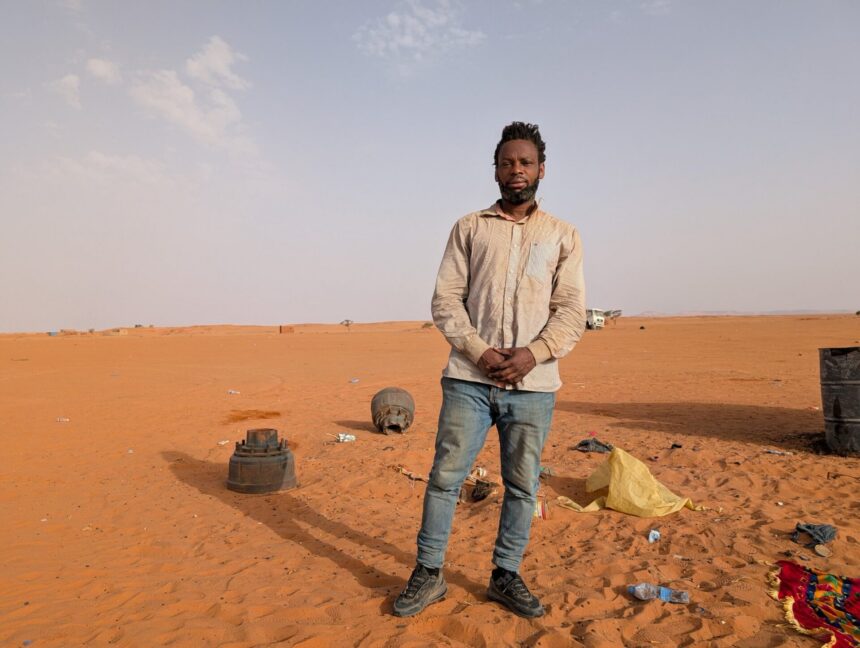
For 47 days, Fisayo Soyombo, founder of the Foundation for Investigative Journalism (FIJ), embarked on the trip from Kano in Nigeria through notorious illegal migrant hubs in Zinder, Agadez and Dirkou in Niger Republic, and al Gatrun and Sabha to Tripoli in Libya, to document the perilous journey some African migrants undertake to Europe.
In the three-part undercover investigation, Soyombo documented how Africans are subjected to modern-day slavery, robbery, dehumanisation, hunger, thirst, and even death in the quest for a better life in other climes.
The investigation unravels the horde of migrants who become stranded in Libya, where some are subjected to slavery or forced into prostitution, without achieving their dream of reaching Europe.

The report also exposes how traffickers show little regard for the lives of migrants, with some preferring that the travellers die in the desert for pecuniary reasons.
In the first part of the investigation, the journalist narrated how he began the journey from Kano in Nigeria, where he was passed to a ‘connection man’ to facilitate his trip to Magaria, a farming and herding settlement in the Zinder region of Niger Republic.
At Zinder, Soyombo and other migrants were stuffed inside a mini-bus conveying chickens from Magaria to Agadez.

During the trip, the driver refused to stop the mini-bus for Emmanuella, one of the migrants, to ease herself, but did not hesitate to bring the vehicle to a halt when a chicken escaped from a cage fastened to the top of the van.
Soyombo spent 18 days in Agadez after “Alhaji Buzu”, the connection man, reneged on the promise to immediately facilitate his trip to Sabha.
At Agadez, the journalist met a man identified as Samuel, who said he regretted leaving Akure, Ondo state, and would not have embarked on the journey if he was apprised of the risks.
As they departed Agadez, the traffickers warned the migrants about staying awake and that anyone who fell from the edge of the truck brimming with luggage, could lose their life.
In the second part of the undercover report, Soyombo narrated how traffickers forced migrants to use their hands to evacuate mud from underneath the tyres of trucks after the vehicle got stuck in mud following a downpour.
The report also highlights the regret of a migrant identified as Destiny, whose sister had warned him against embarking on the journey because she and another migrant were among the only two survivors from 70 aboard a boat billed to cross the Mediterranean Sea.
During the trip, Soyombo encountered bandits and soldiers. He handed cash to some soldiers at certain checkpoints, a mandatory undertaking in those parts to secure ‘rite of passage’. At one barricade, his GPS tracker was seized by a soldier.
Soyombo shared that he was almost abducted at Al Gatrun in Libya during the journey.
‘NOT A JOURNEY I WOULD WISH ON MY ENEMY’
Speaking in an interview with Arise Television, Soyombo, a former editor of TheCable, said the essence of his work is to “help the society in spite of government, not because of government”.


He noted that the entire idea behind the investigation is to get practical firsthand experience of illegal migration in order to educate citizens on why they should not embark on the dangerous expedition.
The FIJ founder said he believes that a good number of people would change their minds about embarking on similar trips to Libya after reading his report.
Soyombo said many migrants embark on the journey through the Sahara Desert to Europe without fully understanding the risks involved.
“What happens a lot of time is, they get to Libya, they realise they can’t cross. They are stuck. They run out of funds. Then they have to go into menial jobs to at least be able to eat. Then they start saving to cross,” he said.

“But don’t forget, you’ve gone into Libya illegally because Libya already criminalised irregular migration. You can’t open a bank account. So you keep cash. Anyone can rob you.
“You can work for an Arab man who decides not to pay you. You can’t report to the police because the police are looking for you.”
Stay ahead with the latest updates!
Join The Podium Media on WhatsApp for real-time news alerts, breaking stories, and exclusive content delivered straight to your phone. Don’t miss a headline — subscribe now!
Chat with Us on WhatsApp