


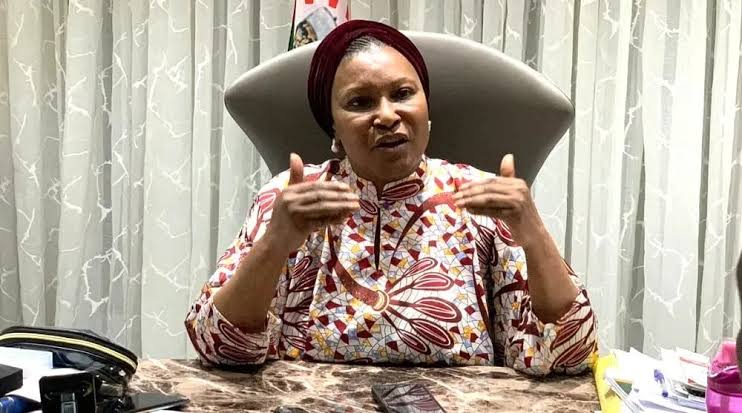
Ireti Kingibe, senator representing the Federal Capital Territory (FCT), has claimed Nigerians could face a 25 percent tax burden, warning the policy could worsen economic hardship ahead of the 2027 elections.
In a video circulating on social media, Kingibe criticised the government over electricity tariffs and taxation, urging Nigerians to demand political change.
“This is our country. We must claim it back. Nobody go do am for us o. Na we o, make I tell you, na we, as the country no sweet us, na we go change am,” she said in Pidgin English.

“How you expect people to manage? Electricity, you increase am; now tax wan increase to 25 percent of wey you earn, the one wey you get sef never do am.”
Kingibe also claimed that the national assembly had passed the relevant tax legislation, but that implementation had been delayed because of concerns about the 2027 elections.
Speaking to journalists on Monday, the senator maintained that the legislation was public and that it had not yet been implemented.
“The tax document, the one the government passed, is a public document; everybody can read it,” she said.
“You understand, it’s not like I disclosed a secret; it’s a public document. We have passed it; it’s true, it has not been implemented yet.”
She added that she believed the government might be reluctant to implement the policy before the general election.
However, a review of the Nigeria Tax Act 2025 shows that the law does not prescribe a flat 25 percent personal income tax for every Nigerian.
WHAT DOES THE TAX LAW SAY?
The Nigeria Tax Act 2025 introduced a progressive personal income tax structure, under which different portions of an individual’s taxable income attract different rates.
The Act provides for the following annual taxable income bands after applicable reliefs and exemptions:
First N800,000 — 0%
Next N2.2 million — 15%
Next N9 million — 18%

Next N13 million — 21%
Next N25 million — 23%
Above N50 million — 25%
The rates are set out in the Act’s Fourth Schedule, which specifies the applicable rates for individuals’ income tax.

This means the 25 percent rate applies only to the portion of an individual’s annual taxable income above N50 million, not automatically to the person’s entire earnings as Kingibe claimed.
For example, an individual with annual taxable income of N2 million would not pay 25 percent on that amount, because the first N800,000 is taxed at zero percent and the remaining N1.2 million falls within the 15 per cent band.
Similarly, someone earning more than N50 million in taxable income would not automatically pay 25 percent on every naira earned, because the lower portions of their taxable income remain subject to the rates prescribed for those bands.
The law also does not automatically impose a 25 percent tax on all money a person owns or holds in a bank account.
HAS IMPLEMENTATION BEEN DELAYED UNTIL AFTER 2027?
Kingibe’s claim that the tax law has not been implemented is also misleading.

The Nigeria Tax Act 2025 took effect on January 1, 2026, according to the federal ministry of finance’s transition guidelines.
The guidelines state that the new tax framework applies from the commencement dates specified in the respective laws — January 1, 2026.
In September 2026, the Joint Revenue Board also announced the release of personal income tax guidelines under the new tax laws.
These official dates contradict the suggestion that the law’s commencement was scheduled to begin only after the 2027 elections.
VERDICT
Kingibe’s description of the personal income tax provisions is misleading.
The law provides for progressive taxation, with rates ranging from zero percent to 25 percent, rather than a flat 25 percent tax on every Nigerian’s earnings.
Stay ahead with the latest updates!
Join The Podium Media on WhatsApp for real-time news alerts, breaking stories, and exclusive content delivered straight to your phone. Don’t miss a headline — subscribe now!
Chat with Us on WhatsApp