


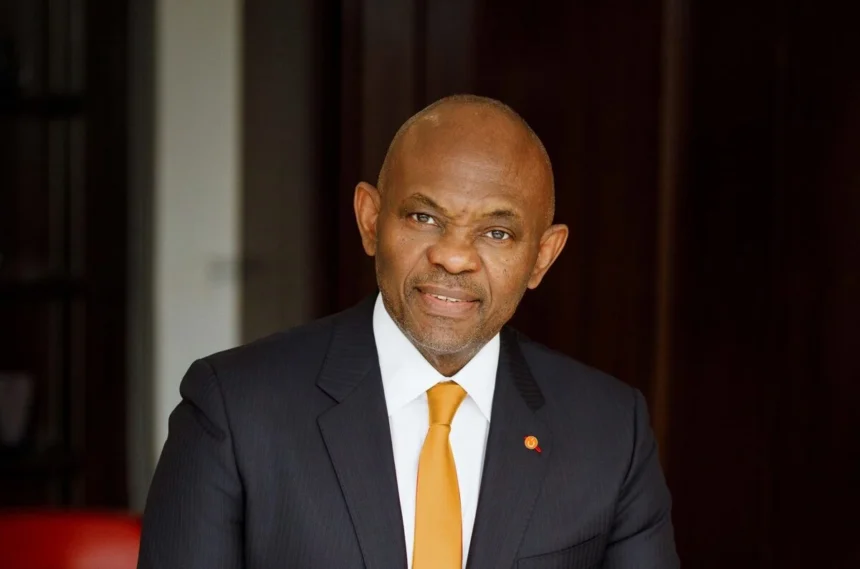
Nigerian billionaire and Chairman of Heirs Holdings, Tony Elumelu, has said Africa will no longer accept an economic relationship with Europe that limits the continent to supplying raw materials while industrial processing and value creation take place elsewhere.
Nigerian billionaire and Chairman of Heirs Holdings, Tony Elumelu, has said Africa will no longer accept an economic relationship with Europe that limits the continent to supplying raw materials while industrial processing and value creation take place elsewhere.
He made the remarks during his keynote address at the Castelfalfi Dialogues 2026, a Europe–Africa strategic forum held in Tuscany, Italy, on Monday, November 16.

He said Europe’s efforts to diversify its energy and mineral supplies must be accompanied by investments in African industries, particularly refining, manufacturing and electricity generation.
The businessman argued that Africa’s natural resources and Europe’s technological and financial capabilities should deliver greater economic benefits to the continent.
Elumelu rejects Europe’s extractive relationship
Speaking on energy, critical materials and supply chain resilience, Elumelu criticised the longstanding relationship in which Africa supplies raw materials while much of the industrial processing takes place elsewhere.
He maintained that Europe’s efforts to secure alternative energy and mineral supplies should create opportunities for industrial development within African countries.
- “We will not be Europe’s raw-material diversification strategy,” he declared.
- “Europe lost Russian gas and has seen disruption in the Gulf. I understand that. But the Europe–Africa relationship cannot continue to be one of extractive dependency, with Africa as the reliable supplier of raw materials and little or no value created on the African continent.”
Elumelu argued that Africa’s resource wealth should translate into manufacturing capacity, employment opportunities and greater participation in industrial value chains.
He identified the Democratic Republic of Congo as an example of the imbalance in the critical minerals industry.
According to him, the country produces approximately 70% of the world’s cobalt but captures limited value because much of the refining takes place elsewhere.
He urged European investors seeking reliable supplies of battery materials to establish processing facilities in Africa.
Elumelu also called for meaningful African equity participation in such investments rather than arrangements focused solely on exporting unprocessed minerals.
Elumelu urges investment in African gas
Elumelu identified natural gas as an immediate opportunity for Europe and Africa to develop a different investment relationship.
He noted that Nigeria has approximately 200 trillion cubic feet of proven gas reserves, which could support industrial activities beyond liquefied natural gas exports.
- He urged European companies to invest in fertiliser production, petrochemicals and gas-powered industrial parks instead of concentrating on purchasing Nigerian gas.
- Elumelu cited Heirs Energies, which supplies gas to Nigerian power plants and factories, as an example of how domestic resources can support industrial development.
He also identified unreliable electricity supply as a major obstacle to African industrialisation.
According to him, Transcorp has approximately 2,000 megawatts of installed electricity generation capacity, while about 650 million Africans remain without access to electricity.

- “No one builds a smelter or a data centre where the grid fails,” he said.
Elumelu maintained that improving electricity supply is essential for attracting industrial investments that require reliable power.
His remarks linked Europe’s demand for secure energy and mineral supplies to the need for greater investment in Africa’s production and processing capacity.
Dangote refinery boosts exports to Europe
Elumelu pointed to Aliko Dangote’s refinery in Lagos as evidence that African countries can establish large-scale industrial processing facilities rather than depend on exporting unprocessed resources.
- He said the refinery had enabled Nigeria to export refined petroleum products to Europe, reversing its traditional reliance on imported fuel.
- In August 2026, Nairametrics reported that Nigeria’s refined petroleum exports to Europe surged by 767%, from 15,000 barrels per day in 2023 to 130,000 barrels per day in the second quarter of 2026. Another report showed that Nigeria’s refined petroleum exports increased by 148% year-on-year to $3.94 billion in the second quarter of 2026.
- In November 2025, [Nairametrics reported that the NNPC/Heirs Energies joint venture increased gas output from OML 17]( to a peak of 135 million standard cubic feet per day.
Heirs Energies subsequently secured a $750 million financing agreement with Afreximbank in December 2025 to support the development and expansion of its oil and gas operations. The increase in domestic gas supply from OML 17 helped TransAfam Power raise electricity generation from approximately 50 megawatts to more than 180 megawatts.

Stay ahead with the latest updates!
Join The Podium Media on WhatsApp for real-time news alerts, breaking stories, and exclusive content delivered straight to your phone. Don’t miss a headline — subscribe now!
Chat with Us on WhatsApp