


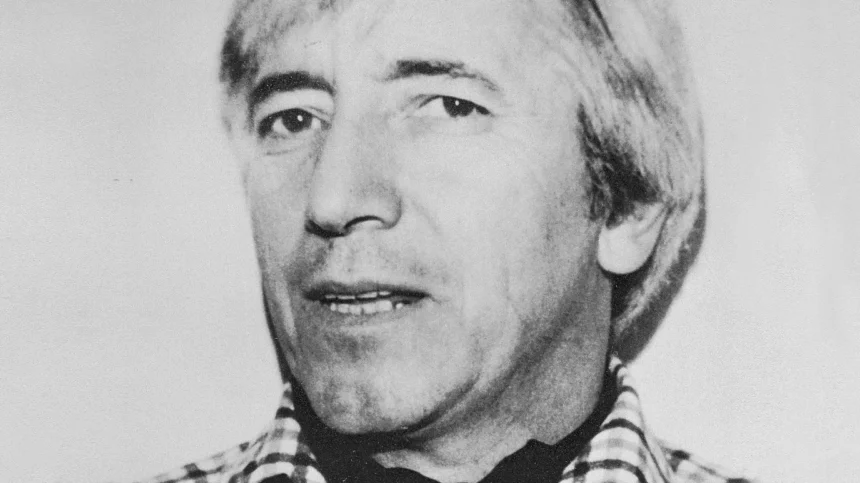
In London, 1978, Georgi Markov was stabbed with an umbrella, in what is suspected to have been a political poisoning by the KGB. He died four days later. The following year, Markov’s widow and elder brother told the BBC’s Panorama that they were warned about the murder plot just months before – by an anonymous man.
“He’d felt a jab in his thigh. And he’d looked round, and there’d been a man behind him who’d apologised and dropped an umbrella.” These are the words of Annabel Markov, talking about her husband Georgi Markov, a Bulgarian dissident, journalist and writer.
On 7 September 1978, 49-year-old Markov was waiting at a bus stop on Waterloo Bridge in central London when he was stabbed with an umbrella. Four days later he died in hospital, with doctors initially diagnosing blood poisoning. Yet detectives soon realised it had been a political murder, one that had used a highly sophisticated technique that also targeted another Bulgarian exile.

Markov’s widow and elder brother told the BBC’s Panorama in 1979 how an anonymous man warned them that Markov was going to be poisoned, months before his death.
And interviews with the former head of a KGB assassination squad and a former colonel in the Bulgarian secret service, both then talking publicly for the first time, placed the assassination at the highest levels of the Bulgarian and Soviet governments.
In the days following Markov’s death, Britain’s anti-terrorist squad found a clue that convinced them that he had been the victim of a unique murder plot. “At Scotland Yard’s forensic laboratory, the chief scientific officer examined a minute metal object that had been found in Markov’s thigh,” said Panorama reporter Michael Cockerell.
“Under the microscope, it was clear that the object was an extraordinarily sophisticated pellet, no bigger than a pinhead. It had four tiny holes passing through that the forensic experts were convinced had contained an infinitesimally tiny amount of a lethally toxic poison.”
The decision had been taken at the highest political level in Bulgaria to kill him
Scientists at Porton Down, the top-secret British chemical and microbiological warfare research establishment, believed that what had killed Markov was the highly lethal toxin ricin.
According to Panorama, it had never before been used for murder in Britain.
It emerged that another Bulgarian exile might have been attacked in a similar way 10 days before Markov was stabbed. Vladimir Kostov had felt a sharp pain in his back as he was leaving the Paris Metro with his wife. He had a high fever for three days but recovered.
After hearing of Markov’s death, Kostov had his back X-rayed, which revealed a tiny metal object. At a clinic in Paris, a surgeon operated on him under the eye of a French police officer wearing a surgical mask and gown.
“The surgeon had to be extremely careful. He removed the metal pellet without touching it at all,” Kostov told the BBC. It was then given to a Scotland Yard inspector and taken to England for analysis.
Using a high-powered scanning electron microscope, Scotland Yard metallurgists analysed the pellet removed from Kostov’s back, finding that it was identical to the one found in Markov.
“Both pellets weighed exactly the same,” said Cockerell. “The holes were in the same places, and both were made of a rare platinum iridium alloy that the human body does not reject.”
Toxicologists at Porton Down found ricin antibodies in Kostov’s flesh and concluded he’d survived because there hadn’t been enough poison in the pellet.
The sophisticated technique used – and evidence of coordinated attacks – convinced Scotland Yard that a state secret service organisation had played a role in Markov’s death.

A novelist and playwright previously acclaimed in his native country, moving within the government elite there, Markov had defected from then-communist Bulgaria in 1969. After settling in the UK, he’d become an outspoken opponent of the Bulgarian government, working for the BBC’s World Service as well as Radio Free Europe (RFE), a US state-funded media organisation.
Annabel Markov said that they had received warnings of a plot to kill her husband, telling the BBC that a man had contacted Georgi in May 1978.
“They spoke Bulgarian all evening. Every so often Georgi would turn to me and say in English, ‘this is extraordinary what this man’s saying’.”
According to Annabel, the anonymous man said that the decision had been taken at the highest political level in Bulgaria to kill him, because of the outspoken broadcasts Georgi was writing for RFE.

Markov’s brother Nikolai backed this up, revealing that he had received a call in September 1977. “A man phoned me saying the decision has been taken to kill Georgi, to eliminate him without trace,” he told the BBC.
“At first, I didn’t believe it. It seemed absurd, impossible. But the man gave me quite specific details about which there could be no doubt. He told me Georgi would definitely be poisoned at the first opportunity… that a sort of poison or some sort of bacteria, he didn’t know exactly which, had already been brought out to Western Europe.”
‘An outspoken opponent’
After moving to the UK, Markov remained a celebrity at home through his talks on RFE, broadcasting weekly programmes about what life was really like at the upper echelons of Bulgarian society. One of his broadcasts was called Life Behind the Curtains, referring to the little curtains on the side and back of every official black Mercedes. He presented a gossipy but damning picture of the misuse of absolute power in the country, with stories about nepotism, financial abuse and corruption.
While the Bulgarian government officially denied that Markov’s broadcasts had any influence, the BBC found that the Bulgarian president, Todor Zhivkov, took particularly strong exception to a revealing series of Markov’s talks called My Meetings with Todor Zhivkov.
“We have heard that he was quite furious about Markov’s talks concerning the meetings with him,” said a Bulgarian broadcaster for RFE, Kyril Panov. “[Markov] was talking about things which are, so to speak, taboo in Bulgaria, things which the regime prefers not to talk about and that the public should not know.”

In History
In History is a series which uses the BBC’s unique audio and video archive to explore historical events that still resonate today. Sign up to the accompanying weekly newsletter.
Zhivkov had ruled Bulgaria since 1956 – and had very close ties to the Soviet Union, describing the relationship between the two countries as like two lungs in the same body, fed by the same bloodstream.
Experts believed that the Soviets must have been involved in Markov’s murder.
Stefan Sverdlov, a colonel in the Bulgarian secret police until he defected in 1971, told the BBC in 1979: “Every department of the Darzhavna Sigurnost [Bulgarian secret service] is controlled by an advisor from the Russian KGB, sometimes known as an uncle, who reports directly to Moscow… It’s inconceivable that this could have been done without the Russians knowing about it.”
And according to the former head of an assassination squad for the KGB, the method pointed to Soviet involvement. “The technique is… almost ridiculously sophisticated,” said Nikolai Khokhlov. “That tells me that the officers who were planning that operation tried to please someone on the highest level.” The fatal attack on Markov was carried out on Zhivkov’s birthday.
After the fall of the Soviet Union, it emerged that the KGB had developed an umbrella that could inject ricin pellets into a victim. And two former KGB officers who defected later said their organisation assisted in the murder, although it was carried out by an Italian criminal codenamed Piccadilly.
No one has ever been charged for Markov’s assassination. Bulgaria closed the case in 2013, due to a lack of suspects, but it remains an open inquiry in the UK.
It would have benefited the Soviets in more than one way, as former KGB officer Khokhlov told the BBC in 1979 – beyond the physical death, it would have had a great psychological impact on dissenters abroad. “The fear that they’re not protected by distance, they’re not protected by the security systems of the West”, he said.
He continued: “The action is like coming behind someone and whispering in his ear, ‘We can get you any time we want. We can kill you.’”
Source: BBC
Stay ahead with the latest updates!
Join The Podium Media on WhatsApp for real-time news alerts, breaking stories, and exclusive content delivered straight to your phone. Don’t miss a headline — subscribe now!
Chat with Us on WhatsApp