
Nigerians expect the presidential candidates to come up with governance frameworks that would checkmate the unabashed looting of the country’s oil resources.
Campaigns for the 2027 general elections have started. A total of 18 political parties are jostling for the most coveted office – the president of Nigeria. In functional democracies, existential challenges shape the debates and town hall meetings, going into these elections. And the soapbox usually quakes as candidates justify why they should be voted for.
Here instead, muckraking and brickbats take the centre stage. Still, incredibly, some candidates shun the debates, as if they do not owe electorates any information about or scrutiny of their purposes in seeking public office.
As the 2027 campaigns gain traction, it is not in doubt that insecurity remains the country’s greatest crisis point. This is closely followed by a high cost-of-living, the sustained looting of the public treasury, absence of quality healthcare and education, good road networks, and adequate electricity supply. These are all very disturbing national deficiencies. The candidates may have listed them as what they would tackle in their manifestos, but the missing link is usually the action plan on how to resolve the concerns. This is where debates become very crucial.

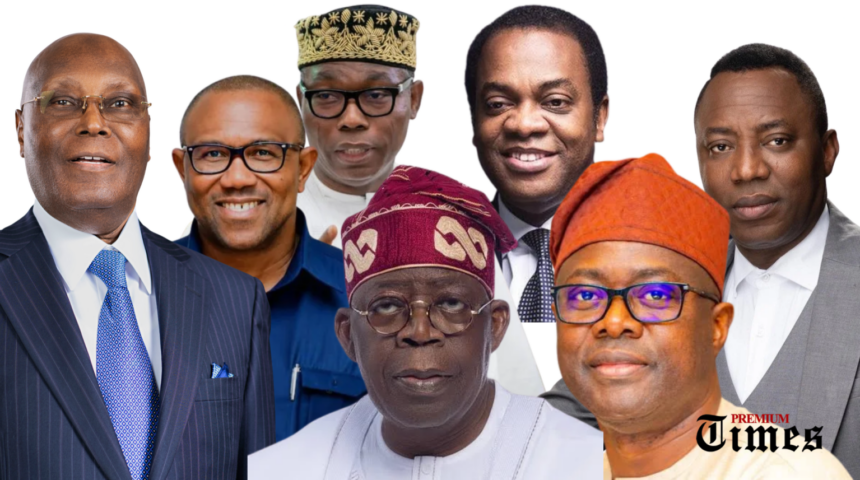
As such, Nigerians eagerly await the presidential candidates – Bola Ahmed Tinubu of the All Progressives Congress (APC), Atiku Abubakar of the African Democratic Congress (ADC), Peter Obi of Nigeria Democratic Congress (NDC), Seyi Makinde of the Allied Peoples Movement (APM) candidate, Omoyele Sowore of African Action Congress (AAC), Donald Duke of Peoples Redemption Party (PRP) and Adebowale Adebayo of the Social Democratic Party (SDP) – for their campaign responses to these burning national issues.
Atiku has set the ball rolling with his promise to restore fuel subsidy if elected. This is a volte-face from his position on the policy in 2023, as he now cites the negative impact of subsidy removal on the cost-of-living in the country. But Tinubu views the retrogression as Atiku’s “demonstration of serious ignorance of the economy and governance.”
Since then, it has become more than just a debate between the two candidates, but an incisive national conversation, animating the different divides on the issue, as other presidential candidates have equally become embroiled in it. A total of the ₦15 trillion saved as a result of subsidy removal between June 2023 and December 2025 appears not have impacted the lives of citizens positively, despite the huge monthly accurals to all the levels of government.
Tinubu had abolished that fiscal tool in his off-the-cuff “fuel subsidy is gone” declaration, during his inauguration in 2023. It earned him plaudits from economists and the Bretton Woods Institutions, who argued that the scheme was not sustainable. Yes, it was not, with the massive heist it was associated with.
Undeniably, the spiralling inflation attendant upon market-driven fuel pricing, combined with the deregulation of the forex market, has made life largely unbearable for most Nigerians. This is evident in the surging costs of food items, transportation, medicare, house rents and social services.
Government seems to have finally got the message – at least in its preliminary campaign messaging – that the economy is now a key issue, despite the seemingly laudable GDP growth figure of 4.43 per cent in the second quarter of 2026. Hence, it announced a reductrion in transport fares from 1st October. Some CNG buses have also been rolled out, as cheaper public transport options, while a 30-day price cut in the pump price of fuel at NNPCL filling stations has been announced. The cap is now at ₦1,350 per litre at NNPCL filling stations across the country.
Ironically, three weeks into this scheme, all the designated stations have been selling petrol above the capped price. Rather unfortunately, instead of better economic engineering, all that is being witnessed is a change in nomenclature, with “discount” as the new terminology for price reduction, as pushback against the continuously questioned terms of “under-recovery” and “import differential” of old. Yet, explanations are being demanded by citizens on who really bears the cost of this new discount, whether it is a ruse that would be charged back somehow along the line when elections are over, and truly what happens at the end of this strange relief window.
However, with the surge in economic hardship, it is left to be seen, for how long Nigerians, especially the 63 per cent living below the poverty line, would be left to the vagaries of the market. Fuel sells between ₦1,380 and ₦1,500 across the country. The fear is that it could go much higher.
The official view that fuel subsidy is not sustainable due to the fraud inherent in it is becoming a lame logic, with the government’s apparent indifference to recovering the looted funds from the indicted fuel importers and oil marketers. These subsidy thieves are well-known. The paper trails are with NNPCL over the dubious payments made back in the day.
A House of Representatives ad hoc committee chaired by Farouk Lawan, and a presidential panel with Aigboje Aig-Imoukhuede as chairman, investigated the subsidy scam in 2012 and uncovered more than ₦1.7 trillion stolen from the country. Surprisingly, 21 oil firms and marketers involved failed to appear before the two panels and nothing has happened to them to date.
More curiously, the immediate Group Managing Director (GMD) of NNPC, Melee Kyari, has since July refused to appear before the Senate Public Accounts Committee to explain a ₦210 trillion expenditure, covering 2017 to 2023, which has been queried by the Auditor-General of the Federation.
Responsible political leadership and accountability matter here. Nigerians expect the presidential candidates to come up with governance frameworks that would checkmate the unabashed looting of the country’s oil resources.
Electoral campaigns are critical in democratic transitions. In the US, for instance, pressing national issues decide the outcome of its elections. The economy, immigration and abortion rights shaped the 2024 presidential campaign. And, the story should not be different here.

One issue that beggars belief is the $1.8 billion the government plans to inject into the turnaround maintenance of Nigeria’s four refineries after it had already sunk $18 billion into them in the past two decades, without any result. This is certainly a monumental loss.
Nigerians grope in the dark year-in-year-out. Industries are unable to reach their optimal operational capacity as the national electricity output vacillates between 3,000 and 5,000 megawatts. In 2025, industries spent ₦1.34 trillion on alternative power supply; and 24 companies alone spent ₦400.8 billion on gas and alternative power supply in the first quarter of 2026.
Successive governments since 1999 have failed woefully to deliver on power. Small and Medium Scale Enterprises, which should have provided jobs for thousands of unemployed youths are mainly comatose, thus fueling the involvement of this crucial demographic in criminal activities. Only short-sighted presidential candidates will ignore the need to address such a critical issue.
Kidnapping, banditry and insurgency are all youth pre-occupations, which have reached pandemic levels, turning Plateau, Benue and Zamfara states into grave yards of sorts. Consequently, a security policy shift with strategies that will reverse our two decades of tragedies is urgent. But it should not be anchored on promises, without pragmatic steps that would midwife results.

Stay ahead with the latest updates!
Join The Podium Media on WhatsApp for real-time news alerts, breaking stories, and exclusive content delivered straight to your phone. Don’t miss a headline — subscribe now!
Chat with Us on WhatsApp