



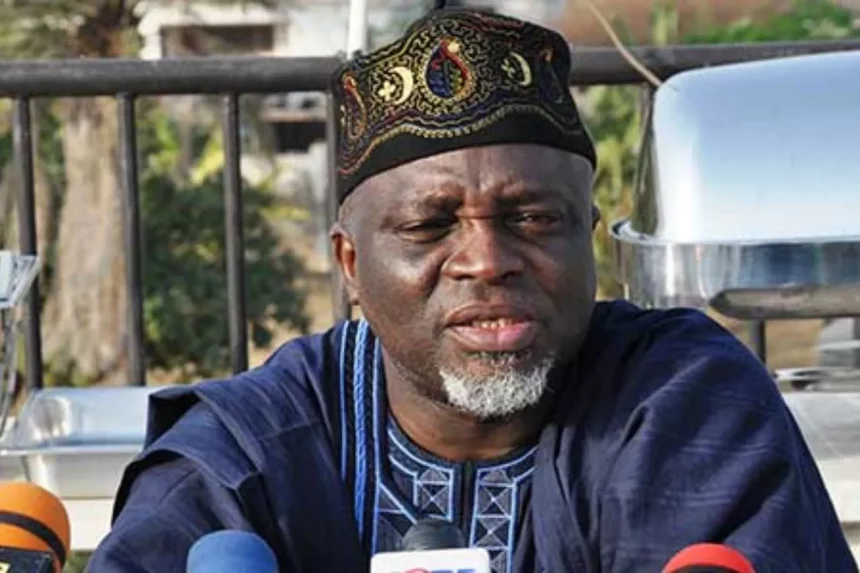
President Muhammadu Buhari appointed Mr Oloyede in August 2016, and his early actions showed his desire to deliver.
Nigerians rarely offer valediction to public servants when they leave office. But Professor Ishaq Oloyede, who until 31st July was the Registrar of the Joint Admission and Matriculation Board (JAMB), has been receiving it in torrents for his transformative stewardship. Undoubtedly, it would remain a touchstone for long. Professor Segun Aina has stepped in.
President Muhammadu Buhari appointed Mr Oloyede in August 2016, and his early actions showed his desire to deliver. Till the very end, he did just that through radical reforms, innovations, accountability and integrity in his management of JAMB, thus extricating the organisation from the mire that his predecessors had plunged it into.
His first clean break with the examination body’s notorious past was in the 2017 remittance of a whopping ₦7.86 billion to the Consolidated Revenue Fund (CRF) of the Federation as revenue surplus. The nation was pleasantly surprised, due to the fact that annual remittance to government coffers before then averaged a paltry ₦3 million.

The new fiscal pattern was so steady that by 2022, JAMB had remitted ₦50 billion to the national treasury in an aggregated six-year revenue surplus. This was against the background of the ₦52 million that his predecessors, altogether, delivered in 40 years of the agency’s existence.
Remarkably, this unprecedented revenue haul came amid Mr Oloyede’s slash of ₦1,500 from the ₦5,000 that candidates used to pay for the Unified Tertiary Matriculation Examination (UTME) forms, to their parents’ relief.
These sharp contrasts in JAMB’s fiscal performance so stirred President Buhari’s curiosity at a Federal Executive Council (FEC) meeting, when the matter was discussed, that he directed the Economic and Financial Crimes Commission (EFCC) and its sister agency, the ICPC, to probe Mr Oloyede’s predecessors. The outcome of their investigation has been the subject of 18 charges against his predecessor in court since 2021. Sadly, it has been stuck in the prosecutorial ambivalence of “trial today” and “out-of-court-settlement tomorrow,” entangling Professor Dibu Ojerinde, who served before Mr Oloyede.

But Mr Oloyede’s brief wasn’t revenue making. His awareness of this fact was evident in the various innovations he brought to bear on the conduct of the UTMEs, which restored its integrity and public acclamation. The use of Computer Based Test had experimentally been introduced in 2013.
However, Mr Oloyede consolidated it, effectively ending the paper-to-pencil examination system, with its inefficiency and fraud-related practices. The beauty of the CBT system is in its variedness of questions; hence, candidates sitting next to one another have no clue about each other’s questions or multiple-choice answer options.
Although some candidates tried to outsmart the system and perpetuate the scourge of cheating, Mr Oloyede’s leadership was ahead of them with the deployment of Closed-Circuit Television (CCTV) cameras within and outside examination halls. As a result, 123 cheats were nabbed in the April 2019 UTME, for instance, and they were quickly prosecuted.
Besides, JAMB delisted 76 CBT centres in Bauchi State, which recorded the highest number of 48 culprits during that examination. Lagos and Sokoto had five each. In all, 23 states were caught in this web of infamy. Abia, Bayelsa, Kaduna, Ekiti, Delta, Gombe, Borno, Oyo, Rivers, Plateau, Enugu, Edo, Ebonyi, Adamawa and the Federal Capital Territory were in this infamous roll call.
Oblivious to many, Nigeria has the Examination Malpractices Act of 1999, which had not been utilised properly prior to Mr Oloyede’s coming. He activated its provisions by ensuring that those caught cheating in UTME were prosecuted. The Act prescribes four years in prison for candidates, invigilators, schools, principals and employees of examination bodies who aid the illegality of subverting exam conduct.
As candidates became more desperate to secure admission into tertiary institutions, the “miracle centres” for malpractices thrived, but Mr Oloyede was able to tighten the noose around them with the introduction of a biometric fingerprint verification process. However, 244 WhatsApp cheating platforms were still discovered during the 2025 UTME.
Equally challenging for him was the misconduct of university vice-chancellors in the illegal admission of students. The Central Admissions Processing System (CAPS), introduced in response, at least, established the distinction between genuine and illegal admissions. It functioned so effectively in its liaison with the National Youth Service Corps (NYSC) scheme for the mobilisation of graduates whose admissions had gone through JAMB’s admission portal.
This was the genesis of the over 4,000 graduates recorded annually that vice-chancellors beg the Minister of Education to regularise their admissions, so that they can participate in the NYSC scheme. The CAPS also mitigates the racketeering of non-graduates seen in NYSC camps with fake call-up letters, seeking to collect allowances they are not entitled to.
Besides the heavy funding of JAMB’s capital projects, Mr Oloyede left behind a welfare legacy of ₦8 billion in pension funds for the Board’s workers, just a month before his departure, to ease the access of retirees to their benefits. This is highly commendable!
Yet, Mr Ololeye’s tenure was not all rosy. In 2025, he was in the eye of a storm due to the mass failure of UTME candidates because of technical glitches in the administration of the exam. Statistics showed that there were 1.5 million candidates who scored below 200 marks out of a maximum 400 marks, representing 78 per cent of the 1.9 million candidates who sat the examination. Again, those who scored 320+ totalled 4,756, or 0.24 per cent of the entire candidates. Lagos and Owerri zones were the worst hit.

It did not end on this disturbing note, as JAMB made amends in the re-sitting of the exam by 379,997 candidates, following the forensic audit report of a team of technical experts on the issue. The body, Educare, which was in charge of the situation, stated that: “The Lagos and South-East servers continued operating on outdated logic that could not interpret the newly shuffled question and answer structure.” Mr Oloyede, in owning up, apologised to Nigerians, especially to the candidates for the trauma that the flop caused them. This was an instance of exemplary leadership.
The case of the ₦36 million, which a JAMB employee, Philomina Chieshe, claimed a snake had swallowed at its Benue office from scratch cards sales, was not properly resolved, in our view, as the suspect was never ultimately made to appear before the law. This absurdity, however, preceded Mr Oloyede’s appointment.
In all, Mr Oloyede’s record at JAMB reminds us of Professor Dora Akunyili’s tenure at the National Agency for Food and Drug Administration and Control (NAFDAC); and it brought into bold relief, once more, the need for building strong institutions, for the country’s development.
Stay ahead with the latest updates!
Join The Podium Media on WhatsApp for real-time news alerts, breaking stories, and exclusive content delivered straight to your phone. Don’t miss a headline — subscribe now!
Chat with Us on WhatsApp