


When Lagos introduced mass housing under former Governor Lateef Jakande in the ’80s, civil servants, factory workers and low-income earners could buy homes through instalment payments that stretched over 30 years.
Four decades later, findings by DevReporting show that many of Lagos’ ‘low-cost’ homes now cost between ₦5 million and ₦25 million, with repayment conditions that exclude 70 per cent of the city’s working population, who earn below ₦100,000. Only 7 per cent (1,400,000) of Lagos residents earn above ₦200,000.
An analysis of government procurement records from 2020-2025, housing prices, mortgage requirements, labour income data
and interviews with allocatees, reveal that a three-bedroom flat under the Lagos Home Ownership Mortgage Scheme requires monthly earnings above ₦343,000 to qualify.

Between 2024 and 2025 alone, Lagos awarded at least ₦2.69 billion in housing-related contracts covering estates in Igando, Egan and Badagry. Yet the schemes met only a fraction of the city’s annual housing needs while targeting income groups far above those of the urban poor.
For residents like Tajudeen Fajobi, the shift is not just statistical but personal. He received allocation for a three-bedroom flat at Abesan Estate under Jakande’s programme in the ‘80s, when a 15-year instalment plan totalled ₦9,700. At the time, he was a SCOA Motors worker earning less than ₦250 monthly, yet the scheme was structured in a way that made ownership possible over time.
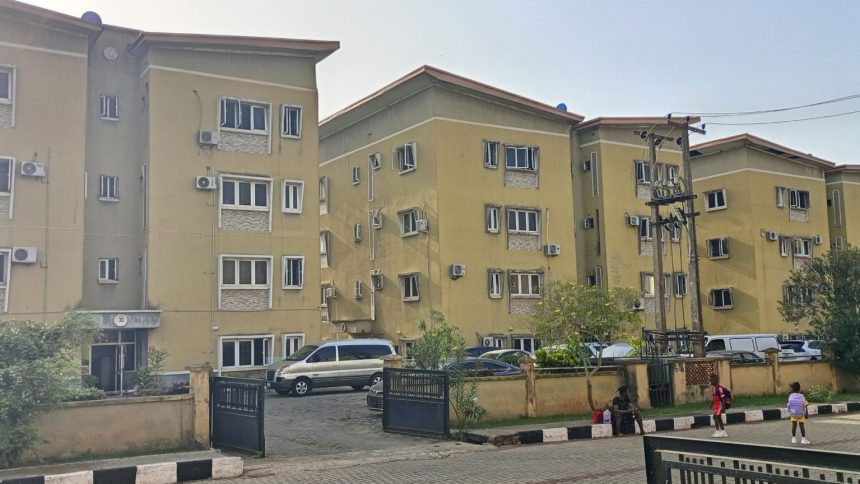
TODAY, those who benefited from the homeownership scheme sell the same flat for between ₦17 million and ₦30 million. What was designed as “low-cost” housing for low-income earners has, over time, become middle-class real estate in Abesan, one of Lagos’ oldest public housing estates.
“These houses are no longer for the poor,” says Mr Fajobi, now Community Development Council (CDC) chairman of Mosan Okunola Local Council Development Area (LCDA), as he surveys the gentrified Abesan neighbourhood where annual rents are as high as ₦1.8 million.
The Affordability Math: Who can pay ₦103,000 monthly?
At Lateef Kayode Jakande (LKJ) Gardens in Igando, a 492-unit estate commissioned in recent years, three-bedroom flats sell for ₦10 million through the Lagos Home Ownership Mortgage Scheme (LagosHOMS). The rent-to-own arrangement requires a 5 per cent down payment (₦500,000 plus ₦250,000 in fees) and monthly deductions of ₦103,000 for 10 years at 6 per cent simple interest.
Tajudeen Adebanjo, a journalist and resident of LKJ Gardens, considers it affordable. “Where will you get that in Lagos State? When house rent is ₦2-2.5 million annually?” he asks.
FOR middle-class professionals like Mr Adebanjo earning in the range of ₦350,000-400,000 monthly, the math works. Standard mortgage lending recommends allocating no more than 30 per cent of income to housing, meaning that ₦103,000 in monthly payments requires a minimum income of ₦343,000.
But Lagos Bureau of Statistics and labour market studies indicate approximately 70 per cent of the city’s workforce operates in the informal sector. They are market traders, artisans, commercial drivers, and food sellers, with median monthly earnings between ₦50,000 and ₦120,000.
For a trader earning ₦100,000 monthly, the ₦103,000 payment consumes 103 per cent of income, which is mathematically impossible. For the minimum-wage earner earning ₦70,000, it exceeds their entire salary by 47 per cent.
Mr Adebanjo, secretary of his estate association, confirms the income mismatch: “Let me say that we do not have up to 5 per cent among the residents who are workers with the state government.”
This matters because civil servants receive a 40 per cent rebate, bringing a ₦10 million flat to ₦6 million. Yet even with this discount, government workers represent fewer than one in twenty residents at LKJ Gardens. The estate houses private sector professionals, business owners, and diaspora Nigerians who can afford ₦103,000 monthly or ₦10 million upfront.
Documentation Barrier: Six months of bank statements
Beyond price, the application process itself excludes informal workers. Lagos HOMS requires six months of bank statements showing regular deposits, payslips proving formal employment, LASSRA card (Lagos residency proof), Guarantor letter from the employer or government official, and ₦20,000 application form fee (up from ₦10,000 two years ago).
“The things required are things you can easily lay your hands on, not things that are stressful,” Mr Adebanjo insisted.
But for informal workers who dominate Lagos’ labour market, these documents are precisely what they lack. Market traders banking irregularly have no six-month statements. Artisans paid in cash have no payslips. Day labourers have no employers to provide guarantor letters.

THE Commissioner for Housing, Lagos State, Moruf Akinderu-Fatai, defended the verification process: “We will not expect you to use all your money to pay for housing. If 33.3 per cent of your income does not cover the payment, that means you are not eligible or ready.”
The 33.3 per cent threshold prevents over-leveraged borrowers from defaulting, a policy that inadvertently ensures only middle-class applicants qualify. An informal trader earning ₦100,000 monthly can afford ₦33,000 in housing payments under this rule, supporting a maximum loan of ₦3 million, which is insufficient for even the ₦5 million one-bedroom unit.
“At times, we advise you can combine with your wife as a family. By the time you combine, you are most likely going to be ready,” the commissioner suggests.
The combined-income option helps lower-middle-class couples. It does not help single mothers selling fish at markets, earning ₦60,000 monthly while raising children alone.

Even civil servants priced out
For Adewale Kasumu (not real name), a Grade Level 12 officer at the State Auditor General’s Office, Lagos’ low-cost housing scheme remains out of reach despite his awareness of it.
“I don’t think it’s affordable,” he said.
Living in Badagry, he spends about three hours commuting to work each day, waking by 5 a.m. to catch the staff bus and avoid traffic. Moving closer to his office would greatly improve his life, but housing prices discourage him from applying.
According to him, information available puts the cost of houses between ₦25 million and ₦35 million, far beyond what he can afford on his salary, even with the civil servant rebate.
Although he has the required documents and knows colleagues who secured allocations, he said most of them are directors.
“I still hope to one day own a home in Lagos,” he said.
Mr Kasumu’s situation illustrates the gap between policy and reality: civil servants receive 40 per cent rebate, bringing a ₦10 million flat to ₦6 million, yet even this remains unaffordable for mid-level officers. Higher-priced units in estates like Fashola (₦35 million) make homeownership even further out of reach.
Then vs. Now: The 84 per cent affordability decline
The gap between government housing and genuine affordability has widened dramatically since Jakande’s era.
In the 1980s, a ₦9,700 three-bedroom flat represented 77.6 months of the ₦125 minimum wage. Today’s ₦10 million flat represents 142.8 months of the ₦70,000 minimum wage, an 84 per cent decline in affordability.

The affordability collapse is compounded by currency devaluation. According to Federal Reserve Economic Data (FRED), the naira traded at an average of 55 kobo to a dollar in 1980 and ₦4.02 in 1987. Today, the Central Bank of Nigeria’s official rate stands at ₦1,373.87 per dollar, a depreciation of over 2,400 per cent. While wages have risen nominally, housing prices have far outpaced both wage growth and currency devaluation.
AN electrician who received an original allocation at Abesan Estate, Bayo Alowoeshin, recalls the difference: “The government did not stress anybody. We decided how much to pay monthly over 30 years. The quicker you paid, the cheaper it was.
Allocatees paying upfront (₦9,700) incurred no interest. Those stretching payments over 30 years paid ₦50,000 total due to accumulated interest. Mr Alowoeshin completed his payment in 2016.
The flexibility made the difference. Mr Fajobi cobbled together financing through loans, his wife’s salary from the Niger Biscuit Company, and contribution schemes to secure his allocation.
“I had to take a loan, got money from my wife. We made contributions to raise money,” he recalls. His salary at SCOA Motors never exceeded ₦250 monthly until retirement.
Jakande delivered shells: basic structure, two doors, external plaster, nothing more. Allocatees finished interiors incrementally, living in partially completed homes while spreading costs over years.
“There was no toilet, though there was sewage, but we were not connected,” Fajobi narrated the situation when he moved in in 1987. He said residents installed windows, plastered interiors, and built bathrooms as funds allowed.
Today’s ₦10 million units come fully finished: tiles, fitted kitchens, wardrobes, modern amenities.
A review of LagosHOMS pricing data across multiple schemes tells a broader story about who these homes are built for. Across projects in Igando, Ikorodu, Sangotedo and Badagry, one-bedroom units range between ₦3 million and ₦5 million, two-bedroom flats between ₦5 million and ₦10 million, and three-bedroom units reach up to ₦25 million. Monthly repayments typically range from about ₦30,000 to over ₦200,000.
APPLYING standard affordability thresholds, even the lower end of this pricing spectrum remains beyond the reach of many informal workers
The production gap
Government procurement records reviewed for this investigation, spanning contracts from 2020 through November 2025, show Lagos State awarded ₦2.69 billion between 2024 and 2025 alone for housing schemes at Ajara-Badagry, LKJ Gardens Igando, and Egan-Igando Mixed Housing Estate.
The spending includes ₦1.96 billion on construction contracts, ₦591 million on infrastructure covering water supply, drainage and roads, ₦167 million on solar street lighting, and ₦107 million on security installations and landscaping.
AT ₦10 million per three-bedroom unit, ₦2.69 billion theoretically delivers 269 homes. Against Lagos’ estimated annual housing deficit growth of 200,000 units, this represents 0.13per cent of need.
Over 25 years (1999-2024), the Ministry of Housing delivered approximately 10,000 units across 52 schemes. These average 400 units annually. The current administration accelerated production to 1,667 units yearly (10,000 units over six years), a significant improvement.
Yet even at this enhanced rate, the government addresses 0.83per cent of annual deficit growth. At current production levels, closing Lagos’ 3-5 million units deficit would require 1,800-7,500 years.
“You naturally have a lot of challenges when demand far outstrips supply. We are conscious that we need to do more, far more. We keep looking for solutions every day in terms of how we build cheaply, how we get cheap materials,” Mr Akinderu-Fatai acknowledged.
Inside Egan-Igando: Same model, same exclusion
Five minutes’ drive from LKJ Gardens, the Egan-Igando Mixed Housing Estate, comprising 270 two-bedroom units, 174 three-bedroom units, and additional one-bedroom flats, represents one of Lagos’ latest housing deliveries.
UNLIKE LKJ Gardens, where each block contains mixed unit types, Egan-Igando segregates apartments into separate blocks by bedroom count. Construction continues even as early allocatees occupy completed two-bedroom units; three-bedroom blocks remain under construction.
Inside a two-bedroom flat, the finishing mirrors LKJ Gardens: tiled floors, fitted kitchen, two ceiling fans in the living room, and optional wardrobes.
However, an allocation letter reviewed for this investigation shows that a two-bedroom unit is priced at ₦12.5 million, significantly higher than the ₦10 million benchmark at LKJ Gardens. Prices for the one-bedroom and three-bedroom units are yet to be officially fixed. Rent-to-own terms and documentation requirements remain unchanged.
Using the same LagosHOMS structure, the ₦12.5 million price implies monthly repayments of about ₦129,000, requiring an estimated ₦430,000 monthly income under standard affordability guidelines.
THIS pushes the entry threshold even further beyond the reach of most Lagos residents. For workers earning ₦100,000 monthly, repayment would consume 129 per cent of income. For minimum wage earners, it rises to 184 per cent.
“These houses are for Lagos residents, not just for government workers,” the Commissioner emphasises when asked about accessibility. However, the emphasis misses the point. It reinforces an economic barrier: ₦12.5 million housing excludes low-income Lagosians regardless of the employment sector.
Why are costs high?
A retired civil servant familiar with Lagos lands and housing, speaking on condition of anonymity, outlined five factors driving “low-cost” housing beyond genuine affordability.
First, he says recent government houses are built for medium, upper-medium, and high-income earners, contrasting current estates’ modern amenities with Jakande’s basic shells. Second, the cost of construction is economically high due to political reasons and the high cost of building materials. Procurement records support this, showing contracts frequently requiring 17-30per cent “variation orders” (additional payments beyond original bids), suggesting either poor planning or contractor bid manipulation.
Third, the lack and cost of redeeming mortgage loans, principal and interest, are beyond low-income earners’ reach. At 6 per cent interest over 10 years, a ₦10 million loan costs ₦12.36 million total. The 30-year, interest-free terms that made Jakande estates accessible no longer exist.
Fourth, the government’s focus is more on revenue generated from houses than on social benefits to the public. When pressed on this claim, the commissioner noted that the government sells at below-market rates (₦10 million vs. ₦15 million market value), suggesting a genuine subsidy rather than the alleged profit motive.
Fifth, lands are inadequate in supply, and those acquired command compensation, explaining why the government cannot simply provide free land as in Jakande’s era.
The construction cost gap
A registered estate surveyor and valuer, Nathaniel Adenuga, estimated the current construction costs at ₦180,000-250,000 per square metre, excluding land. A 75-square-metre two-bedroom flat with mid-range finishes costs approximately ₦16.5 million to construct.
YET at Fashola Estate in Ibeshe, Ikorodu, a Lagos State government-owned estate, two-bedroom flats sell for ₦35 million. At this pricing, a minimum wage earner saving 10 per cent monthly would need 416 years to afford a purchase.
“While Jakande was more focused on true low-cost housing for poor people to reduce homelessness, this new age government is pricing and valuing houses for gain,” Mr Adenuga said.
His analysis confirms this investigation’s affordability calculations: In 1981, purchasing a Jakande flat required 78 months of minimum wage; today it takes 143 months, an 83 per cent decline matching this investigation’s 84 per cent finding.
Mr Adenuga estimates only 2.5 per cent of Lagos workers can afford the current “low-cost” housing. “There is currently zero supply in the ₦1.5 million to ₦5 million range in the formal market,” he noted.
Women doubly excluded
Lagos City Management Associate, African Cities Research Consortium (ACRC), Taibat Lawanson, a professor, highlights how women face compounded barriers.
“Female-headed households are unable to access housing, whether through rental or allocation to public housing, primarily because of the patriarchal dynamic of the political sector,” she explains.
Women dominating informal markets as traders and food sellers lack the payslips and bank statements required for allocation. Single mothers cannot “combine with wife” as the Commissioner suggests.
“Women have more trouble getting decent housing,” Ms Lawanson said simply.
The ACRC Lagos City foundation report, according to Ms Lawanson, found that Lagos needs two million new builds and three million units from urban upgrading, not evictions, but intentional slum improvement. Yet current housing policy addresses neither need at scale.
Unoccupied units, while millions need homes
At government estates, a troubling pattern emerges: some units sit empty.
This report was facilitated through a partnership between DevReporting and Pro-Poor Development Media Network (PDM-Network) and supported by the African Cities Research Consortium (ACRC).
“We encourage people from the diaspora,” the Commissioner said. “Some people only come home twice or three times yearly. They must pay facility management fees. But they’re a minority.”
For rent-to-own beneficiaries, occupancy is mandatory. For outright purchasers paying ₦10 million within three months, enforcement proves harder.
“At a particular point, we sealed off so many properties. We cancelled so many,” the Commissioner says. “If you have rent-to-own and you’re not living there, we take it off.”
In one scheme, the ministry recently reviewed 94 units for non-compliance, including non-payment of facility fees, security issues, and non-occupancy. Monitoring capacity across 52 schemes remains limited.
The irony persists: taxpayer-subsidised housing, sold below construction cost to address a 5-million-unit deficit, sits empty as investment vehicles while millions live in slums.
At Abesan, Mr Fajobi’s ₦9,700 flat trades at 1,752-3,093 times its original price. The government’s subsidy for the poor became middle-class wealth. Nothing prevents the same at Igando and Egan.
What genuine affordability requires
Housing experts and the retired civil servant interviewed for this investigation point to interventions beyond the government’s current approach.
Mr Alowoeshin’s recommendation reflects a Jakande-era lesson: “The government should get building materials in stores close to the land. Let there be moulding machines. Desist from handing it to contractors.”
He advocates returning to shell-and-core delivery, where the government provides basic structure at two to three million, and allocatees finish interiors incrementally while living there. This reduces upfront barriers while maintaining eventual quality.
The retired civil servant argued that the government “cannot single-handedly cater for housing needs and must create an enabling environment for private participation” through tax incentives, reduced import duties on building materials, satellite town development with infrastructure provision, and research into alternative building materials.
The ACRC research recommends combining new construction with “intentional and rapid upgrading of slums” rather than evictions. This approach addresses the three million units needed from urban upgrading alongside two million new builds.
Housing economists interviewed suggest tiered pricing matched to income brackets: ultra-low-cost housing at ₦2-3 million with 30-year payment terms for the bottom 40 per cent of earners, standard low-cost at ₦5-7 million for the lower-middle class, and affordable middle-class housing at ₦10-15 million. This would stop marketing ₦10 million units as “low-cost” when they exclude 70 per cent of the target population.
Alternative documentation pathways could address informal worker exclusion, accepting market association verification letters, community vouching systems, or tax records for informal businesses instead of requiring six months of bank statements that informal workers cannot provide.
Several experts advocate government-retained rental housing charging ₦50,000-80,000 annually (half market rates) rather than sale programs. Permanent government ownership prevents speculation, maintains perpetual affordability, and provides secure tenure without the documentation barriers of ownership programs.
The Verdict: Low-cost for who?
Mr Fajobi sits in his Abesan flat, the shell he moved into in 1987, now worth ₦17 to 30 million. “The government has tried,” he says carefully. “But the population now is beyond the government’s expectation.”
Yet population does not explain why housing requires 142.8 months of minimum wage today versus 77.6 months in Jakande’s era, an 84 per cent affordability decline despite economic growth.
Mr Adebanjo loves his LKJ Gardens flat. For a middle-class journalist, ₦10 million represents genuine value compared to ₦2.5 million annual rent.
“It’s very cheap compared to rent outside,” he says.
Between 2024-2025, Lagos invested ₦2.69 billion producing 0.13per cent of annual housing needs. The procurement records show genuine investment. The income data shows systemic exclusion.
Mr Akinderu-Fatai’s frustration is evident: “We keep looking for solutions every day.” But solutions require acknowledging that the current model serves the wrong income bracket.
Housing experts point to ₦2-3 million completed units or ₦500,000-1 million serviced plots as genuine affordability thresholds for Lagos’s bottom 40 per cent. Current government housing costs 3-10 times these amounts.
The question is not whether Lagos can afford to build for the poor. The ₦2.69 billion already spent proves capacity. The question is whether Lagos will build what the poor can afford.
At Abesan, where Jakande’s mass housing became middle-class real estate, Fajobi reflects simply: “These houses are no longer for the poor.”
Four decades later, at LKJ Gardens and Egan-Igando, the government is still building “low-cost” housing that the poor still can’t afford.
This report was facilitated through a partnership between DevReporting and Pro-Poor Development Media Network (PDM-Network) and supported by the African Cities Research Consortium (ACRC).
Stay ahead with the latest updates!
Join The Podium Media on WhatsApp for real-time news alerts, breaking stories, and exclusive content delivered straight to your phone. Don’t miss a headline — subscribe now!
Chat with Us on WhatsApp