



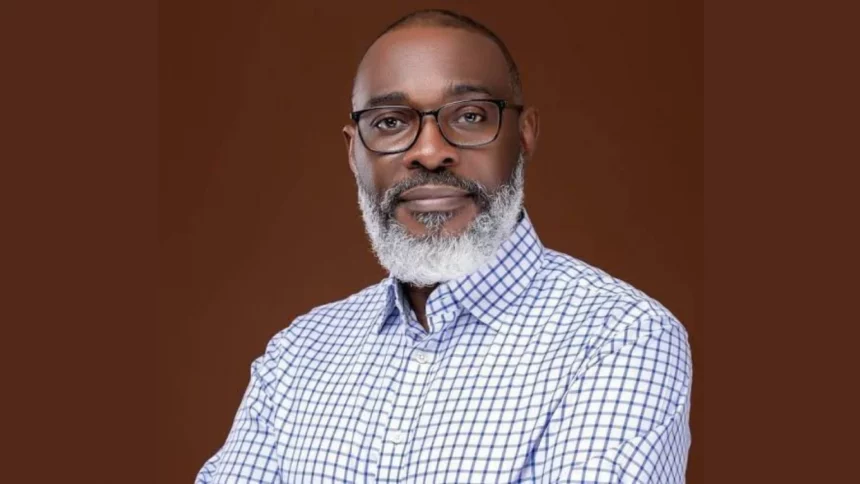
A new term has been added to Nigeria’s security architecture — homeland security — and Adeyinka Famadewa has been chosen as the man to lead the charge.
Famadewa’s appointment was announced on Monday by the office of the secretary to the government of the federation (OSGF).
Before the announcement, Famadewa’s popularity was largely confined to the country’s defence and security circles. As such, the retired major general’s appointment came as a surprise and has been widely viewed as another decorative addition in a security system that critics say has produced more structural adjustments than measurable improvements in safety.

As special adviser on homeland security, Famadewa will be tasked with enhancing the administration’s efforts toward achieving a safer and more secure Nigeria through improved coordination of homeland security initiatives, intelligence integration, and proactive risk management, the OSGF said.
While the appointment has now thrust Famadewa into the national spotlight, his ideas on security have been taking shape for years.
CHEMISTRY GRADUATE TURNED INTELLIGENCE OFFICER
Famadewa, a native of Ile-Ife, Osun state, was commissioned into the Nigerian Army Intelligence Corps as a member of the 37 regular course of the Nigerian Defence Academy (NDA), Kaduna, in September 1990.
He has a bachelor’s degree in chemistry from NDA and a master’s of business administration (management) from the Federal University of Technology, Akure, as well as a master’s of strategic studies from the University of Ibadan.
Famadewa is also a graduate of both the junior and senior command/staff courses of the Armed Forces Command and Staff College, Jaji.
In addition to bouts of professional training in military intelligence, Famadewa also attended the national and international security programme at the prestigious Kennedy School of Government, Harvard University, US, and the Canadian security studies programme (CSSP) at the Centre for National Security Studies of the Canadian Forces College, Toronto, Canada.
He is also an alumnus of the programme on advanced security studies from the George Marshall Center, Garmisch-Patenkirchen, Germany, as well as the Galilee International Management Institute, Israel, and is a fellow of the National Defence College (NDC).
Some of the appointments Famadewa has held include chief instructor at Nigerian Army Intelligence School, Lagos; deputy director, technical development, DIA; commander, counter-intelligence command, Nigerian Army; and director, intelligence, production centre, Nigerian Army.
He also had a tour of duty in the United Nations Mission in Sudan (UNMIS) as Sector J2. His military decorations include the meritorious service star (MSS), among others.
FAMADEWA’S UNCONVENTIONAL SECURITY LENS
Famadewa has long been critical of Nigeria’s approach to tackling insecurity. Once, he chose a 1990s hip hop hit to vent his frustration.
In a 2023 article, the veteran officer drew parallels between the country’s security architecture and Salt-N-Pepa’s ‘Let’s talk about sex’.

“To support this belief, the writer stated in the lyrics that the song would be prohibited by the radio services. However, surprisingly or even disappointingly enough, the song was all over the radios at that time because so much was said and yet, so little was said,” Famadewa wrote.
“The national security conversation in Nigeria for the last 15 years is akin to Salt-N-Pepa’s song on the aforementioned subject. While so much has been said about national security to the extent that it has influenced the decision of who sits at the apex of government in the revered Aso Rock Villa, the results we have consistently seen suggest that ‘yet, so little is said.’”
He criticised the state’s overdependence on the military as an all-encompassing solution to tackling insecurity and called for a multidimensional approach to mitigating threats.
Famadewa also frowned on the absence of a clear definition of Nigeria’s national security and proposed a review of the country’s national security strategy.

The retired general has also advocated for military officers to understand Nigeria’s three major languages — Hausa, Igbo, and Yoruba — in order to achieve operational goals.
FROM THEORY TO PRACTICE — THE INTELLIGENCE FUSION CENTRE
Famadewa is credited with establishing the Intelligence Fusion Centre (IFC) at the office of the national security adviser (ONSA).
Between 2015 and 2021, he served as the principal general staff officer to the NSA.
The IFC was designed to integrate intelligence from multiple agencies — including the Department of State Services (DSS), National Intelligence Agency (NIA), Defence Intelligence Agency (DIA), and the Nigeria police — to improve how the country assesses and responds to strategic threats.
Famadewa is said to have played a pivotal role in shaping Nigeria’s modern intelligence coordination framework.

Last year, Famadewa called for a reappraisal of the country’s intelligence architecture. He said it was necessary to “reduce the uncertainties” of surprise attacks by terrorists.
AUTHOR AND RESEARCHER
After retirement, Famadewa worked as a senior research fellow at the Nigerian Army Resource Centre, Abuja.
His research focus includes policing, civil-security cooperation, and security sector reforms.
He also authored a monograph titled ‘Policing and national security in Nigeria’, focused on improving inter-agency collaboration.
Source: The Cable
Stay ahead with the latest updates!
Join The Podium Media on WhatsApp for real-time news alerts, breaking stories, and exclusive content delivered straight to your phone. Don’t miss a headline — subscribe now!
Chat with Us on WhatsApp