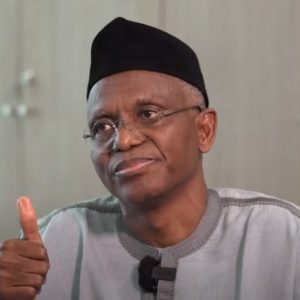




In the early hours of Saturday, US President Donald Trump announced that Abu-Bilal al-Minuki, the second-in-command of ISIS, had been killed in Nigeria.
Trump said al-Minuki was killed in a “complex mission” carried out by Nigerian and American troops.
President Bola Tinubu confirmed the operation, describing the strike as a “significant example of effective collaboration in the fight against terrorism”.

Al-Minuki’s death could temporarily weaken ISWAP’s ability to coordinate sophisticated operations in the region, security experts say, as “several lieutenants” of the ISIS second-in-command were also killed in the US-Nigeria mission.
But who was the terrorist commander, and why is his death considered a symbolic victory in Nigeria’s fight against terrorism?
THE NIGERIAN-BORN TERRORIST WITH A REGIONAL FOOTPRINT
Al-Minuki, also known as Abor Mainok or Abubakar Mainok, was born in 1982 in Mainok, Benisheikh, Borno state.
Details of the ISIS commander’s movements remain murky, though Trump’s assertion that “he thought he could hide in Africa” suggests the continent was not his earlier base of operations.
ISIS (Islamic State) was established in Iraq and subsequently expanded into Syria, becoming a transnational insurgency centred on the Iraq–Syria region.
After the dramatic collapse of the ISIS caliphate in 2017, the US said the jihadist group was forced to splinter and relocate to Africa and Central Asia, exploiting the weak governance structures in both regions.
Though by late 2014, cells of militants claiming to be affiliates or direct extensions of ISIS had emerged in several conflict zones in West Africa.
THE ARRIVAL OF AL-MINUKI WITH 60 FIGHTERS
Security and intelligence sources familiar with extremist operations in the Lake Chad Basin say al-Minuki arrived in the region alongside nearly 60 foreign fighters dispatched to strengthen ISWAP’s operational structure and battlefield capabilities.
ISIS provinces operate as Boko Haram and Islamic State in West Africa Province (ISWAP) in the Sahel and Lake Chad Basin, where parts of northern Nigeria fall.
The foreign operatives al-Minuki arrived with were believed to possess combat experience from the Middle East and other jihadist theatres, and reportedly introduced a new phase of insurgent warfare into Nigeria’s conflict environment.
Their arrival also coincided with noticeable tactical changes in ISWAP operations: increased night assaults on military formations, coordinated raids using mobile attack teams, deployment of armed drones for surveillance and attacks, more sophisticated use of improvised explosive devices (IEDs), renewed suicide bombing campaigns, and improved battlefield communication and logistics coordination.

These were tactics associated with ISIS operations in Iraq and Syria.
Al-Minuki was believed to have played a strategic role in coordinating international funding channels, allowing for the use of armed drones in jihadist attacks.
He also facilitated strategic communications, training support, and doctrinal guidance between ISIS central leadership and ISWAP factions operating across West Africa.
According to the ministry of foreign affairs, al-Minuki was also responsible for some of the recent attacks on military formations in the north-east.

RIVAL TO SHEKAU AND MAMMAN NUR
According to the International Crisis Group, al-Minuki had a troubled relationship with Abubakar Shekau, Boko Haram leader.
Despite benefiting from ISIS’s largesse, Shekau bristled at the caliph’s assertions of authority over him. When ISIS requested 1,000 ISWAP fighters to help defend the city of Sirte in Libya, Shekau declined, saying he could not spare the men.
According to defector accounts, Shekau was often irritated at the constant prying of Abu Obeidah and his team, whom he believed posed a threat to his command. Obeidah was reportedly an experienced Libyan jihadist who arrived in the Sambisa forest to coordinate training.
After Shekau declined ISIS’s request to send fighters to Libya, al-Minuki, who was ISWAP’s Lake Chad area commander at the time, sent some fighters himself.
The action angered Shekau and pointed to a growing rift between the then-Boko Haram commander and those who wanted a closer working relationship with ISIS.

Around mid-2016, ISWAP split in two, with internal opposition to Shekau’s leadership finally coming to a head.
In 2018, Mamman Nur, ISWAP leader, was executed by members of the terrorist group. In the weeks leading up to his death, there was said to be internal dissent about how the Dapchi incident was handled. On February 19, 2018, ISWAP fighters abducted 110 girls from the Government Girls’ Technical School, Dapchi, in the Bursari LGA of Yobe state.
Some 107 hostages were later released. Though there were undocumented reports to the contrary, both the government and ISWAP denied that ISWAP had received a ransom, as the terrorist group claimed that it was making a goodwill gesture.
AL-MINUKI’S GROWING INFLUENCE
After Nur’s death, al-Minuki, who was a rival, emerged as a leading figure in the organisation, alongside Mustapha Kirmima, another ISWAP commander. Al-Minuki was reportedly among the hardliners dissatisfied with Nur’s leadership. The Nigerian military has now linked him to the 2018 schoolgirls kidnapping.
In 2020, al-Minuki was identified as the second deputy emir of ISWAP in a letter that sought to address the institutional leadership crisis.
It is uncertain when the commander became the senior leader of ISIS’s al-Furqan office, one of ISIS’s most vigorous and best-established regional networks.
The al-Furqan office covers Nigeria and its neighbours, as well as the Islamic State in the Greater Sahara (ISGS) affiliate in the western Sahel and provides ISIS affiliates with operational guidance and international funding.
US-SPECIALLY DESIGNATED GLOBAL TERRORIST
On June 8, 2023, the US designated al-Minuki as a specially designated global terrorist (SDGT).
SDGTs are entities and individuals that the Office of Foreign Assets Control (OFAC) finds have committed or pose a significant risk of committing acts of terrorism, or who OFAC finds provide support, services, or assistance to, or otherwise associate with, terrorists and terrorist organisations.
These designations block assets, prohibit transactions with listed individuals or entities, and can apply to foreign persons providing material support to terrorism.
Stay ahead with the latest updates!
Join The Podium Media on WhatsApp for real-time news alerts, breaking stories, and exclusive content delivered straight to your phone. Don’t miss a headline — subscribe now!
Chat with Us on WhatsApp