


It is a rare privilege when a thinker of Professor Chidi Osuagwu’s caliber taps you on the shoulder, metaphorically speaking, to hand you a map of the world’s hidden plumbing. When he sent me his piece, “Obamanomics and Economics Beyond Cambridge,” an opinion editorial he did for BusinessDay of 9 December 2014, it arrived with the casual yet piercing confidence of a man who has seen the ending of the movie while the rest of us are still arguing over the opening credits.
“See here Collins,” his note read, “I spotted Trump as trouble long before the public knew him.”
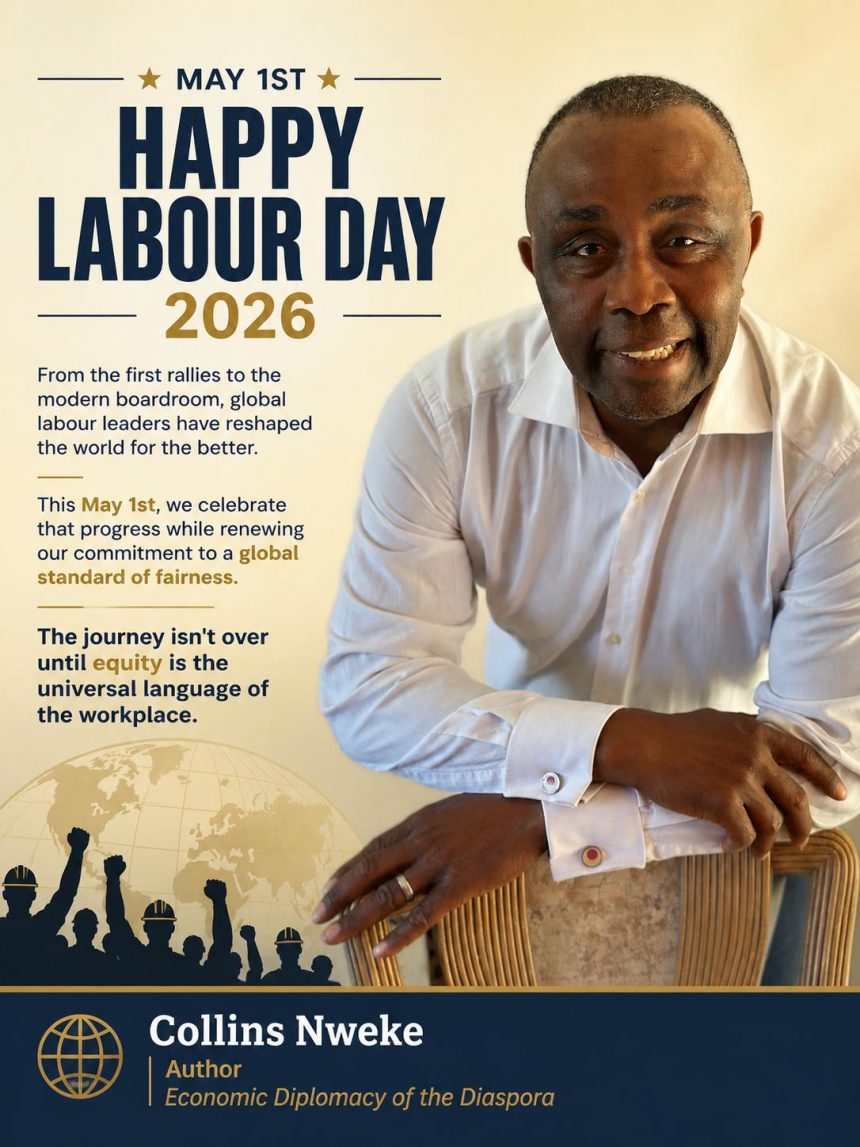
The timing of his message; landing in my inbox on Labour Day 2026 as I was just fine-tuning my Labour Day message, was, I suspect, no accident. For a man who views the economy through the prism of the “Matthew Effect” (where the rich grow fat and the poor grow lean by some perverse mechanical gravity), sending a treatise on the “Econosociofugal Force” on the very day dedicated to the dignity of the worker is the height of intellectual symbolism. It was a silent nod to the fact that while the world celebrates Labour, the current economic machinery is designed to ensure that the fruits of that labor rarely stay in the hands that produced them. I suspect that since reading over the past year or two, after our initial path-crossing at the corridors of setting up industrial park clusters in Nigeria’s Southeast Region, Prof knew that his piece will speak to me.

The Pragmatist in the Prophet’s Robe
In psychologising Prof. Osuagwu’s ideological leanings, one finds a fascinating tension. He is what I would call a Pragmatic Internationalist, yet one whose pragmatism is seasoned with a dash of the prophetic.
He looks at Barack Obama and sees a kindred spirit, a non-doctrinaire pragmatist and someone trying to weld the rigid pipes of Monetarism, Keynesianism, and Marxian theory into a functional machine. Prof respects the craft of governing. He understands that to save a ship from the “abyss,” you use whatever tools are on deck. However, where he departs from the standard pragmatic statesman is in his refusal to accept that the abyss was a one-time event.
The Physics of Sin: The Heterodox Mind
What strikes me most about Prof’s psyche is his Heterodoxy. He isn’t content with the dry, bloodless formulas of Cambridge or Chicago. To him, economics isn’t just social science. Economics to him is a branch of thermodynamics. He writes of the Econosociofugal Force as if it were a law of gravity, a “nothing comes out of nothing” reality that most bankers conveniently ignore.
There is a distinct Moralist-Egalitarian streak here. When he references Karl Marx as “Christ’s much younger cousin,” he isn’t just being witty; he is revealing a worldview where economic justice is a spiritual imperative. He sees the concentration of wealth not as a success of the market, but as a “perverse” mechanical failure that tears the social fabric. To Prof Osuagwu, a system that violates the laws of entropy and the laws of equity simultaneously is not just inefficient. It is doomed or as Nigerians will typically say, dead on arrival.
The Long View: Predicting the “Trouble”
His note about spotting Trump early makes perfect sense when you look at his analysis of the under-expectations of the Obama era. Prof saw that while Obamanomics saved the system, it didn’t fix the drain. He understood that if the “Matthew Effect” continued to hollow out the middle, the resulting vacuum would inevitably be filled by something volatile. He didn’t need a poll to see the “trouble” coming. He simply looked at the pressure gauges of his “Econosociofugal” model and saw the mercury rising.
The “No-Fault” Statesman
Perhaps the most “statesmanlike” quality of Prof’s ideology is his call for a Universal, No-Fault Debt Jubilee. It is a radical proposal, yes, but it is born of a cold, hard realism. He recognizes that the global debt is a mathematical fiction that cannot be repaid without destroying the human element it was meant to serve.
In Professor Chidi G Osuagwu, we find a mind that is at once deeply grounded in the physical laws of our world and soaring in its demand for a higher moral order. He is the pragmatic internationalist who realises that if we don’t fix the plumbing, the most beautiful house in the world; be it in Washington, Abuja, or Brasilia; will eventually collapse.
So, on this Labour Day, as I sat with his words, I realised Prof wasn’t just sharing an article. He was sharing a warning. And if his track record on “spotting trouble” is any indication, we would be wise to stop arguing about the tools and start looking at the foundations.
About the AUTHOR

Collins NWEKE is an International Trade Consultant & Economic Diplomacy researcher. He was a former Green Councillor at Ostend City Council, Belgium, where he served three consecutive terms until December 2024. A first-generation migrant who transitioned from civil society activism into elected office, he writes frequently on democracy, governance, and Africa–Europe relations. He is the author of the book ‘Economic Diplomacy of the Diaspora’. He is also a Distinguished Fellow of the International Association of Research Scholars and Administrators, serving on its Governing Council. A columnist for The Brussels Times, Proshare, and Global Affairs Analyst with a host of media houses, Collins writes from Brussels, Belgium. X: @collinsnweke E: admin@collinsnweke.eu W: www.collinsnweke.eu
Stay ahead with the latest updates!
Join The Podium Media on WhatsApp for real-time news alerts, breaking stories, and exclusive content delivered straight to your phone. Don’t miss a headline — subscribe now!
Chat with Us on WhatsApp