



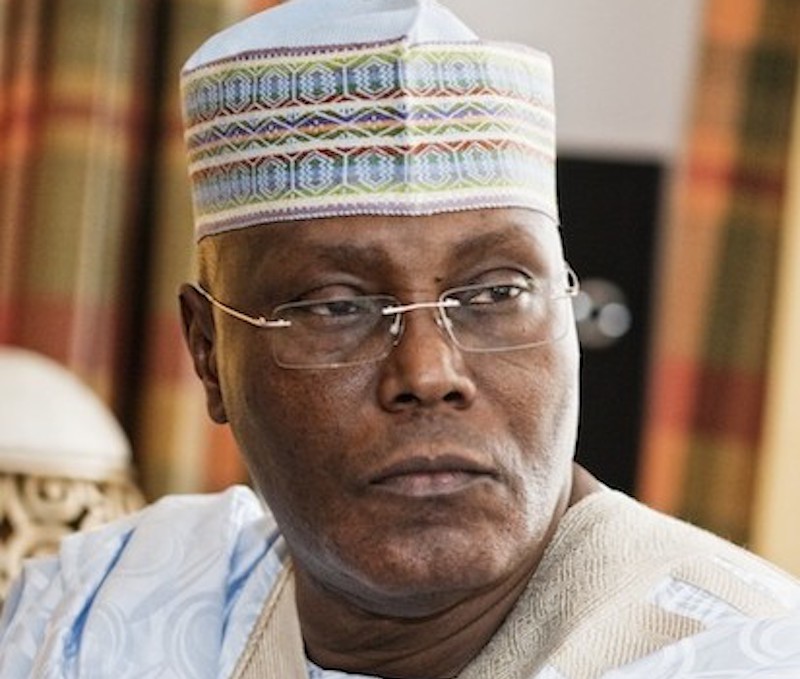
“I know Goodluck Jonathan very well. He is a decent young man, but also inexperienced, and I believe that contributed to his inability to manage the affairs of the country, particularly when he was faced with challenges.”
The more I reflect on the above quote, the more it fuels my anger.
There are moments in public discourse when a statement does more than provoke disagreement. It exposes a mindset. The recent remarks by former Vice President, Atiku Abubakar about President Goodluck Jonathan fall squarely into that category.

To describe a former President of the Federal Republic of Nigeria as “a decent young man, but inexperienced” is not only inaccurate, it is deeply condescending. It betrays either a careless disregard for facts or a deliberate attempt to diminish another man’s record for political advantage.
Jonathan was not a political accident. Before becoming President, he had served as Deputy Governor, Governor, Vice President, and then Acting President before winning a full mandate in 2011. By that time, he had spent years at the highest levels of governance. He was in his mid-fifties, not some novice learning on the job.
So, one must ask a simple question. By what standard does Atiku measure experience?
Was Barack Obama inexperienced when he became President of the United States at 47. Or is Atiku suggesting that leadership should be reserved for men approaching 80. If that is the argument, then it is not about experience at all. It is about entitlement.
What makes this claim even more astonishing is the source. Atiku’s own career does not support the towering assertion of superior experience he now projects. He retired from the Nigeria Customs Service without leading it. He never governed a state. Yes, he was elected
Governor of Adamawa State, but he never served a single day in that office before being picked as running mate by Olusegun Obasanjo.
His only substantive executive role was as Vice President. Even that tenure is remembered less for governance and more for a prolonged and bitter conflict with his principal that pushed him to the margins during their second term.
So, the question remains unavoidable. In what way is he more experienced than Jonathan, who occupied virtually every rung of executive leadership before becoming President. You cannot rewrite history simply because it is inconvenient.
Then comes his argument on zoning, which reveals an even deeper problem. By counting political power only from 1999, Atiku attempts a clever but flawed narrative, as though Nigeria came into existence at the start of the Fourth Republic. Nigeria gained independence in 1960, and any honest assessment of power distribution must reflect the entire historical landscape.
The principle of North/South rotation may not be written into the constitution, but it is rooted in the country’s political reality. It is a stabilising understanding built on equity, justice, and national cohesion. Even the Peoples Democratic Party, PDP, the very party that shaped much of Atiku’s political career, adopted zoning as a guiding principle in their constitution.
To now dismiss it as irrelevant is not a principled stand. It is political convenience.
Atiku’s career has been defined by an unrelenting quest for the presidency spanning more than three decades. Since 1992, the pattern has remained the same. Contest. Lose. Reposition. Repeat. Ambition in itself is not a crime, but ambition that refuses to recognise context, fairness, or timing becomes a problem.
In 2023, after Muhammadu Buhari, a northerner, completed eight years in office, there was a broad national expectation that power should return to the South. Yet Atiku pushed forward, ignoring that consensus. The consequence was immediate. His party fractured. Nyesom Wike and other key figures broke ranks and backed Bola Ahmed Tinubu, a southern candidate from a rival party.
That rupture was not accidental. It was the direct result of perceived injustice.

Now, the same approach appears to be resurfacing ahead of 2027. The pattern is clear and difficult to ignore. Fairness seems to apply only when it aligns with Atiku’s personal ambition. Principles become flexible. History becomes selective. National sentiment becomes secondary.
But a country cannot be governed on the basis of one man’s lifelong pursuit of power. It must rest on balance, inclusion, and a shared sense of fairness.
This is not just about an interview or a controversial quote. It is about a worldview that talks down on others while elevating itself. A worldview that edits history to suit present needs. A worldview that treats power not as a responsibility to be fairly distributed, but as a prize to be pursued at all costs.
Nigeria deserves better. Nigeria does not need an Atiku.

Stay ahead with the latest updates!
Join The Podium Media on WhatsApp for real-time news alerts, breaking stories, and exclusive content delivered straight to your phone. Don’t miss a headline — subscribe now!
Chat with Us on WhatsApp