

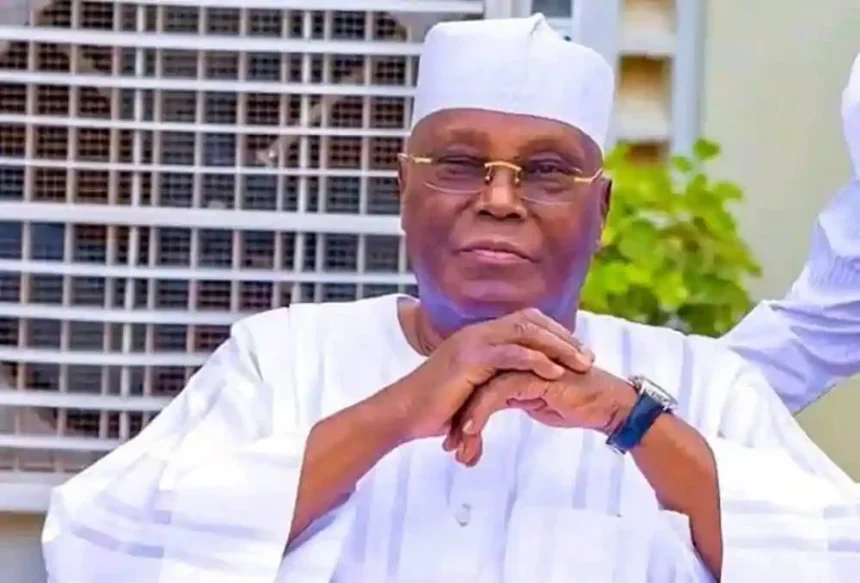
Former Vice President Atiku Abubakar’s promise to restore petrol subsidy if elected President raises a fundamental question that Nigerians must ask before getting carried away by the political rhetoric:
Under what law?
This is not merely an economic question. It is first a question of legality.

The Petroleum Industry Act 2021 fundamentally changed the legal framework governing Nigeria’s downstream petroleum industry. Section 205 provides that wholesale and retail prices of petroleum products shall be based on unrestricted free-market pricing conditions.
The Act’s transitional provision allowing the Federation to bear the cost of PMS supplied through NNPC as supplier of last resort was expressly limited to six months.
Therefore, Atiku cannot become President and simply announce that petrol subsidy has returned. A presidential proclamation cannot repeal or suspend an Act of the National Assembly. If he wants to create a new subsidy regime, he must explain the legislation, appropriation and regulatory framework that would make it lawful.
That is the first problem with his promise.
The second is even more serious. Atiku appears to be asking Nigerians to return to an economic model that this country spent decades trying to escape.
For years, Nigeria treated petrol as a political commodity. Government controlled prices, absorbed the difference between market costs and politically determined pump prices, and spent enormous sums supposedly protecting ordinary Nigerians.
Yet after decades of subsidy, Nigeria remained heavily dependent on imported refined petroleum products despite being a major crude oil producer. Our refineries became symbols of government inefficiency, corruption and waste. Port Harcourt, Warri and Kaduna consumed enormous public resources through repeated rehabilitation efforts while failing to establish sustained commercial production.
The lesson should be obvious: government ownership and intervention did not produce a sustainable petroleum industry.
The Petroleum Industry Act was intended to change that model by creating a commercially driven and investment-friendly petroleum industry.
And it is beginning to happen.
Look at Dangote Refinery.
Dangote did not invest billions of dollars in Nigeria on the assumption that government would permanently determine its selling price or guarantee its profits. It invested in a deregulated petroleum market where crude could be sourced, refined and sold commercially, subject to market forces.
That is why the refinery can operate as a commercial enterprise.

But here is the economic reality Atiku’s subsidy rhetoric conveniently avoids: crude oil does not become cheap simply because it is refined in Nigeria.
Crude is an internationally traded commodity. Its economic value is influenced by global supply and demand, international benchmarks, OPEC and OPEC+ production decisions, geopolitical developments, foreign exchange, freight, insurance and other market forces.
So what exactly would Atiku subsidise?
If government sells crude to a refinery below its economic value, government is effectively subsidising it through foregone revenue. If government compensates the refinery for selling petrol below commercial cost, that is a subsidy. If government fixes the pump price and compensates whoever bears the difference, we are back to the old under-recovery system.
Changing the name does not change the economics.
And this is precisely why the current attempt to bring private capital into Nigeria’s moribund government-owned refineries is so important.
NNPC is pursuing discussions with private investors for technical and equity partnerships involving the Port Harcourt and Warri refineries, with the objective of achieving sustainable commercial operations and long-term profitability.
These investors are not coming to participate in another government charity project. They are interested because Nigeria now has a deregulated downstream market in which a properly managed refinery can operate commercially, compete and make a profit. That is the investment proposition.
Nigeria is effectively telling international investors: bring your capital, rehabilitate these assets, operate them efficiently, compete in the market and earn a return.
Why would such investors commit billions of dollars if the government intends to re-enter the market and manipulate the price of the product through a subsidy regime?
Investors invest on the basis of predictable laws and commercial economics, not political promises.

This is the contradiction Atiku must explain.
You cannot simultaneously invite private investors to revive Nigeria’s dead refineries as commercial enterprises and promise voters that government will restore a subsidy mechanism capable of distorting the very market on which those investments depend.
You cannot tell investors that Nigeria has embraced deregulation and then tell them that government may once again determine the economics of their products.
And you cannot pretend that the fiscal cost disappears because the subsidy is described as being “targeted” or “tied to domestic refining.” Ultimately, somebody pays.
It could be the Federal Government through direct expenditure. It could be through foregone crude revenue. It could be through compensation to refiners or marketers. It could be through borrowing. But there is no magic source of money called subsidy. The cost ultimately falls on the Nigerian public.
This is why Nigerians must look beyond the seductive promise of cheaper petrol. Of course everyone wants cheaper petrol. But cheap petrol is not the same thing as a prosperous economy.
Nigeria needs investment, productivity, competition, efficient refineries, infrastructure, jobs and a petroleum industry capable of generating value beyond crude extraction.
We have already travelled the other road. We have seen the abandoned refineries. We have seen endless rehabilitation contracts. We have seen petrol queues. We have seen opaque subsidy calculations. We have seen enormous public resources disappear while Nigeria continued importing refined petroleum products.
We should not romanticise that past.
If Atiku wants to change the Petroleum Industry Act, he should say so. If he wants to restore price controls, he should say so. If he wants government to absorb petroleum costs, he should tell Nigerians exactly how much it will cost and who will pay.
But he cannot simply become President and announce the resurrection of a subsidy regime that the existing legal framework has moved away from.
Nigeria has finally begun building something different: a commercially driven petroleum industry in which Dangote and other private refiners can compete, investors can commit capital, and even the long-moribund government refineries can potentially be transformed into commercially viable businesses through private participation.
That is progress.
Atiku’s subsidy promise risks taking us backwards.
Nigeria does not need a political sugar rush that recreates the economic distortions of yesterday. We need to make today’s reforms work.
We have lived through the subsidy era. We know where it took us.
We should not dig up its corpse merely because an election is approaching.
Like I said in my past interventions on this issue, Atiku is the proverbial man who has been trying to lure a beautiful damsel into bed for many years without success. He finally got one last opportunity for a one-on-one encounter with her and decided to promise her heaven on earth if she would just allow him to “put the tip” saying, “Walahi, just the tip…”
Selah!
©Kay Lord, 290826
Stay ahead with the latest updates!
Join The Podium Media on WhatsApp for real-time news alerts, breaking stories, and exclusive content delivered straight to your phone. Don’t miss a headline — subscribe now!
Chat with Us on WhatsApp