



While Kano did record the largest number of candidates who met the five-credit benchmark, it also recorded the largest number of candidates who failed to meet the benchmark.
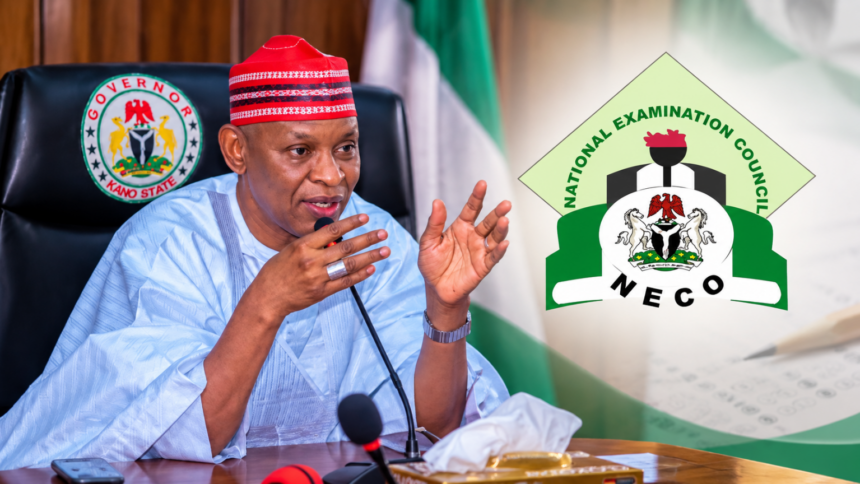
For the second consecutive year, the Kano State Government has celebrated what it described as a first-place finish in the National Examinations Council (NECO) Senior School Certificate Examination (SSCE).
Reacting to the results from this year’s examination, Governor Abba Yusuf said Kano had again emerged as the leading state after 74,413 candidates obtained at least five credits, including in English Language and Mathematics.
Candidates seeking admission into Nigerian tertiary institutions are generally required to obtain at least five credits in the SSCE, including English Language and Mathematics. This makes the five-credit benchmark a useful measure of candidates who meet the basic academic requirement for admission into tertiary institutions.

But an analysis of the 2026 NECO performance figures tells a considerably less flattering story about Kano’s performance.

Kano’s true performance
While Kano produced the largest number of candidates who met the five-credit benchmark, it also recorded the largest number who failed to meet the benchmark.
This is because Kano has the highest number of candidates who sat the examination.
According to NECO, 162,302 candidates sat the examination in Kano, more than the 97,771 in Lagos, which has the second-highest number.
But the figures show that Kano’s performance of 45.85 per cent remained below the national average of 60.13 per cent.
It also revealed a decline in Kano’s success rate when compared to its 2025 performance in the same examination.
When ranked by performance, Kano ranked 31st of 36 states and the Federal Capital Territory (FCT), a decline from 29th place it recorded last year.

The same celebration, the same problem
Just as it did last year, the Kano State Government interpreted the sheer number of its candidates who passed as a success rate, ignoring the fact that it has more candidates who failed than those who passed.
In the 2025 examination, Kano had 68,159 candidates who obtained at least five credits, including in English and Mathematics, the highest number among the states. But those candidates represented only 49.84 per cent of the 136,762 presented by the state for the examination.
The percentage ranked Kano 29th among the 36 states and the FCT in the 2025 examination.
2026 performance is worse
Meanwhile, a review of the 2026 results revealed that Kano performed worse than it did last year.
This year, 162,302 candidates sat for the examination in Kano, with 74,413 or 45.85 per cent obtaining at least five credits, including English and Mathematics.

The Kano candidates who failed the examination also increased from 68,603 last year to 87,889 this year. However, the number of successful candidates also increased from 68,159 to 74,413.

This is explained by the state’s number of candidates, which rose by 25,540 from 136,762 in 2025 to 162,302 in 2026.
National performance
PREMIUM TIMES also reported that the national performance in the 2026 NECO performance declined slightly when compared to the 2025 performance.

According to the results announced by NECO’s Registrar, Dantani Wushishi, a professor, 58.67 per cent of candidates who sat the examination obtained five credits and above, including English Language and Mathematics.
While 1,371,992 sat the examination, 804,948 candidates or 58.67 per cent, passed with the credit benchmark.

Last year, 60.26 per cent of candidates who sat the examination passed with at least five credits, including English Language and Mathematics.
Stay ahead with the latest updates!
Join The Podium Media on WhatsApp for real-time news alerts, breaking stories, and exclusive content delivered straight to your phone. Don’t miss a headline — subscribe now!
Chat with Us on WhatsApp