



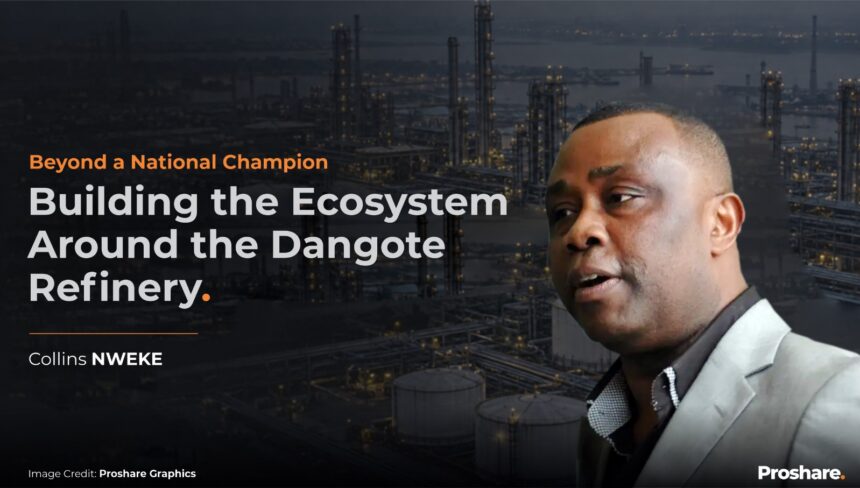
Nigeria’s emergence as a large-scale refining centre marks a structural change in its industrial economy, but the value created will depend on the institutions and markets built around the asset.
Collins Nweke argues that the Dangote Petroleum Refinery’s public offer, expansion plan and increasing use of Nigerian crude provide evidence of productive capacity at a scale long considered difficult to achieve on the continent. The same concentration that gives the refinery strategic weight also creates exposure across fuel supply, trade, public revenue and regional energy markets. The policy response should combine predictable feedstock arrangements, credible competition rules, strategic reserves, independent regulation and space for additional refiners to invest and compete.
The public offer adds a governance test. Wider ownership can deepen capital-market participation, while minority shareholders will require transparent disclosure, board independence and fair treatment in related-party transactions.

Nweke also places the refinery within a changing Nigeria–Europe commercial relationship, in which logistics, engineering, environmental technology and specialised finance can support African production rather than sustain dependence on imported finished products. The national objective is to convert one company’s achievement into a broader base of suppliers, manufacturers, skills and investible enterprises.
Nigeria has spent decades discussing the necessity of refining its own petroleum. It has now reached the more demanding stage of deciding what to do when large-scale refining succeeds.
This past week, Dangote Petroleum Refinery launched a public offer expected to become the largest in Africa. The company is seeking approximately N2.15trn from investors and has announced a US$14.3bn programme to double refining capacity to 1.4m barrels per day by 2029.
The offer materials also disclosed a significant financial turnaround, with profit after tax of US$1.82bn for H1 2026 following a loss in the previous full year. Meanwhile, industry sources reported that the refinery had secured at least 16m barrels of Nigerian crude for October, equivalent to approximately 520,000 barrels per day. This provides operating evidence alongside the company’s industrial ambition.
The significance extends far beyond one company or one public offering. Nigeria is witnessing the emergence of an enterprise large enough to reshape its trade, capital markets, energy security and international economic relationships. That achievement should be recognised. It should also be governed wisely.
From dependence to conversion
For much of its petroleum history, Nigeria occupied an economically uncomfortable position. It exported crude oil, imported refined products and surrendered much of the value between extraction and consumption. The Dangote refinery has disrupted that pattern. Nigerian crude is increasingly being converted within Nigeria. Refined products are supplying domestic and foreign markets. Petrochemical production creates possibilities beyond transport fuels. The country’s trade relationship with European refining and distribution centres is changing accordingly.
Belgium offers an instructive vantage point. Antwerp-Bruges is one of Europe’s major centres for refining, petrochemicals, storage and commodity logistics. Historically, the wider Amsterdam–Rotterdam–Antwerp region supplied substantial quantities of fuel to West Africa. As Nigeria’s refining capacity expands, the commercial relationship must evolve. Europe may sell less finished fuel to Nigeria while providing more specialised logistics, engineering, inspection, maintenance, environmental technology and access to capital. Nigeria can move from being primarily a consumer of European conversion capacity towards becoming an industrial partner and supplier. Economic transformation becomes visible when productive capability changes the terms of trade.
Success creates a new form of risk
Yet a country can escape dependence on imports and still create another form of dependence. When one refinery accounts for an overwhelming share of domestic fuel supply, absorbs a large portion of national crude production and becomes increasingly important to export earnings, its performance becomes a matter of public economic consequence.
This does not mean that the enterprise must become state-owned. Nor should its success be punished simply because public institutions failed for decades to accomplish the same task. It means that policy must recognise concentration risk. An operational disruption, financing difficulty, ownership dispute or regulatory confrontation at such a facility would affect consumers, government revenue, crude exports, transport costs and potentially the wider West African market. The appropriate response is not hostility towards a national champion. It is the development of institutions and markets strong enough to ensure that the national interest does not depend entirely upon the uninterrupted success of one private group.
Nigeria needs transparent feedstock-allocation rules, predictable competition policy, adequate strategic stocks, independent regulation and credible emergency arrangements. Other refiners must be able to enter, expand and compete under rules that are clear and consistently applied. A national champion should anchor an ecosystem without becoming its only pillar.
Public ownership must bring public-market discipline

The public offer introduces another dimension. Inviting citizens to own shares in a strategic industrial asset can deepen financial participation and strengthen the Nigerian capital market. The minimum subscription of 10 shares makes the offer accessible to a broad range of investors. Accessibility, however, is not the same as investor protection. The refinery’s importance to Nigeria and Africa reinforces the need for the ordinary scrutiny that should accompany any investment.
Investors need to understand the assumptions behind the valuation, the durability of current refining margins, the terms under which crude is supplied, the scale and cost of borrowing, related-party exposures, dividend policy and the financing of the proposed expansion. The prospectus indicates that controlling ownership will remain highly concentrated after the offer. Minority shareholders will therefore depend heavily on board independence, effective regulation, transparent disclosure and fair treatment in transactions involving connected companies. The Nigerian Code of Corporate Governance and NGX listing rules provide the relevant governance and disclosure framework. Patriotic language cannot substitute for these protections. Nigerians buying shares are investors, not donors to an industrial cause.
The success of the offer should ultimately be judged not by its headline size or the number of subscribers, but by the quality of governance that follows the listing.
Do not mistake a geopolitical windfall for a permanent margin

The timing also demands analytical restraint. Global oil and fuel markets are experiencing extraordinary disruption. Brent crude moved above US$100 per barrel during the week as conflict affected shipping and energy supplies from the Middle East. Dangote’s management has acknowledged that international fuel shortages supported refinery margins and altered the financing premise for expansion. Well-positioned enterprises can benefit when markets tighten, but those conditions require careful interpretation.
Investors and policymakers must separate cyclical advantage from structural competitiveness. Conflict-driven shortages will not last indefinitely. Refining margins fluctuate, new capacity will enter other markets, and environmental regulation will become more demanding. Electric mobility, efficiency and alternative fuels will gradually change patterns of petroleum consumption. The refinery’s long-term case must therefore rest on efficient operations, reliable feedstock, competitive logistics, product quality, petrochemical integration and disciplined capital allocation, rather than an assumption that current exceptional margins will become permanent.
Build the ecosystem around the asset
Nigeria’s policy objective should now extend beyond ensuring that the refinery succeeds. It should also ensure that the refinery’s success stimulates a broader industrial economy. In my considered view, this requires at least five actions.
- First, domestic supplier development should become systematic. Nigerian engineering, maintenance, fabrication, testing and logistics companies need credible routes into the refinery’s procurement chains.
- Second, petrochemical expansion should be connected to downstream manufacturing. Plastics, packaging, industrial chemicals and intermediate inputs can support thousands of smaller enterprises if reliable supply, finance and industrial infrastructure are available.
- Third, competition and regulation must remain credible. Market power should neither be ignored because the enterprise is nationally important nor constrained through arbitrary intervention.
- Fourth, public-market governance must be enforced consistently. Listing rules, disclosure obligations and minority-shareholder protections should apply without deference to corporate size or political access.
- Fifth, Nigeria must maintain a realistic energy-transition strategy. Refining capacity will remain economically important for years, but new investment should incorporate efficiency, emissions management, cleaner-fuel standards and credible pathways for adapting to changing global demand.
Europe must also update its proposition
European engagement with Nigeria should reflect the same transition. The old commercial model, in which Europe imported African raw materials, converted them and sold finished products back to African markets, is becoming less defensible and, in some sectors, less viable. The opportunity now lies in partnerships that reinforce African production.

Belgian and European firms can contribute maritime logistics, tank storage, process technology, industrial efficiency, emissions verification, water treatment, safety systems and specialised finance. European ports can become gateways for Nigerian products as well as sources of expertise. But partnership must create capability in Nigeria. It should develop suppliers, train engineers, improve standards and help Nigerian enterprises participate in higher-value stages of production.
Europe should respond to African industrialisation by positioning itself within emerging value chains rather than preserving an older trade structure.
From corporate achievement to national value
The Dangote refinery demonstrates what patient capital, industrial ambition and determined execution can accomplish in Africa. It has begun to alter Nigeria’s trade profile and has challenged the assumption that projects of exceptional scale cannot be built on the continent.
The next test is institutional. Nigeria must convert this corporate achievement into competitive markets, widen productive ownership without weakening investor protection, connect petrochemical capacity to manufacturing, and support additional enterprises so that national energy security does not depend on one facility.
Progress across these areas will determine whether the Dangote moment becomes principally the story of an extraordinary company or the beginning of a more broadly productive Nigerian economy.
Nigeria should celebrate the champion while accepting the larger responsibility of building the ecosystem.
‘The refinery’s public offering, expansion ambitions and growing command of Nigerian crude represent an extraordinary industrial achievement. Nigeria’s larger task is to convert the success of one national champion into competitive markets, capable institutions and broadly shared productive value.’ – Collins Nweke
Stay ahead with the latest updates!
Join The Podium Media on WhatsApp for real-time news alerts, breaking stories, and exclusive content delivered straight to your phone. Don’t miss a headline — subscribe now!
Chat with Us on WhatsApp