


The National Universities Commission (NUC) has signed an additional $65m deal with the World Bank under the Sustainable Procurement, Environmental and Social Standards Enhancement Project (SPESSE) currently being implemented in universities across the country.
The SPESSE project was launched in 2021 with an initial $80m World Bank facility to strengthen Nigeria’s capacity in procurement, environmental, and social governance through specialised training in universities.
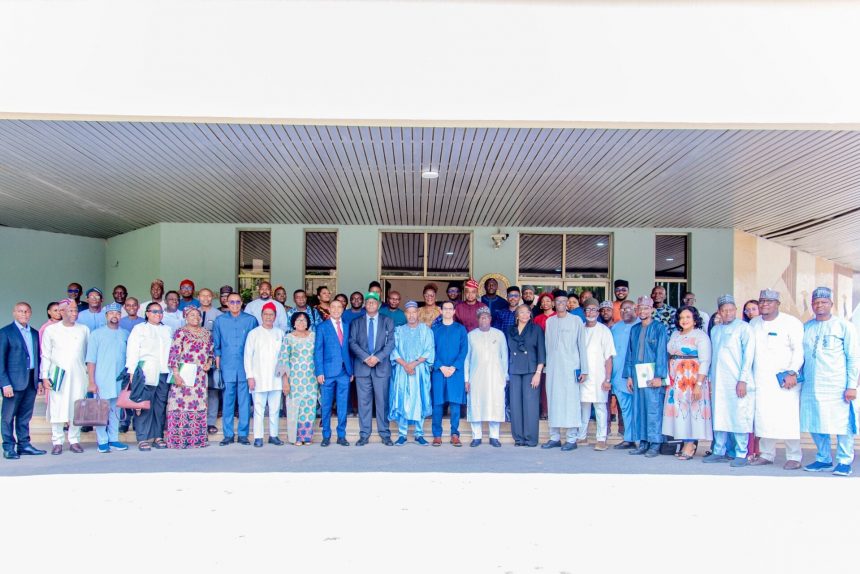
The fresh contract was signed on Wednesday at the NUC secretariat in Abuja, with representatives of participating universities, the World Bank, and the Bureau of Public Procurement (BPP) in attendance.

Speaking at the event, Abdullahi Ribadu, executive secretary of the NUC, said the additional financing phase marked “not only a continuation of the initiative, but also a renewed opportunity to consolidate achievements, scale impacts, and deepen sustainability measures across the participating institutions”.
“The project was conceived to address a critical gap in the Nigerian university system,” he said according to Punch.
“Insufficient supply of skilled professionals in procurement, environmental and social safeguards, as well as the limited availability of specialised academic programmes in these fields.”
Ribadu said six centres of excellence were established across the geopolitical zones to implement the project under the coordination of the NUC and with support from the World Bank.
He said the implementing centres are located in Ahmadu Bello University (ABU), Lagos State University (LASU), and other universities across the country.
He added that since 2021, the project had recorded significant milestones, including the development of curricula for short courses, postgraduate diplomas, master’s degrees, and undergraduate programmes.
“Today, these institutions are playing a strategic role in producing the skilled manpower required to support transparency, environmental responsibility, and socially inclusive development in Nigeria and beyond,” Ribadu said.
“Resource verification exercises have enabled the centres to mount postgraduate diplomas, master’s, and bachelor’s programmes, while investments in high-performance computing infrastructure, learning management systems, live streaming facilities, and digital learning platforms have strengthened teaching, learning, and research across the centres.”
The NUC boss said some centres had begun enrolling foreign students, while over 68 international partnerships had been established.
“In 2025, certification protocols for all three thematic areas — procurement, environmental, and social standards — were developed and activated by the Bureau for Public Procurement, the Federal Ministry of Environment, and the Federal Ministry of Women’s Affairs, respectively, to authenticate practitioners,” he said.
According to Ribadu, three of the six centres had already commenced PhD programmes, while the remaining centres are expected to begin in the next academic session starting in July 2026.
“Across the project, we expect to see the production of at least 60 PhDs, the enrolment of no fewer than 60 foreign students, the facilitation of at least 18 staff internships, and the provision of no less than 60 student exchange programmes with foreign institutions,” he said.
“We already have an expression of interest from The Gambia to send some of their citizens to the centres, and I ask the vice chancellors to take advantage of this opportunity.”

He added that the additional financing would deepen and expand previous achievements under the project.
“This one is now building on the achievements of the first phase. It will further deepen and expand the specific projects. It will focus on specific areas. Unlike the first one that was just like a template, now it will focus on specific areas of sustainability, environment, and procurement,” he said.
“The government intends to have all procurements in the future done electronically. So all this will now be possible within this funding framework.”
In his address at the event, Ishtiak Siddique, task team leader of the SPESSE project, said the World Bank currently has a $17bn portfolio with Nigeria, but described SPESSE as particularly important.

“This particular project is very close to our heart because it actually cuts across all the sectors,” he said.
“This additional financing, you have already heard that two weeks ago, the additional financing of $65m became effective. But it is built on the success of the original $80m SPESSE project.
“More than 40,000 people have already been trained in these three standards, which is a big deal.
“It is not like people will be trained and then forget about their training. They have to continuously nurture their skills, continuously learn, and that will be monitored through this certification programme.”
He said the additional financing is aimed at training another 24,000 people, particularly from critical public institutions.
“We are aiming even higher — at least an additional 24,000 people will be trained under the additional financing,” he said.

“On the procurement side, the additional financing includes implementation of an end-to-end electronic procurement system at the federal level initially, which will later be rolled out at the state level.”
He added that the system would utilise emerging technologies.
“The way it is being designed, it takes advantage of new technologies like machine learning and artificial intelligence to improve the efficiency and effectiveness of public procurement,” Siddique said.
Also speaking, Adebowale Adedokun, director-general of the BPP, said more than 2,700 officers had already been trained under the project.
“This project has so far trained and certified over 2,700 officers from various sectors of excellence and indeed from the private sector, drawn from MDAs at the federal, state, and local government levels,” Adedokun said.
“In this additional financing stage, we will support the development and deployment of the government’s electronic procurement system.
“It will also support online capacity building for small and medium-scale enterprises, as well as policymakers dealing with public funds.”
Stay ahead with the latest updates!
Join The Podium Media on WhatsApp for real-time news alerts, breaking stories, and exclusive content delivered straight to your phone. Don’t miss a headline — subscribe now!
Chat with Us on WhatsApp