



Try these science-backed shifts.
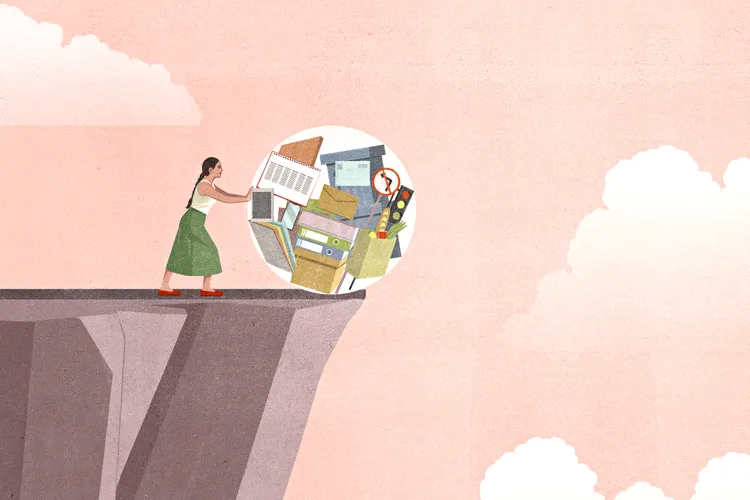
Once the stress levels start rising, life can get overwhelming real quick. You already have a million plates spinning, when—ugh—here comes 102 more things to juggle. That to-do list starts to look insurmountable, everything seems stacked against you, and all you wanna do is curl up into the fetal position.
Not surprisingly, mental health experts say there are better ways to cope. While you can’t always control what’s coming at you, you can change how you respond. These simple, intentional, science-backed shifts can calm your nervous system, clear your head, and help you regain a sense of control.

Do Something Unexpected
“I recommend introducing a moment of novelty when your brain is stuck in a stress loop—something unexpected, playful, or slightly unusual. This could be saying a sentence in a silly accent, naming five objects around you that rhyme or listing them in alphabetical order, or stretching your arms in an exaggerated way. Because it’s hard for the brain to hold high stress and novelty at the same time, these small, surprising actions can quickly interrupt anxiety and help you reset. These techniques work especially well because they don’t require special tools or a lot of time.” —Meghan Marcum, PsyD, chief psychologist at A Mission for Michael, a mental health care center in San Juan Capistrano, California
Change Up How You Talk to Yourself
“Your internal voice matters, and research shows that second-person self-talk (‘you’) reduces anxiety more effectively than first-person self-talk (‘I’). So instead of saying, ‘I can handle this’ or ‘I shouldn’t feel this way,’ try something like, ‘You don’t have to fix everything at once’ or ‘You’re allowed to feel overwhelmed.’ Why does this work? Second-person language creates psychological distance from the emotion and activates problem-solving pathways rather than threat pathways. This technique turns your inner critic into your inner coach!” —Liz Ross, PhD, licensed clinical psychologist and founder of Coping Resource Center, a mental health care practice in Houston
Find Comfort With Keepsakes
“Make a self-soothe box featuring items associated with positive memories, such as cards, notes, or photos of loved ones and pets. Some people choose to include other things like a dried flower from a birthday, a drawing made by their child, or a small toy from their own childhood. I like to include a printout of a favorite poem or an inspiring quote. The choices are endless, as long as you find comfort in each object. When you are anxious or worried, take out the box and spend at least 10 minutes going through it, thinking of the memories attached to each item. Nostalgia can make you feel comforted. It serves as a wonderful way to promote positive feelings, which can offset negative feelings like anxiety and stress.” —Lori Davis, PsyD, a New York City-based licensed clinical psychologist specializing in anxiety disorders
Shake It Off
“Purposely shaking the body is a quick way to get back to a state of homeostasis, which is the stable equilibrium we want. You’re looking to return the body to balance. Let’s say you got off a really terrible phone call with your boss. Hang up, stand up, and literally shake every part of your body vigorously—the arms, shoulders, head, and legs. Do it for at least 60 seconds and up to a couple of minutes. Then shake your head like you’re nodding no and trill your lips like you’re giving someone raspberries—with as much sound as you can! That vocalization will help stimulate the vagus nerve, the path between our brain and organs, which helps activate our parasympathetic nervous system to calm the body.” —Emily Read Daniels, MEd, certified counselor and creator of The Regulated Classroom, a program helping educators create emotionally stable environments
Practice Some Mindfulness
“When you first start to feel anxious, use a simple grounding action to help break the continuing internal loop. This might look like pressing your feet into the floor, relaxing your jaw, wiggling your toes, or subtly shifting your posture. If you’re stuck in traffic, you might notice the feeling of your hands on the steering wheel or the weight of your body in the seat. These actions help because anxiety feeds on speed and repetition, and interrupting the loop early slows the system down, anchors attention in the present moment, and reinforces the sense that stress is manageable rather than overwhelming.” —Amareen Dhaliwal, MD, MPH, a Tampa, Florida-based psychiatrist
Tickle Your Funny Bone
“Think of a hilarious moment. It can be a real situation or something from a show, book, or movie. While personal humor is more potent (you have interacted with the moment, so it’s part of you), both are very helpful to get you laughing. When laughter is present, cortisol—aka the stress hormone—is reduced. Laughter also causes your muscles to contract and release, which is a common form of physical relaxation.” —Steven Sultanoff, PhD, adjunct faculty at the School of Education and Psychology at Pepperdine University
Change Your Body Temp
“You only need to splash cold water on your face for about 20 to 30 seconds to interrupt a stress response. Feeling something cold on your cheeks, like an ice cube or water, can quickly feel grounding because it activates the parasympathetic nervous system. If you’re at home and have time, you could take a warm shower too. Doing so combines temperature, pressure, and sensory input, all of which relaxes the nervous system.” —Esin Pinarli, licensed clinical social worker and founder of Eternal Wellness Counseling in Boca Raton, Florida
Make a Pie Chart of Your Life
“When we’re hyperfocused on one thing, it can lead to spiraling and negative bias. If you were laid off, for example, you might feel like you’re not successful or that everyone else is better off than you. Creating a visual of the different facets of your life can help you zoom out and get perspective. You’ll see that this stressor is only one aspect of your life. Take a step back and list out all the things that deeply matter, like your relationships, health, hobbies, or spirituality. Then try to depict the relative weight of each in a circle, so you have a picture of what you do have. This method helps strengthen our psychological flexibility, which is our ability to cope with, accept, and adjust to difficult situations.” —Jenny Taitz, PsyD, licensed clinical psychologist and author of Stress Resets: How to Soothe Your Body and Mind in Minutes
Do Some Tapping
“Bilateral tapping, which involves stimulating the left and right sides of your body, helps you slow down and process stress in the moment. I like the butterfly hug. Face both palms toward you, twirl your thumbs together, and spread your fingers out. With your intertwined thumbs on your collarbone and hands on chest, tap your fingers on the left and then on the right. Left, right. Slowly. This slow tapping sends signals to your corpus callosum, which is the bundle of nerve fibers that helps regulate emotion. Keep tapping for as long as you need to feel grounded or calm.” —Tracy Vadakumchery, a licensed therapist in the greater New York City area
Put in Waayyyy Less Effort
“When your nervous system is overwhelmed, it prioritizes safety over productivity, which can make even simple tasks feel heavy, confusing, or impossible to begin. Lower the bar on purpose. Tell yourself it’s enough to just show up. Don’t worry about finishing anything. Start with the least demanding action of whatever you want to do. If you need to tackle a work assignment, open the document, jot one messy sentence, or review some notes. Tiny steps reduce paralysis and create a sense of momentum, which can reassure you that you’re capable and not stuck. Small actions also release tension and help you shift from threat mode into problem-solving mode. Pair the task with something grounding too, like a sip of water or a deep breath, so your body feels safe enough to start.” —Najamah Davis, a licensed clinical social worker and psychotherapist at ND Counseling Services in Maplewood, New Jersey
Source: www.realsimple.com
Stay ahead with the latest updates!
Join The Podium Media on WhatsApp for real-time news alerts, breaking stories, and exclusive content delivered straight to your phone. Don’t miss a headline — subscribe now!
Chat with Us on WhatsApp