Moscow and Beijing left spluttering helplessly from sidelines as Donald Trump wields US military might
It took only a minute to change the world. Within the first 60 seconds of Operation Epic Fury, Israeli officials claimed, Iran’s Supreme Leader and his principal henchmen were dead.
But the precision-guided missiles that struck central Tehran in the opening salvo of the war did not merely kill Ayatollah Ali Khamenei and upend half a century of Iranian history.
They also underscored a more basic reality – where true power still lies in the world.

Much has been written in recent years about “multi-polarity” – the idea that emerging powers have wrested back some of the dominance the United States wielded unilaterally after the Cold War.
Such arguments are not without merit. China’s manufacturing heft and its dominance over critical resource supply lines challenge Washington’s economic primacy. Rising middle powers have ensured that the US no longer enjoys uncontested sway in every region.
But when it comes to military might, the US still reigns supreme – a point Donald Trump has sought to emphasise repeatedly since returning to office.
Whether or not he is America’s greatest president, as he sometimes suggests, Mr Trump is certainly among its most consequential.
Few predecessors have wielded hard power so bluntly. In the space of two months, he has removed two leaders on two continents: Nicolás Maduro in Venezuela and Khamenei in Iran.
Unlike Theodore Roosevelt, Mr Trump speaks loudly and wields the big stick without compunction.
For nearly two decades, China and Russia have sought to build a global coalition to counter US hegemony. With Mr Trump taking a sledgehammer to those ambitions, Moscow and Beijing have been reduced to spluttering helplessly from the sidelines as their regional clients are swatted aside.
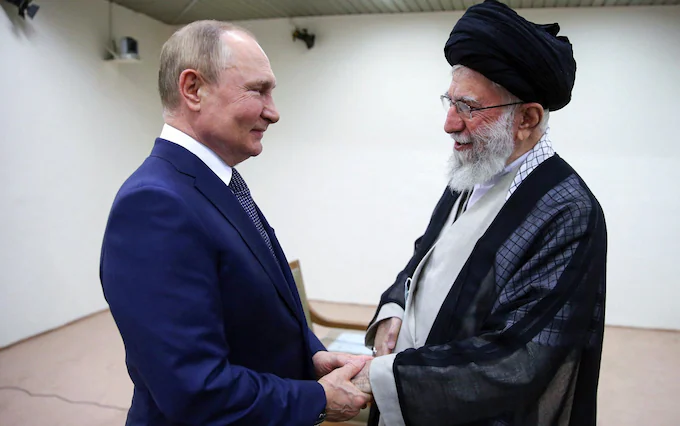
After Khamenei’s death, Vladimir Putin, the Russian leader, offered his “deep condolences”, condemned a “cynical murder that violated all norms of human morality and international law” and mourned the passing of “an outstanding statesman”.
The subtext will not be lost on the coterie of strongmen who depend on Moscow’s patronage – when the missiles fall, Russia can offer little more than sympathy.
For now, Mr Trump can savour his triumph, having wrong-footed his critics and confounded received wisdom.
For while the killing of Khamenei is hardly the end of the affair – the Middle East has a record of turning Western triumph to ashes – the opening stages of this war have already achieved what many thought impossible.
Iran’s leaders, experts said, would surely have learned the dangers of congregating in one place after Israel killed at least 20 senior officials and nuclear scientists in last year’s 12-day war, or eliminated Hezbollah’s leader and inner circle in Lebanon the year before.
Regime insiders had said security around Khamenei and his inner circle was “layered and deep”. They circulated through a network of safe houses, abandoned all traceable communications technology and oversaw purges and executions intended to seal the leaks through which US and Israeli intelligence had once penetrated the regime.

Any attempt to locate and kill him, it was assumed, would require a prolonged and dangerous campaign – as in Libya in 2011, when it took seven months of Nato bombardment to find and kill Muammar Gaddafi.
Yet two factors explain why Washington has been far more successful 15 years on.
In Libya, the US chose to “lead from behind”. Barack Obama, keen to avoid the optics of another American war in the Middle East, allowed Britain and France to spearhead air strikes – only to discover that they lacked the firepower to force a swift capitulation.
Mr Trump, by contrast, does not do coalitions, except with Israel. As has become standard, he has neither consulted nor informed European allies before striking Iran. For him, the cloak of international legitimacy and the sharing of risk with partners barely exist.
The second factor is intelligence. US capabilities are vastly more sophisticated than in 2011. Alongside human intelligence, Washington now employs cyber penetration, AI and high-altitude long-endurance drones capable of identifying a single individual by gait, voice or electronic signature – before deploying so-called Ninja missiles, whose extendable steel blades “shred” their target.
Unlike in Gaddafi’s day, hiding has become vastly harder.
Yet history – especially in the Middle East – cautions against triumphalism.
After US troops captured Baghdad in just 21 days in 2003, George W Bush infamously addressed the nation from an aircraft carrier beneath a banner reading “Mission Accomplished”. Hundreds of thousands of civilians died over the following years as Iraq slid into anarchy.
Mr Trump cannot claim vindication until it is clear Iran does not follow the same path.
For all the success of the opening salvos, it is far from clear that Iran’s theocracy has suffered a mortal blow.

Though reeling from the loss of its Supreme Leader and the decapitation of its top echelon, the revolutionary system was designed to endure such shocks. It may take weeks to see how badly weakened it truly is.
Even if it does collapse, Iran – a nation of 90 million people – is acutely vulnerable to civil war. Kurds, Arabs, Azeris and Baluchis harbour ambitions for autonomy.
The Islamic Revolutionary Guard Corps is unlikely to surrender power willingly. A peaceful transition seems less plausible than a violent one. Mr Trump’s declaration that his objective is “peace throughout the Middle East” may come back to haunt him.
China and Russia will be watching for Mr Trump to stumble.
Khamenei’s death – like Mr Maduro’s fall before it – has exposed the limits of their global reach.
Both shied away from supplying Iran with systems that might have provided a genuine strategic deterrent. Russia, despite benefiting from Iran’s drone technology, offered only training jets and vague promises of shoulder-fired missiles, repeatedly prevaricating over the S-400 air-defence system and Su-35 fighter jets that might have made a meaningful difference.
China, while reportedly assisting with ballistic-missile propellants, did little to help Iran achieve parity.
Both powers offered economic partnership, but not the security guarantees needed to ensure the survival of their leadership.
The rupture carries risks for them too. Iran supplies roughly 1.4 million barrels of oil a day to China, some 9 per cent of its total consumption.
Should Mr Trump complete a clinical victory, Beijing and Moscow will find it harder to persuade potential partners that American power is in terminal decline. The informal anti-Western bloc known as the CRINKs (China, Russia, Iran and North Korea) will look far less credible if the “I” has been excised.
Yet neither capital will assume the story is over.
Higher oil prices will benefit Putin’s war machine. Any quagmire in Iran would rapidly erode Mr Trump’s newfound credibility. If anxious Gulf states come under sustained Iranian attack and press Washington for restraint, US dominance in the Middle East could unravel, creating opportunities for Moscow and Beijing to exploit.
And whatever happens in Iran, Putin believes that where it matters most, he is secure. Mr Trump may pursue regime change elsewhere, but Russia is not on that list. Its leader is, after all, the kind of dictator the US president likes.
Stay ahead with the latest updates!
Join The Podium Media on WhatsApp for real-time news alerts, breaking stories, and exclusive content delivered straight to your phone. Don’t miss a headline — subscribe now!
Chat with Us on WhatsApp