


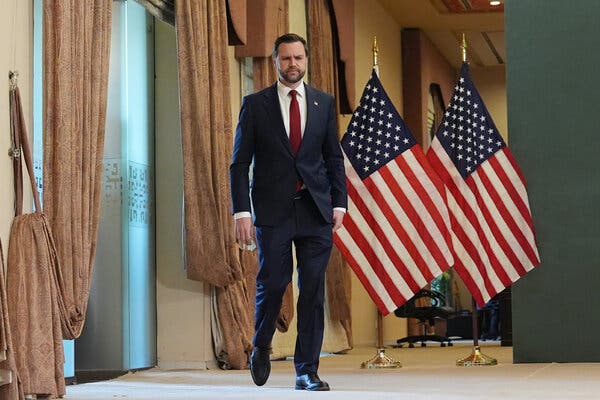
Vice President JD Vance said the Iranian delegation had not accepted American terms for ending the war after a marathon, face-to-face session in Pakistan.
Vice President JD Vance said on Sunday that 21 hours of peace talks in Pakistan, between the United States and Iran had failed to produce an agreement to end the war, leaving the question of what happens after the current two-week cease-fire up in the air.
“They have chosen not to accept our terms,” Mr. Vance said in a brief news conference in Islamabad, though he left open the possibility that terms could still be reached. “We leave here with a very simple proposal: a method of understanding that is our final and best offer,” he added. “We’ll see if the Iranians accept it.”

The marathon talks between high-level officials stretched past 6 a.m. local time on Sunday, a momentous encounter between decades-old adversaries as they sought to broker peace after more than a month of war. Mediated by Pakistan, the negotiating session was the highest-level face-to-face encounter between U.S. and Iranian officials since Iran’s 1979 Islamic Revolution, which put the two countries on a collision course.
Esmaeil Baqaei, the spokesman for Iran’s foreign ministry, said on social media earlier on Sunday that the discussions in Pakistan “were held on various dimensions of the main negotiation topics, including the Strait of Hormuz, the nuclear issue, war reparations, lifting of sanctions and the complete end to the war against Iran and in the region.” Mr. Baqaei, who was in Pakistan as part of the Iranian delegation, added that the success of the talks depended on the United States’ “acceptance of Iran’s legitimate rights and interests.”
Israel was not involved in the talks, and even though its forces have not struck Iran since the cease-fire was reached, they have continued to strike targets in Lebanon. On Saturday, Prime Minister Benjamin Netanyahu said that while Iran’s military had been badly damaged, the war was “not over.”
As Mr. Vance was detailing the impasse in negotiations, President Trump and Secretary of State Marco Rubio were at a sports arena in Miami for UFC 327, watching a video montage of past fights. Earlier in the evening, from Washington, Mr. Trump had projected nonchalance, claiming it did not matter to him whether the U.S. delegation reached an agreement with Iran. “We win, regardless,” he said. “We’ve defeated them militarily.”
Even though the talks did not produce a diplomatic breakthrough, the fact that the speaker of Iran’s Parliament, who was leading Iran’s delegation, met with the American vice president is still extraordinary, given the long history of animosity between the two nations. Just six weeks ago American and Israeli airstrikes killed Iran’s supreme leader, and Iranian officials pledged to avenge his blood.
On Tuesday, the United States and Iran agreed to a provisional cease-fire on Tuesday that suspended the fighting for at least two weeks. But in public statements since then, officials from the two governments have been far apart on several issues, including control of the Strait of Hormuz, what will happen to Iran’s nuclear stockpiles and whether the current cease-fire covers the fighting in Lebanon.
Israel’s military campaign in Lebanon against Hezbollah, the Iran-backed militant group, has threatened to derail the truce. Iran had accused Israel of breaking the cease-fire by continuing to attack in Lebanon, leading Mr. Trump to ask Israel to rein in its assault.
Israeli fighter jets have not attacked the Lebanese capital of Beirut since Wednesday. But Israel has kept up its airstrikes in southern Lebanon, including on Saturday morning, according to Lebanon’s state media.
Control of the Strait of Hormuz and Iran’s uranium stockpiles were sticking points.

When talks between the United States and Iran ended just before dawn on Sunday morning without a permanent cease-fire, the Americans said they had made their final best offer and that Iran had not accepted.
“We’ve made very clear what our red lines are, what things we’re willing to accommodate them on, and what things we’re not willing to accommodate them on,” Vice President JD Vance said after 21 hours of meetings with top Iranian officials at the Serena Hotel in Islamabad.
Mr. Vance did not say what those red lines were. In the days leading up to the talks, both sides had issued public statements suggesting they remained far apart on several critical issues. They did not even agree on whether the two-week truce they reached on Tuesday applied to fighting in Lebanon, a dispute that nearly derailed the meeting.
By early Sunday, three main sticking points remained, according to two Iranian officials familiar with the talks: the reopening of the Strait of Hormuz; the fate of nearly 900 pounds of highly enriched uranium; and Iran’s demand that about $27 billion in frozen revenues held abroad be released.
The United States had demanded that Iran immediately reopen the strait to all maritime traffic. But Iran refused to relinquish leverage over the critical choke point for oil tankers, saying it would do so only after a final peace deal, according to the two Iranian officials, who spoke on the condition of anonymity to discuss sensitive diplomatic negotiations.

Iran also sought reparations for damage from six weeks of airstrikes and asked for frozen oil revenues held in Iraq, Luxembourg, Bahrain, Japan, Qatar, Turkey and Germany to be released for reconstruction, the officials said. The Americans refused those requests.
Another point of contention was President Trump’s demand that Iran hand over or sell its entire stockpile of near-bomb-grade enriched uranium. Iran made a counterproposal, but the sides were unable to reach a compromise, the officials said.
“When two serious teams with an intention for a deal come to the table, it has to be a win-win for both. It is unrealistic to think we can come out of this without making any serious concessions; the same holds true for the Americans,” said Mehdi Rahmati, an analyst in Tehran, in a telephone interview.
Even though the meetings ended without an agreement, the fact that they took place at all was a sign of progress. Just six weeks earlier, the United States and Israel had killed Iran’s supreme leader, Ayatollah Ali Khamenei, in an airstrike, and Iranian officials vowed to avenge his death. At the time, the prospect of any high-level meeting between Iranian and American officials seemed remote.

Still, Mohammad Bagher Ghalibaf, the head of Iran’s Parliament and an influential military commander, led the Iranian delegation and met face-to-face with Mr. Vance. The two men shook hands, and the talks was described as cordial and calm, the two senior Iranian officials familiar with the talks said. While no diplomatic breakthrough was reached, a taboo — shaped by decades of hostility, sharp rhetoric and chants in Iran of “death to America” — was broken.
The meeting between Mr. Vance and Mr. Ghalibaf was the highest-level face-to-face engagement between representatives of Iran and the United States since diplomatic relations were severed in 1979 after the Islamic Revolution. Shortly afterward, Iran’s new rulers stormed the U.S. Embassy and took American diplomats hostage.
“This is the most serious and sustained direct talks between the U.S. and Iran, and it reflects the intention of both sides to end this war,” said Vali Nasr, a professor and Iran expert at Johns Hopkins University. “And there has been clearly positive momentum for the talks to go as long as they have and not break down.”
Tyler Pager traveled with Vice President Vance to Islamabad for the negotiations with Iran. David E. Sanger has covered the efforts to use sabotage, negotiation and military force to end the Iranian nuclear program over the past two decades.
What now? The failure of marathon talks leaves Trump with difficult options.

Vice President JD Vance’s failure to win the concessions the United States sought from Iran in a single, marathon negotiating session over its nuclear program was no surprise.
But what now?

The failure leaves the Trump administration facing several unpalatable options: A lengthy negotiation with Tehran over the future of its nuclear program, or a resumption of a war that has already created the largest energy disruption in modern times, and the prospect of a long struggle over who controls the Strait of Hormuz.
White House officials said they would defer to President Trump, who traveled to Florida for the weekend to attend an Ultimate Fighting Championship match, to announce the administration’s next move. But each of those paths carries significant strategic and political downsides.
Mr. Vance said little about what took place during more than 21 hours of negotiations, suggesting he had handed the Iranians a take-it-or-leave-it proposal to forever terminate their nuclear program, and they left it.
“We’ve made very clear what our red lines are,” Mr. Vance told reporters, “what things we’re willing to accommodate them on.” He added, “They have chosen not to accept our terms.”
In that respect, this negotiation appears to have differed little from the one that ended in deadlock in Geneva in late February, leading Mr. Trump to order what became 38 days of missile and bombing attacks across Iran, aimed at its missile stockpiles, its military bases and the industrial base inside Iran that produces new weaponry.
But Mr. Trump’s bet, one he described several times over the past month, was that Iran would change its mind once faced a huge demonstration of American military prowess, with more than 13,000 targets hit, according to the Pentagon. The Iranians, for their part, were determined to show that no amount of American ordnance would force them to give way.
“The heavy loss of our great elders, dear ones, and fellow countrymen has made our response to pursue the Iranian nation’s interests and rights firmer than every before,” the Iranian foreign ministry said in a statement as Mr. Vance headed to a military airfield to leave for home, empty-handed for now.
Perhaps that will change. But the administration’s fear of being sucked into a complex, lengthy conversation with Iran is palpable. Mr. Trump believes that he emerged the victor of the conflict, and therefore, as the special envoy Steve Witkoff puts it, Iran should simply “capitulate.”
That is not how it happened in the past. The last major agreement between Tehran and Washington, reached during the Obama administration, took two years to negotiate. And it was full of compromises, including allowing Iran to retain a small amount of its nuclear stockpile, and gradually lifting the restrictions on its nuclear activities until 2030, when Iran would be permitted to conduct any nuclear activity permissible under the Nuclear Nonproliferation Treaty.
But the deadlock Mr. Vance ran into was essentially the same as the ones that derailed negotiations in late February, and prompted Mr. Trump to order the attack. (That negotiation was run by Mr. Witkoff and Jared Kushner, the president’s son-in-law, who were present in Islamabad during the more than 20 hours of negotiations.)
Back then, the Iranians offered to “suspend” their nuclear operations for a few years, but not to give up their stockpiles of near-bomb-grade uranium or permanently surrender the capability to enrich uranium on their own soil. To the Iranians, that is their right as a signatory of the Nuclear Nonproliferation Treaty, which commits them to never making a nuclear weapon. To the Americans, it is what Mr. Witkoff called “a tell” that Iran always wants a ready option to build a nuclear weapon, even if it never exercises that option.
Thirty-eight days of war appear to have hardened that view, not loosened it.
Mr. Trump’s chief leverage now comes in his ability to threaten to resume major combat operations. After all, the fragile two-week cease-fire ends on April 21. But while the threat of resuming combat operations may be invoked in coming days, it not a particularly viable political choice for Mr. Trump — and the Iranians know it.
Mr. Trump declared the cease-fire last week in large part to stem the pain from the loss of 20 percent of the world’s oil supplies, which was sending the price of gasoline soaring, and creating shortages of fertilizer and, among other critical supplies, helium for the production of semiconductors. Markets rose on the prospect of an agreement, even an incomplete or unsatisfactory one. Should the war resume, the markets would most likely decline, the shortages would worsen and inflation — already up to 3.3 percent — would almost inevitably rise.
And that leaves the most urgent issue: the reopening of the Strait of Hormuz. The Iranians, in their own description of the meeting, put it first among their list of issues discussed. “In the past 24 hours, discussions were held on various dimensions of the main topics, including the Strait of Hormuz, the nuclear issue, war reparations, lifting of sanctions and the complete end to the war against Iran,” the Iranian foreign ministry said in a statement.
It was a notable list, since the closing of the strait was not an issue until after the war started and the Iranians decided to make use of their most potent weapon of economic chaos.
Now control of the waterway is wrapped in Iran’s other demands, including that the United States pay for damage done to Iran in the course of the bombing and missile strikes, and that it lift more than two decades of sanctions against the country. The United States has rejected the first idea, and said the second could happen only slowly, as the Iranians put in place their part of a deal.
What Mr. Vance’s trip made clear is that both sides think they emerged as the victor of the first round: the United States by dropping so much ordnance on Iran, the Iranians by surviving. Neither seems in the mood for compromise.
Pakistan’s foreign minister, Ishaq Dar, said in a state broadcast on Sunday morning that it was “imperative” that the parties uphold their commitment to a ceasefire after talks between the two sides to end the war in the Middle East ended without an agreement.
Iran’s foreign ministry spokesman, Esmaeil Baqaei, told state media that Iran and the U.S. had reached an agreement on some points but a few issues, such as the Strait of Hormuz, prevented a final breakthrough. “These talks happened in the aftermath of a 40-day war and in an ambiance of mistrust and skepticism,” Mr. Baqaei said, according to Iran’s official news agency, IRNA. “Naturally, we should have never expected to reach a deal in one session. We will continue to work to bring the two views of Americans and Iranians closer together.”
Ali Gholhaki, a conservative analyst close to the Iranian government, said on social media that talks fell apart because the United States demanded zero enrichment, removal of nearly 900 pounds of stockpile uranium from the country and U.S. “management of the security of the Strait of Hormuz on their own terms.” Mr. Gholhaki said the United States also provided no commitment to end Israel’s bombing of Lebanon. “It seems the Americans didn’t come to negotiate!” he said.

Air Force Two is rolling for takeoff from Islamabad. After marathon negotiations, Vice President Vance is leaving Pakistan with no deal with the Iranians.

An Iranian state television broadcast said that the United States’ “demanding too much” was an obstacle to reaching an agreement. The report said the major sticking points were the opening of the Strait of Hormuz, Iran’s rights to enrich uranium and “other issues.” “Despite various creative approaches by the Iranian team, the Americans’ overreach and unreasonable demands prevented talks from advancing,” the state television report said.
Many Iranians were taking to social media and sending text messages to one another expressing anxiety about Vice President JD Vance’s announcement that no deal was reached with Iran. Many Iranians had been watching and following the talks closely, hoping for a diplomatic breakthrough that would end the war and perhaps bring them badly needed economic relief with sanctions lifted. “May God help us, I guess this means we are back to war again,” wrote Amir Hossein, a resident of Tehran, in a text message.
As Vance was detailing the impasse in negotiations, President Trump and Secretary of State Marco Rubio were watching a video montage of UFC fighting at a sports arena in Miami.

It was always a stretch that Vice President Vance was going to get an agreement in a single negotiating session. The 2015 agreement with Iran took about two years to negotiate. While the conditions today are different, since the two nations are at essentially at war, the complexity of the issues, the centrality of the nuclear program to Iran’s national identity and the arguments over control of the Strait of Hormuz all suggest a long negotiation.
Vance’s statement that they need an “affirmative commitment” not to build a nuclear weapon was odd, given that Iran has often made that commitment, including in writing under the 2015 nuclear accord with the Obama administration. Iran is also a signatory to the Nuclear Non-proliferation Treaty, whose core bargain is that it can receive nuclear technology as long as it commits to not building a weapon, and allows international inspections.
But Vance’s emphasis on assurances that Iran would not “seek the tools that would enable them to quickly achieve a nuclear weapon” is likely the key element to what is blocking an agreement. That would require Iran to commit to never to enrich uranium and to turn over its current stockpile of nuclear fuel, starting with the 970 pounds of near-bomb-grade uranium, stored largely at Isfahan. Without those concessions — no stockpile and no enrichment on Iranian soil — the two sides appear to remain at odds.
“We leave here with a very simple proposal: a method of understanding that is our final and best offer. We’ll see if the Iranians accept it,” Vice President Vance says before departing.

Vice President Vance exits and does not answer questions about next steps, including the Strait of Hormuz and the future of the conflict.
Vice President Vance says he doesn’t want to negotiate in public and won’t list all terms, but they need to see an “affirmative commitment” that Iran won’t seek a nuclear weapon, or the tools with which to achieve one.
“They have chosen not to accept our terms,” Vice President Vance says.
Vice President Vance says “the bad news is that we have not reached an agreement.”

Vice President Vance is expected to address reporters shortly at the Serena Hotel in Islamabad.
We’re now crossed 4 a.m. local time in Islamabad and Vice President JD Vance is still in negotiations with the Iranians. The American delegation arrived at the Serena Hotel shortly after noon on Saturday, but the press has not seen Vance or other senior officials since they arrived in Pakistan hours earlier. During the more than 15 hours of talks, the White House has not provided any details about the status of the negotiations.

President Trump stopped to talk to reporters before leaving the White House for a trip to Miami. As negotiations continue in Pakistan, Trump said it did not matter to him if a deal with Iran is reached or not. “We win, regardless,” he said. “We’ve defeated them militarily.”
Trilateral in-person negotiations are still ongoing as we approach 2 a.m. local time in Islamabad.
While the U.S.-Iran talks on Saturday have not yet resulted in a diplomatic breakthrough, the fact that the head of Iran’s Parliament met face to face with the American vice president is still extraordinary given the long history of animosity between the two nations. Just six weeks ago American and Israeli airstrikes killed Iran’s supreme leader, Ayatollah Ali Khamenei, and Iranian officials pledged to avenge his blood. But on Saturday, Mohammad Bagher Ghalibaf, the speaker of Iran’s Parliament and a powerful military and political figure, shook hands with Vice President JD Vance, according to two senior Iranian officials, who described the mood of the meeting as cordial and calm.
A new round of trilateral talks between Iran, the United States and Pakistan began in Islamabad, according to IRIB, Iran’s state broadcaster, with journalists awaiting a final readout as negotiations continue amid what it described as “serious disagreements.”
Iranian and U.S. negotiators have continued exchanging messages into the early hours of Sunday through Pakistani mediators, IRIB reported. Iranian media said last-minute efforts were underway to reach a breakthrough before dawn.
Hundreds of journalists who have spent the day at a lofty convention center across from the Serena Hotel, where talks are taking place in Islamabad, are slowly leaving the premises. It is nearly 1 a.m. local time, and some of them have spent more than 15 hours in that center with no update from Pakistani officials or the two delegations, and little clarity on what comes next. At least there was live traditional Pakistani music, a nice buffet and specially branded “Brewed for Peace” coffee cups.

Iranian and American expert teams negotiated for two rounds on Saturday and are likely to continue negotiations on Sunday, according to IRNA, Iran’s state news agency, and two senior Iranian officials familiar with the negotiations. The Strait of Hormuz remains a sticking point in the talks, with the U.S. demanding an immediate opening of the chokepoint and Iran doubling down on its stance that the economically vital passageway will re-open only after a final peace deal is reached, according to the two officials, who spoke on the condition of anonymity. The U.S. delegation has not yet publicly commented on the status of the talks.
Michael Crowley and Julian Barnes reported from Washington, Adam Rasgon reported from Tel Aviv, Tyler Pager reported from Islamabad.
Navy entered Hormuz, but turned back after destroying a drone, U.S. officials said

As high-level U.S. and Iranian officials met to negotiate an extended cease-fire, two American Navy destroyers entered the Strait of Hormuz on Saturday and destroyed an Iranian surveillance drone approaching one of the ships, according to multiple U.S. officials.
The operation was the beginning stage of an effort to clear mines from the strait and demonstrate to commercial tankers that the waterway could be transited safely.
The two Navy ships sailed from the Gulf of Oman before entering the Strait of Hormuz and then turning around, according to U.S. officials and others briefed on the operation. It is not clear exactly when the Iranian surveillance drone was destroyed. One person briefed on the operation said the drone was likely meant to signal a threat to the U.S. warships.
Though the American officials said the surveillance drone was not a direct threat, the Navy determined that it did not want Iranian forces tracking the ships’ movements. The American officials insisted that destroying the drone did not violate the cease-fire.
Iran strongly denied that the American warships had entered the critical international waterway on Saturday.
The U.S. military is eager to transit through the strait to show that it is open and that nations do not need to pay the tolls Iran is trying to impose.
But American officials also want to avoid an escalation at an exceedingly delicate moment, with Iranian and U.S. negotiators meeting in Islamabad for peace talks this weekend. The U.S. delegation is led by Vice President JD Vance.
In a statement, U.S. Central Command, which oversees American forces in the Middle East, said that the two ships, the U.S.S. Frank E. Petersen Jr. and U.S.S. Michael Murphy, both guided-missile destroyers, entered the Persian Gulf through the strait in preparation to locate and clear naval mines that Iran had laid in the waters. The ships were only in the Persian Gulf briefly before returning through the strait to the Gulf of Oman.
The destroyers were not assigned to locate or remove mines on Saturday, and officials said the destroyers had completed their primary task for the day when they left the strait.
The New York Times spoke to multiple people from multiple countries who were familiar with the movements of the vessels. All spoke on condition of anonymity because of the sensitive diplomatic negotiations.
Iran agreed to reopen the strait to shipping traffic as part of a two-week cease-fire with the United States announced on Tuesday. But that process has been slow, in part because Tehran cannot locate all the mines and lacks the capability to remove them, according to U.S. officials.
U.S. officials have also said that Iran is not eager to reopen the strait, and that it now wants to impose tolls on ships passing through. It is unclear how many mines are in the strait or how dangerous they are.
The Central Command statement added that more U.S. military resources, including underwater drones, would join the clearance effort “in the coming days.”
A spokesman for Iran’s military, Ebrahim Zolfaghari, denied that the American vessels had approached and entered the strait, and said Iran’s armed forces still controlled the waterway, according to Iran’s state broadcaster.
Tasnim News Agency, a semiofficial Iranian news agency, also claimed on Saturday “that there is currently no traffic in the Strait of Hormuz,” and that Tehran had refused “permission” to an American destroyer that sought to enter it.
Multiple U.S. officials disputed the Iranian account that they had blocked the ships, explaining that the destroyers had entered the strait and turned back.
A choke point for energy and chemical shipments on which the global economy depends, the strait has been effectively closed since the United States and Israel attacked Iran in late February. Iran attacked several commercial ships and laid mines in the area in response to the bombings.
The conflict has led to widespread increases in energy prices and slower economic growth forecasts. Roughly a fifth of the world’s oil supply passes through the strait.
Reopening the strait is a central U.S. demand in the sensitive, face-to-face negotiations that continued into Sunday morning in Islamabad with U.S., Iranian and Pakistani officials. Iran has allowed some commercial ships to pass through Hormuz, but Iranian officials publicly insist that any peace deal ensure Tehran receive future revenue from shipping traffic in the waterway.
Here’s a timeline of negotiations between the U.S. and Iran.

An American delegation led by Vice President JD Vance met on Saturday with senior Iranian negotiators in Pakistan, officials from Iran and the White House said.
It was a historic encounter between top officials from the United States and Iran, adversaries with a strained diplomatic history that stretches back almost half a century. Here is a look at key moments from past negotiations.
The Hostage Crisis and the 1980s
On Nov. 4, 1979, Iranian students seized the U.S. Embassy in Tehran and took dozens of Americans hostage, igniting a 444-day crisis that defined the final year of Jimmy Carter’s presidency.
The hostages were not freed until the start of President Ronald Reagan’s first term in 1981, through an agreement brokered by Algeria. In exchange for the hostages’ freedom, the United States agreed to lift sanctions on Iran and stay out of Iranian politics.
In the 1980s, American officials began secretly facilitating the sale of weapons to Iran in exchange for its help in securing the release of American hostages held by Hezbollah, the Lebanese armed group backed by Iran. The U.S. government then used the money from those weapons sales to fund a right-wing insurgency in Nicaragua.
The scandal, known as the Iran-Contra affair, broke with U.S. policy of not negotiating with terrorist groups and not aiding Iran. It also revealed that, despite the frequently heard chants of “Death to America” in Iran, senior Iranian officials were willing to deal with the United States if they saw it as being in their interest.
The Late ’90s and Early 2000s
This period saw increased public engagement between the United States and Iran. Talks between senior American and Iranian officials took place at the United Nations General Assembly in 1998.
After the Sept. 11 terrorist attacks, the United States and Iran developed back channels to coordinate the American military campaign in Afghanistan against the Taliban, who were harboring Osama bin Laden, the Al Qaeda leader who directed the attacks.
But relations deteriorated sharply after President George W. Bush described Iran as being part of an “axis of evil,” and the U.S. invasion of Iraq in 2003 saw Iran-allied militias fighting American troops there.
There was also growing U.S. concern over Iran’s nuclear program, which the Iranians said was for peaceful scientific purposes.
The Short-Lived Nuclear Deal
President Barack Obama came into office in 2009 emphasizing his desire for diplomacy with Iran. But attempts to foster better relations were scuttled after Mahmoud Ahmadinejad, then Iran’s hard-line president, ordered a crackdown on domestic protests and the expansion of the nuclear program.
The Obama administration then placed far-reaching, devastating sanctions on Iran to persuade it to abandon its nuclear ambitions.
In 2013, the election in Iran of Hassan Rouhani, a more moderate president, offered an opening to reset the relationship, as exemplified by a historic phone call between Mr. Obama and Mr. Rouhani that same year.
In 2015, after months of painstaking negotiations, Iran, the United States and other countries reached a nuclear deal known as the Joint Comprehensive Plan of Action. The deal limited Tehran’s nuclear program in exchange for the lifting of some American and international economic sanctions.
Three years later, President Trump pulled out of the deal and reimposed stringent sanctions. Since then, various diplomatic efforts to curb Iran’s nuclear program have largely been unsuccessful.
The 12-Day War
In April 2025, the Trump administration began new nuclear negotiations with Iran. Indirect meetings were held in Oman, led by Steve Witkoff, the president’s special envoy, who is involved in the current negotiations in Pakistan. Oman mediated further talks in Rome and Muscat, the Omani capital, but the sides struggled to reach an agreement.
The talks were derailed in June when Israel launched a military campaign that decimated Iran’s military chain of command. A week later, the United States joined with Israel to attack sites they said were used to enrich uranium, dealing significant damage to Iran’s nuclear program.
2026 Nuclear Talks
In February, amid escalating threats by Mr. Trump to attack Iran over its nuclear program, American and Iranian officials took part in indirect talks in Switzerland but did not find a breakthrough.
On Feb. 28, the United States and Israel launched strikes across Iran, igniting a war that lasted for more than a month, with a cease-fire agreed this week.
Mr. Vance, who is leading the American delegation in Pakistan, said ahead of the talks that he believed the negotiations were “going to be positive,” but he also had a warning for Iran.
“If they’re going to try to play us, then they’re going to find that the negotiating team is not that receptive,” he said.
Yeganeh Torbati contributed reporting.
U.S. intelligence shows China taking a more active role in the Iran war.

American intelligence agencies have obtained information that China in recent weeks may have sent a shipment of shoulder-fired missiles to Iran for its conflict with the United States and Israel, according to U.S. officials.
The officials said that the intelligence is not definitive that the shipment has been sent, and that there is no evidence that the Chinese missiles have yet been used against American or Israeli forces during the conflict.
But even a debate in Beijing over sending missiles to Iran suggests the degree that China sees itself as having a stake in the conflict. Intelligence agencies have assessed that China is secretly taking an active stance in the war, allowing some companies to ship chemicals, fuel and components that can be used in military production to Iran for the war.
Shoulder fired missiles, known as MANPADS, are capable of shooting down low-flying aircraft.
China has long been reluctant to send finished military equipment to Iran, but some officials in the government want Beijing to allow its companies to directly supply the Iranian security forces during the conflict with the United States.
If the Chinese government did allow the shipment of missiles, it would be a significant escalation and an indication that at least some of China’s leaders are working actively to bring about an American military defeat in a war that has engulfed the Middle East.
The intelligence about possible Chinese support to Iran comes as American intelligence agencies have seen evidence that Russia has provided the Iranian military with specific satellite intelligence to help Iran’s Islamic Revolutionary Guards Corps target American ships, along with military and diplomatic installations throughout the Middle East.
Taken together, the military support to Iran shows how America’s powerful adversaries have seen an opportunity to raise the costs for the United States for launching the war and to potentially bog down the American military in the conflict.
Chinese support to Iran comes at a delicate moment in U.S.-China relations. President Trump is planning next month to travel to China to meet with President Xi Jinping of China, a summit that is expected to focus on a range of trade, technology and military issues. The summit was originally scheduled for March, but was delayed because of the Iran war.
American intelligence agencies have been carefully tracking what support Russia and China have provided to Iran during the war. American officials have seen Russia as more eager to help, sending food aid, nonlethal military supplies and satellite imagery to Tehran. But Moscow appears to have ruled out providing any offensive or defensive military equipment, for fear of provoking the United States.
Chinese officials overall have been eager to protect, at least publicly, their image as a neutral party. Former officials say that Iran is reliant on China for parts that go into its missiles and drones, but Beijing is able to argue that those components, however crucial, can be used to manufacture more than just weaponry. China also provided some intelligence and supplied dual-use parts to Iran, much as they provided to Russia during its war with Ukraine.
A CNN report on Saturday said that China was preparing to send a shipment of shoulder-fired missiles to Iran in the coming weeks.
A spokesman for China’s embassy to the United States strongly denied his government had shipped missiles to Iran during the war.
“China has never provided weapons to any party in the conflict; the information in question is untrue,” said Liu Pengyu, the spokesman. “As a responsible major country, China consistently fulfills its international obligations. We urge the U.S. side to refrain from making baseless allegations, maliciously drawing connections, and engaging in sensationalism; we hope that relevant parties will do more to help de-escalate tensions.”
China is heavily dependent on oil that passes through the Strait of Hormuz, and is anxious not to do anything that extends the war, according to American officials. At the same time, at least some Chinese officials are interested in supporting Tehran in a war that is seen as weakening American standing and strength.
China is Iran’s largest trading partner, and the largest purchaser of Iranian oil. According to a report by the U.S.-China Economic and Security Review Commission, a group founded by Congress to examine America’s bilateral ties to China, “Chinese purchases account for roughly 90 percent of Iran’s exported oil, providing tens of billions of dollars in annual revenue that supports Iran’s government budget and military activities.”
Still, China experts have noted that China’s public rhetoric during the Iran war has been mostly neutral, possibly because of the deep economic ties that China has with Arab nations in the Persian Gulf which have been under attack by Iran during the conflict.
“If anything, they are siding rhetorically more so with their Gulf partners than with Iran,” said Henrietta Levin of the Center for Strategic and International Studies in Washington. “The economic, the technological relationship, the energy relationship with the Gulf is in many ways more strategically significant for China than anything it has with Iran.”
Anton Troianovski contributed reporting from Washington.
There are few public details about the high-level talks — not even the timing.

Vice President JD Vance traveled just shy of 17 hours on Friday for what he hoped would be the highest-level meeting between U.S. and Iranian officials since 1979.
But even after his arrival in Islamabad, the timing of any talks remained unclear. Iranian officials threatened at various points to refuse direct meetings if the United States did not accede to various demands, including unfreezing Iran’s overseas assets and expanding the cease-fire to include Lebanon.
The White House did not share any schedule, with officials emphasizing the sensitivity and fluidity of the negotiations. It was unclear how many meetings the U.S. delegation — which included Steve Witkoff, President Trump’s special envoy, and Jared Kushner, the president’s son-in-law — would hold while in Pakistan. They were not even sure how long they would stay in the country.
By Saturday afternoon, the American delegation had held one meeting with foreign counterparts: a bilateral engagement with Pakistan. Mr. Vance, Mr. Witkoff and Mr. Kushner met with Prime Minister Shehbaz Sharif of Pakistan and other Pakistani officials. The White House did not provide a statement about the meeting.
The talks are being held amid a fragile cease-fire that Pakistan negotiated hours before a Tuesday deadline set by Mr. Trump. The president had threatened to wipe out Iranian civilization if the country did not agree to reopen the Strait of Hormuz. The in-person talks were announced the day after the cease-fire deal, even amid disagreements about what the cease-fire included and whether each side was holding up its end of the arrangement.
Mr. Vance, meanwhile, finds himself leading an American delegation to negotiate a lasting peace for a war he adamantly opposed starting. He repeatedly raised concerns before the conflict, telling colleagues that regime-change war would be a disaster.
And yet on Saturday morning, Mr. Vance arrived in Islamabad, greeted by a delegation of Pakistani leaders and given a bouquet of flowers by a young boy. He made a brief stop at the U.S. Embassy before continuing on to the Serena Hotel, the five-star hotel that was emptied out earlier in the week to accommodate the delegations.
Throughout Islamabad, Pakistani officials have affixed signs on lampposts and billboards with the American, Pakistani and Iranian flags to advertise the negotiations, which they have termed the “Islamabad Talks.”
Many Iranians are glad the fighting has paused. Some hard-liners aren’t.
VideoSigns held during a march in Tehran on April 9 to commemorate the death of Iran’s former supreme leader.CreditCredit…Arash Khamooshi for The New York Times
When the United States and Iran agreed to a cease-fire this week, many Iranians welcomed the reprieve from a devastating war that had stretched for over five weeks. But some hard-line supporters of the government were left deeply unhappy.
At a march held on Thursday in Tehran to commemorate the death of Ayatollah Ali Khamenei, the supreme leader who was killed at the outset of the U.S.-Israeli campaign, some demonstrators held signs that read: “Cease-fire is prohibited. It’s time for revenge” and “No compromise, no surrender. Fight until victory.”
The hard-liners’ distaste for negotiations with the United States is adding to the pressure on Iranian officials as they engage with their American counterparts on Saturday in Pakistan to discuss terms for an end to the war.
Conservative Iranians opposed to the cease-fire argue that the United States and its ally Israel have proven that they cannot be trusted. They point to the last two rounds of negotiations between Iran and the United States, which were interrupted by military attacks on Iran.
They are furious that Israel has continued to strike Lebanon in the days after the cease-fire was agreed. And they believe that Iran was winning the war, and now risks squandering that advantage.
“What happened was #diplomatic_sabotage in the midst of battlefield success,” wrote Seyed Ehsan Hosseini, an energy journalist who previously worked at a news outlet affiliated with Iran’s Revolutionary Guards, in an X post on the second day of the cease-fire. “Abandon Lebanon, and God will abandon us.”
After President Trump wrote on social media that Iran could not enrich uranium, something it has claimed as an inherent right, Ebrahim Rezaei, a member of Iran’s parliament and spokesman for the legislature’s national security and foreign policy committee, called for Iranian officials to “cancel negotiations with the defeated devil so they know that we are not in a position of weakness.”
Hard-liners within Iran generally have more freedom to harshly criticize the government, especially the conduct and policy decisions of elected figures who come from more moderate camps.
Some of those conservative figures have been upset for years over what they see as inadequate deterrence against attacks by the United States and Israel, believing this has emboldened Iran’s enemies to act more aggressively against the country.
Much of the Iranian population is opposed to the current government, and the country has seen round after round of nationwide protests demanding an end to the Islamic republic.
Given that limited popular support, ensuring the backing of its base is especially important for the government.
If this round of negotiations were to again be cut short by strikes on Iran, or if Iranian officials were seen to be conceding too much, the support of those hard-liners could be at risk.
Source: www.nytimes.com/
Stay ahead with the latest updates!
Join The Podium Media on WhatsApp for real-time news alerts, breaking stories, and exclusive content delivered straight to your phone. Don’t miss a headline — subscribe now!
Chat with Us on WhatsApp