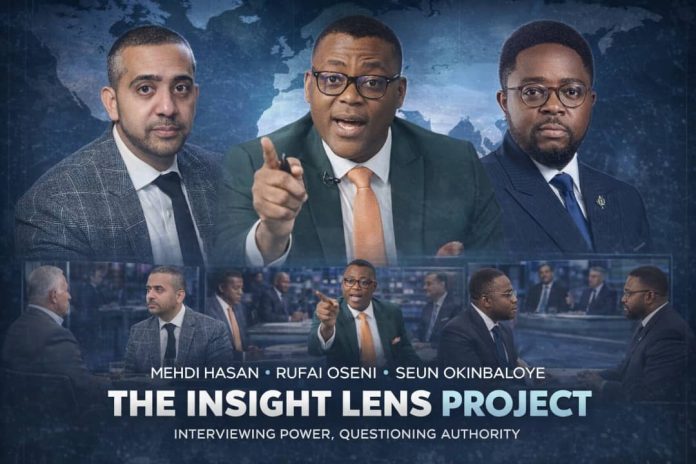
In the modern arena of political journalism, the interview has become more than a conversation. It is a contest of ideas, a test of credibility and, increasingly, a stage where power is compelled to answer to the public. Few figures illustrate the shifting art of the political interview better than Mehdi Hasan, Rufai Oseni and Seun Okinbaloye. Each represents a distinct tradition in the practice of questioning authority, shaped by audience expectations, cultural context and personal philosophy.
Politics
Mehdi Hasan has built his reputation on the international stage through a method that resembles a courtroom cross-examination. Calm, meticulously prepared and rhetorically precise, his interviews often unfold like carefully constructed debates. Rather than relying on emotion or raised voices, Hasan deploys facts, quotations and logical sequencing to corner contradictions. His approach is strategic, he frequently begins by acknowledging an opponent’s point before gradually tightening the argument around it.

The result is an interview that feels less like a routine exchange and more like an intellectual duel. Hasan’s interruptions, when they come, are usually calculated to prevent evasion or to introduce evidence that challenges a guest’s claim. Admirers see this as the hallmark of serious journalism in an age of political spin. Critics, however, argue that the style can drift toward performative trap moments, where the pursuit of contradiction risks overshadowing deeper exploration. Yet his composure and mastery of debate have made him one of the most recognisable interrogators in global television journalism.
Politics
On Nigeria’s morning airwaves, Rufai Oseni presents a strikingly different approach. His style is unapologetically confrontational, driven by a belief that the interviewer must act as a civic watchdog on behalf of an often frustrated public. On live television he challenges officials directly, frequently pressing them to explain policy failures, contradictions or perceived dishonesty.
Oseni’s interviews are intense and fast-paced. He interrupts frequently, pushes back against statements he believes are misleading and often injects his own analysis into the conversation. For supporters, this assertiveness embodies the spirit of accountability journalism in a country where trust in institutions is fragile. To many viewers he represents a voice asking the difficult questions ordinary citizens would ask themselves.
But the same qualities that energise his audience also attract criticism. Detractors argue that the confrontational tone sometimes blurs the line between journalism and advocacy. When debate becomes heated, critics say, the exchange can shift from inquiry to confrontation, leaving less room for guests to fully explain their positions. The result is a style that is highly engaging but frequently polarising.
Seun Okinbaloye, by contrast, has cultivated a reputation for measured firmness. His interviews rely less on confrontation and more on methodical questioning. Known for careful preparation, he often guides guests through a sequence of inquiries that gradually exposes inconsistencies or weaknesses in their arguments.
Rather than dominate the conversation, Okinbaloye typically allows responses to unfold before introducing new facts or contradictions. The tone is restrained but deliberate, and the effect can be quietly revealing. Guests sometimes find themselves acknowledging uncomfortable truths simply through the logic of the discussion.
This balanced approach has earned him praise for maintaining professionalism while still pressing for accountability. Yet some critics believe the style can occasionally appear too cautious in a political environment where sharper confrontation might produce clearer answers. Even so, the method has reinforced a reputation for calm authority and credibility.
Politics
Taken together, the three journalists illustrate the diverse forms that political interviewing can take. Hasan’s style is rooted in rhetorical precision and global debate, Oseni’s in passionate civic challenge, and Okinbaloye’s in disciplined, fact-based dialogue. All share a common purpose, confronting power with questions the public wants answered.
Their differences reveal something deeper about the evolving role of journalism itself. In an age of political polarisation and public scepticism, the interviewer has become both investigator and performer, navigating the delicate balance between confrontation and fairness. Whether through Hasan’s strategic cross-examinations, Oseni’s fiery exchanges or Okinbaloye’s measured probing, each approach reflects a different path toward the same goal, forcing power to speak plainly before the public.
©️ Adebamiwa Olugbenga Michael is a Lagos-based political economy and policy intelligence analyst and publisher of The Insight Lens Project, providing data-driven insights across Nigeria and West Africa using open-source data.
Stay ahead with the latest updates!
Join The Podium Media on WhatsApp for real-time news alerts, breaking stories, and exclusive content delivered straight to your phone. Don’t miss a headline — subscribe now!
Chat with Us on WhatsApp