



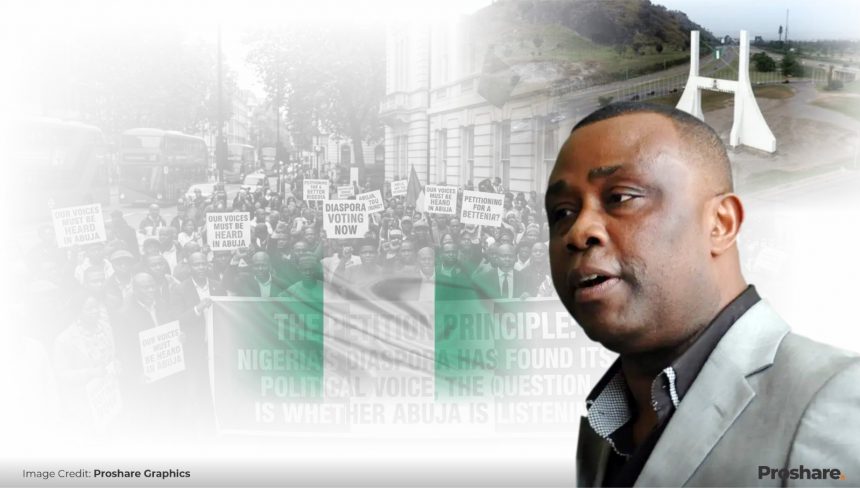
When a Nigerian diaspora group petitioned Mexico’s president to reject a proposed Nigerian ambassador, the immediate reaction in policy circles was divided. The more important question was structural. A diaspora community with no formal institutional voice at home had demonstrated the capacity to insert itself into the sovereign diplomatic calculus of a foreign state. That is not overreach. It is what political agency looks like when the official channels have been left empty.
In recent days, news emerged that a Nigerian Diaspora group wrote to the President of Mexico urging the rejection of a proposed Nigerian ambassador. The action has sparked debate across diplomatic and policy circles. Some see it as activism overreaching into the sovereign affairs of states. Others interpret it as a bold assertion of Diaspora political voice.
Viewed dispassionately, however, the episode offers something more significant: a vivid case study in the growing political agency of diasporas as non-state actors in international affairs. Whether the petition succeeds or fails may ultimately matter less than the precedent it represents.

A Diplomatic Question Before Mexico
In formal diplomatic practice, ambassadors are accredited through a process known as agrément. This is a host state’s consent to receive a foreign envoy. Under long-standing international practice codified in the Vienna Convention on Diplomatic Relations, a receiving state has absolute discretion to accept or reject a nominee. It is not obliged to explain its decision.
Therefore, the question before Mexico is neither procedural nor legal. It is political and diplomatic. Mexico’s current president, Claudia Sheinbaum, leads a government shaped by the political culture of the ruling Morena movement. It is one that often frames itself as attentive to popular voices, civil society, and social justice narratives.
Yet Mexico also possesses a deeply institutional diplomatic tradition, anchored in the Estrada Doctrine, which historically emphasises non-interference and respect for state sovereignty.
These two instincts, democratic responsiveness and diplomatic caution, are likely to shape the Mexican government’s response. In practical terms, Mexico has three plausible options:
- Quiet Acceptance: approve the ambassadorial nominee and proceed with standard diplomatic practice.
- Silent Refusal: declined agreement without public explanation.
- Delayed Consideration: postpone approval while reviewing political implications.
Historically, states tend toward the first or third option unless the nominee presents clear diplomatic complications.
What Success Would Look Like
If Mexico were to reject the nominee following Diaspora advocacy led by Dr Frederick Odorige, the implications would be considerable. Success would not simply mean blocking one appointment. It would signal that Diaspora voices can influence the diplomatic calculus of host states.
Such a precedent would demonstrate three emerging realities:
- Diaspora communities are transnational political stakeholders, not merely migrant populations.
- Governments increasingly operate within a global public opinion ecosystem, where diaspora networks shape narratives across borders.
- Non-state actors can insert themselves into the traditionally closed world of diplomacy.
In essence, it would represent a subtle shift from state-centric diplomacy toward networked diplomacy.
The Message Beyond Success or Failure
Even if Mexico ultimately admits the ambassador, the petition itself carries symbolic weight. Diasporas historically influenced politics through remittances, philanthropy, and advocacy. Today, they are evolving into political intermediaries between nations.
For Nigeria, whose Diaspora remittances remain among the largest in Africa, this is not trivial. It signals that the Nigerian Diaspora increasingly perceives itself as a stakeholder in the country’s global representation, not merely a distant observer.
This evolving consciousness aligns closely with a central argument in my book, Economic Diplomacy of the Diaspora: that diasporas represent an underutilised strategic asset in international engagement. Diaspora communities possess:
- local knowledge of host societies,
- professional networks across borders,
- and legitimacy within multiple political systems.
When mobilised constructively, these attributes can amplify a nation’s diplomatic reach. The petition to Mexico may therefore be understood as a practical, if imperfect, illustration of diaspora agency in global diplomacy.
The Legal and Sovereign Grounds for Rejection

Mexico retains several legitimate bases for declining to engage with the petition. First is state sovereignty. Diplomatic appointments are fundamentally matters between governments, not civil society groups.
Second is diplomatic protocol. Entertaining petitions regarding foreign envoys could set a precedent inviting external lobbying over internal diplomatic decisions.
Third is non-interference, a principle embedded in Mexican foreign policy traditions.
On these grounds, Mexico could reasonably conclude that the matter should remain strictly between the two states.

The Case for Listening
Yet there is also a principled argument for acknowledging the petition. Modern diplomacy increasingly recognises the role of public diplomacy and citizen diplomacy. Governments routinely engage with civil society, diaspora groups, and non-governmental actors.
Ignoring such voices entirely risks reinforcing the perception that diplomacy remains insulated from democratic accountability. Mexico could therefore justify considering the petition, not as a binding instruction, but as input from a concerned transnational constituency. Doing so would be consistent with contemporary governance norms where public opinion intersects with foreign policy.
Why Governments Should Not Ignore Diaspora Voices
For both Nigeria and Mexico, the broader lesson is instructive. Diaspora communities represent bridges between societies. They translate culture, facilitate investment, and often help shape bilateral understanding.
Dismissing their concerns outright risks weakening those bridges. Statesmanship requires a more nuanced approach. Governments must guard sovereign decision-making while also recognising that diplomacy today operates within a wider ecosystem of actors, diasporas included. Constructive engagement, even where disagreement persists, strengthens democratic legitimacy.

A Moment of Reflection for Nigeria
For Nigeria, the episode raises a deeper question. If diaspora groups feel compelled to lobby foreign governments about Nigerian diplomatic appointments, what does this say about the mechanisms available for diaspora consultation at home?
Nigeria has long celebrated its diaspora as a strategic national asset. Yet meaningful institutional channels for diaspora participation in foreign policy remain weak despite the existence of Nigerians in Diaspora Commission (NiDCOM).
Strengthening these channels through properly constituting the board of NiDCOM, advisory councils, consultative frameworks, or diaspora diplomacy platforms; would help ensure that diaspora influence strengthens rather than complicates Nigeria’s global representation.
Diaspora Power in the Twenty-First Century
Ultimately, the petition to Mexico is less about one ambassadorial nomination and more about the evolving architecture of international relations. The age when diplomacy was conducted exclusively by states behind closed doors is fading.
Diasporas, cities, corporations, and civil society actors increasingly shape global outcomes. The Nigerian Diaspora group, Global Coalition for Security and Democracy in Nigeria (GCSDN) as petitioner, may or may not achieve its immediate objective. But it has already illustrated something important: diaspora communities are discovering their political voice in global affairs.
And once discovered, such voices rarely retreat into silence. For policymakers willing to listen, that voice can become not a nuisance, but a powerful instrument of national influence.
Stay ahead with the latest updates!
Join The Podium Media on WhatsApp for real-time news alerts, breaking stories, and exclusive content delivered straight to your phone. Don’t miss a headline — subscribe now!
Chat with Us on WhatsApp