Niccolo Machiavelli once opined that politics has no relation to morals. Nothing demonstrates this more succinctly than the decision of Peter Obi, the former Labour Party presidential candidate in the 2023 election, to align himself with the African Democratic Congress, an association dominated by the political elite class he once condemned as a “structure of criminality”. For many Nigerians, Peter Obi’s political unravelling was only a matter of time.
For his critics, he unravelled long before December 31, 2025. Long before the 2023 presidential election, Obi critics had insisted that, beyond the facade of rhetoric and modest branding was a career politician who rode on the back of post-EndSARS anger and frustrations of young Nigerians looking for a Messiah.
Nigerian youths, tired of the status quo and galvanised by the police brutality protests that gripped the country, had queued behind Obi, who presented himself as an outsider, a “new breed politician” different from the old political order and promising to dismantle a system he continually described as corrupt and criminal. His supporters canonised him as a near Messianic figure. They were convinced he would rescue Nigeria from the iron grip of recycled politicians. That belief seems to have now collided with reality.

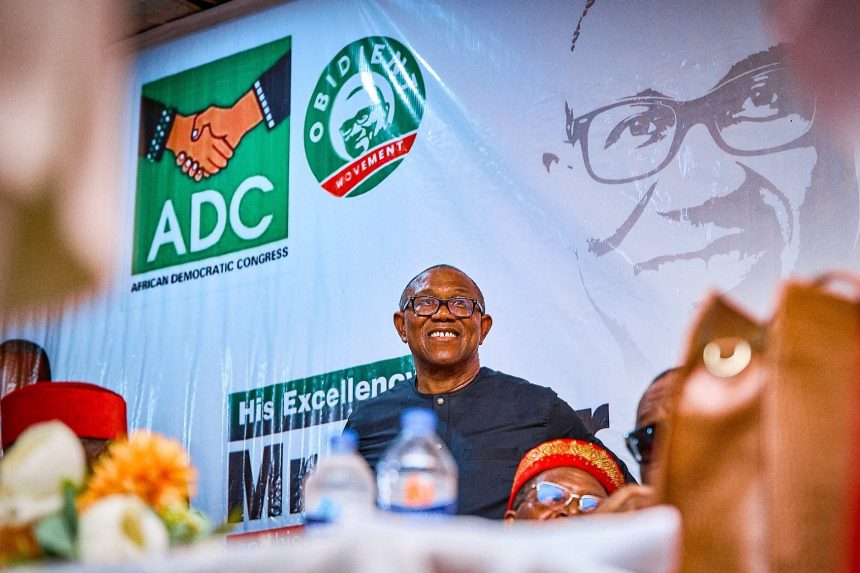
In the closing hours of 2025, Peter Obi declared for the African Democratic Congress and announced his intention to contest for the 2027 presidential election under its platform. At the declaration in Enugu, Obi called on Nigerians to join him in ADC to rescue the country under the leadership of Senator David Mark. David Mark – a symbol of the old political elite and order he vowed never to associate with. It was not a Freiduan Slip. It was a conscious political choice.
The ADC is a conglomerate of old and familiar faces. Former Vice-President Atiku Abubakar. Nasir el-Rufai, the former Kaduna state governor. David Mark, former senate president. Abubakar Malami, who is currently facing corruption charges. Rauf Aregbeshola, who fell out with his long-time political mentor and benefactor, President Tinubu. Rotimi Amaechi, who served as Buhari’s transport minister. Many of these political figures were part of the previous administration widely blamed for Nigeria’s economic problems, widespread insecurity and institutional decay.
These are the same politicians Obi spent years condemning. Obi insists joining the coalition is a strategic move to remove President Tinubu from power. But that is where the contradiction lies, and it beggars belief that he cannot see it. Can strategy erase contradictions? How can you spend years condemning a system only to return to it in the name of convenience? This seems more like reintegration than reform.
Even on its own terms, the coalition offers no pathway to Obi’s presidency. If Obi runs as vice-president, history shows he would wield little or no power in a political system where the presidency holds enormous power. Previous vice presidents were sidelined with little or no fuss. If he emerges as the president under the ADC coalition, it would be naive to think he would carry out any radical reform in a coalition built on deal-making, entrenched interests and competing agendas. The ADC coalition is not a change but a power transfer. Replacing one political elite class with another.
This paradox is glaring. Obi has always based his public image on the perception of personal integrity and frugal living. His supporters have praised him for being modest (even for personally cooking his own meals), an attribute they consider rare in Nigeria’s ‘big man’ politics. These qualities stood him out among his supporters in 2023. But these attributes are not enough to cause a transformative change in a political system surrounded by political actors whose records are the direct opposite of any reformist agenda.
Already, cracks are appearing among his Obedients supporters. Many followed him to the ADC reluctantly, hoping he would secure the presidential ticket and exercise full authority if elected. Yet even they struggle to explain what Obi and the coalition would do differently beyond removing the APC. The merger appears driven largely by Atiku Abubakar’s long-standing presidential ambition, with other figures nursing personal grievances against the Tinubu administration.
Obi’s history of party defections further weakens his claim to be a new kind of politician. From APGA to PDP to Labour Party and now ADC, his political career reflects the same opportunistic mobility typical of Nigerian politicians, which he often criticises. If Obi truly believed the old political order was corrupt and irredeemable, the more credible option was to stay and build the Labour Party into a lasting alternative. With his influence and popularity, he could have nurtured a new political class, invested in young technocrats, and played the long game of reform.
Instead, he chose the shortcut.
Peter Obi’s return to the structure he once called criminal raises serious questions about consistency and trust. Nigerians have seen this pattern with politicians before: loud criticism, and eventual reunion with the same old players. What has changed is not the system, only the political actors.
Stay ahead with the latest updates!
Join The Podium Media on WhatsApp for real-time news alerts, breaking stories, and exclusive content delivered straight to your phone. Don’t miss a headline — subscribe now!
Chat with Us on WhatsApp