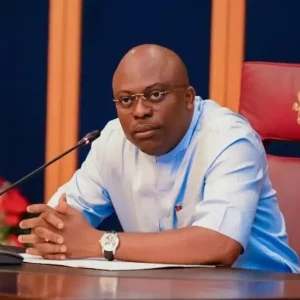

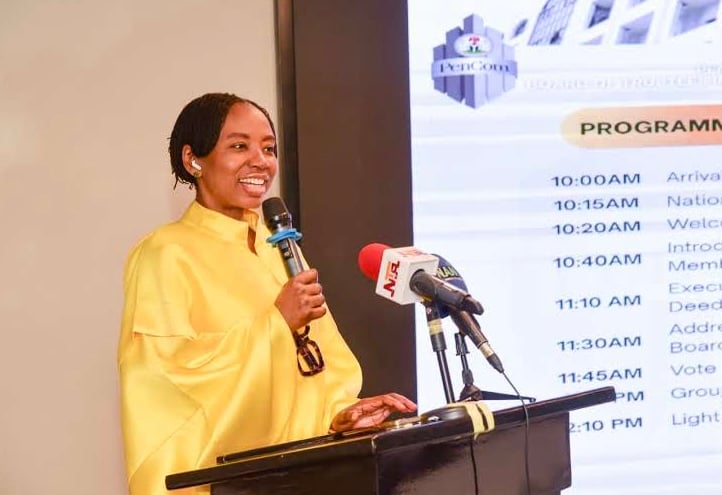
Omolola Oloworaran, the director-general (DG) of the National Pension Commission (PenCom), has come under fire for trying to justify the recent deal between the federal government (FG) and the Academic Staff Union of Universities (ASUU) regarding the pension benefits of professors.
The federal government, on January 14, signed a renegotiated agreement with the ASUU to address the incessant strikes in Nigeria’s public tertiary schools.
Under the agreement, a professor will receive N1,740,000 per annum as allowance, while the reader allowance is pegged at N840,000 per annum for those on the consolidated university academic salary structure (CONUASS) 07 and 06.

Among other things, the arrangement, according to an X post by President Bola Tinubu’s special assistant on social media, promised improved pension benefits, which could see professors “earn pension equivalent to their annual salary at retirement (age 70)”.
There is also a 40 percent salary increase for academic staff.
Experts expressed fears that the deal could mark a surreptitious return to the costly defined benefit scheme (DBS) exited two decades ago due to funding gaps.
Reacting to the news on X, Kalu Aja, a financial analyst, sharply flagged the deal as inimical to Nigeria’s fiscal health, saying Tinubu “has promised what he will struggle to deliver” relating to the pension benefits.
“This means the University system will exit the Defined Contributory scheme and revert to a Defined Benefit scheme,” the Aja said.
“The impact is a new burden on the FGN budget to fund these pension obligations. Why go back to defined benefit, which the whole world is running away from because of costs?”
‘AGREEMENT NOT A RETURN TO DBS’
In response, Oloworaran, defended the government’s position, arguing that Tinubu has already delivered on pensions.
She said the agreement is not a return to the DBS, noting that the Pension Reform Act (PRA), 2014, already provides for professors to retire at age 70 with enhanced pension benefits, including up to 100 percent of last salary — subject to funding of the differential.
The PenCom chief said funding and implementation have been the issues over the years, but the president has now addressed them.
“What has changed is leadership and execution,” Oloworaran said.
“President Tinubu took the decisive step to clear long-standing government pension liabilities, including pension differentials. As a result, eligible professors have begun receiving these benefits within the Contributory Pension Scheme, which remains fully intact.
“Pension obligations are no longer being deferred. Pension increases for all FGN treasury-funded MDAs, as well as Pension Boost for CPS retirees, have been implemented, arrears cleared, and all government pension liabilities eliminated for the first time in almost 20 years.”

But Oloworaran’s explanation further riled financial professionals.
Feyi Fawehinmi, an investment accountant known as ‘tyro’ on X, described her statement as ‘nonsensical’.
“With the greatest respect, this is a nonsensical thing for a pensions regulator to type openly in public,” he wrote.
CONTRIBUTORY PENSION SCHEME (CPS) VS DBS

The gross inefficiencies and fiscal burdens of the DBS forced the government to stop the scheme with the introduction of the CPS in 2004. Prior to this, Nigeria grappled with a pension deficit of over N2 trillion, highlighting the burden of pension payment under the DBS.
Under the system, retirement benefits were predetermined based on factors such as years of service and final salary.
Pension funding in the defined benefits scheme, which reportedly favoured public servants, was solely from government coffers, leading to countless cases of arrears, delayed payments, and even pension crises — leaving retirees at the mercy of budgetary allocations.
However, the CPS turned the tide, as it requires employees and employers to make regular contributions to an individual’s retirement savings account (RSA).
Under the CPS, employers are mandated contribute 10 percent of the worker’s remuneration into the person’s RSA, while the employee contributes 8 percent.
The accumulated funds are then invested, and the retirement benefit is determined by the value of the account at the time of retirement.

With a contributory system, the retirement benefit is directly linked to the individual’s contributions and investment returns, ensuring the pension system remains financially viable and sustainable.
WHAT THE LAW SAYS ABOUT PROFESSORS’ BENEFITS
Section 6(2) of the PRA 2014 addresses professors’ pension benefits.
The law states thus: “In the case of professors covered by the Universities (Miscellaneous Provisions) (Amendment) Act, 2012 and category of political appointees entitled, by virtue of their terms and conditions of employment, to retire with full benefits, the Commission shall issue guidelines to regulate the administration of their retirement benefits provided that any shortfall shall be funded from budgetary allocations by the employer.”
According to the Universities (Miscellaneous Provisions) (Amendment) Act, 2012, referenced in the PRA 2014, the compulsory retirement age for academic staff in the professorial cadre is 70 years, while that of non-academic staff is 65 years.
Section 9(1) of the law said an academic staff member who retires as a professor in a recognised university “shall be entitled to pension at a rate equivalent to his annual salary provided that the professor has served continuously in a recognised University up to the retirement age”.
“(2) Notwithstanding subsection (I), where the professor has not served up to the retirement age, he shall be entitled to the rate of pension mentioned under subsection (1) provided that he has served a minimum of 20 years as professor in a recognized University,” the law reads.
“(3) Where an academic joins a Nigerian University as a professor, such a professor shall have served continuously for at least 20 years in a recognized university.”
In a counter response, Aja argued that if the pension of professors is based on their final salary, it implies that the CPS for ASUU has been converted to DBS – a position that seems to align with the provisions of the law and the principles of DBS.
“… if professors receive a defined benefit upon retirement—in this case, 100% of their annual salary at retirement—then they are not receiving a pension funded by the principal and investment returns in their Retirement Savings Account, but rather, as you stated, a pension also funded by a “differential” paid by the FGN,” the financial educator said.
‘PENSION REFORM UNDER SERIOUS THREAT’
Sources told TheCable that the provisions of the law make the FG-ASUU deal defined benefits, as pension benefits are tied to the last salaries of professors at retirement.
“… but it is contributory because the law says the employer only comes in to cover any shortfall, if… it’s similar to what was approved for the Perm. Secs,” the insider said.
“So, it may be safe to refer to it as neither contributory nor defined but ‘contributory defined’. The most important thing to note is that the employer is expected only to pay a shortfall where one exists and not the whole pension.”
Industry analysts expressed worry that “pension reforms [are] now under serious threat in a very insidious way” under the current PenCom leadership.
“Little things here and there now chipping away at the principle of the reforms,” another source said,
“The Nigerian CPS was written to avoid the DB stuff that everyone globally is running away from. But slowly, as we appointed people without any technical background, they have proceeded to naively do stuff that works opposite to that principle.”
IS THE DBS STILL IN OPERATION?
Officially, the introduction of the CPS marked the end of the DBS, but the federal government has continued to fund pension payments in recent years.
In August 2025, the federal government disbursed N5.12 billion pension arrears to 90,689 retirees under the DBS. In June of the same year, the Pension Transitional Arrangement Directorate (PTAD) confirmed paying another pension arrears installment of the N32,000 increment approved by Tinubu in 2024.
In February 2025, the federal executive council (FEC) approved the issuance of a N758 billion bond to clear outstanding pension liabilities.
Wale Edun, the minister of finance, said the funds would be used to pay pensioners who were part of the old system (DBS) before the 2004 switch to the CPS.
Insisting that the CPS remains intact, Oloworaran said pension sustainability is not achieved by pretending obligations do not exist.
She said sustainability is achieved by acknowledging them, funding the liabilities annually, and reforming the system so arrears do not accumulate.
“That failure to confront reality is precisely what led to the collapse of the old Defined Benefit era, where liabilities were ignored until they became catastrophic,” the PenCom DG said.
“’The direction is clear: honour existing promises, protect the CPS framework, and build sustainability so today’s delivery endures tomorrow.’”
Opposing her views, Fawehinmi questioned how the CPS remains intact when arrears constantly accumulate, requiring a bailout.
“What you’ve called a ‘decisive step’ is the use of a bond to clear the arrears. That is, borrowing from the future to pay for the past,” he said.
Fawehinmi said the reason this keeps happening because there is “a DB scheme hiding inside a DC scheme and they’re of course really incompatible with each other”.
Stay ahead with the latest updates!
Join The Podium Media on WhatsApp for real-time news alerts, breaking stories, and exclusive content delivered straight to your phone. Don’t miss a headline — subscribe now!
Chat with Us on WhatsApp