


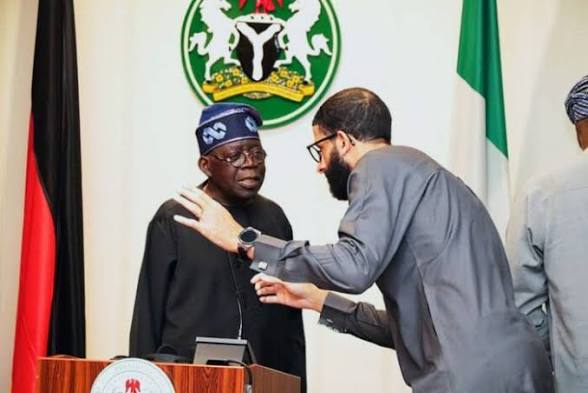
Former presidential spokesman and envoy, Ajuri Ngelale, has delivered a sweeping and deeply reflective tribute to President Bola Ahmed Tinubu, portraying him as a rare statesman-teacher whose strategic depth and mentorship continue to shape lives long after direct service under him has ended.
In a lengthy statement shared via his X handle to mark the President’s 74th birthday, Ngelale anchored his reflection on a philosophical premise: that the true measure of a teacher is not the immediacy of their impact, but the enduring resonance of their lessons years after the student has left the classroom.
Drawing from his time in the inner corridors of power, Ngelale disclosed that although he possesses extensive records and vivid recollections of his tenure, he has deliberately chosen not to publish a memoir. According to him, this decision is rooted not in reticence, but in reverence—an understanding that some of the most profound experiences in public service are best preserved, with only carefully distilled insights shared in moments of historical reflection.

At the core of his tribute is a detailed portrayal of Tinubu’s leadership architecture. Ngelale described the President as possessing an extraordinary capacity to read human character and political terrain with precision—an ability he said spans an individual’s strengths, vulnerabilities, motivations, loyalties, and long-term strategic value within the national development matrix.
He likened Tinubu’s method to that of a master gardener, one who does not merely assemble talent, but intentionally cultivates it—creating conditions for growth while maintaining a firm grasp of the broader ecosystem in which each actor operates.
Recounting his personal evolution under Tinubu’s mentorship, Ngelale admitted that he entered government with the instinctive urgency of a technocrat—driven by a desire to diagnose and immediately resolve problems. That disposition, he said, was fundamentally recalibrated through direct engagement with the President.
According to him, Tinubu introduced him to the complex reality of governance in Nigeria, where many challenges are not linear but multi-layered and phased. He explained that the President emphasized the importance of restraint, warning that premature solutions—even when well-intentioned—can obscure or even derail outcomes that only become visible at later stages of a problem’s evolution.
Ngelale revealed that in private consultations, often held in tightly controlled and secure environments, the President would patiently unpack the anatomy of leadership decisions. In those moments, he said, Tinubu stressed that effective leadership is not defined solely by the desire to act or even the accuracy of diagnosis, but by the disciplined sequencing of responses—timing, calibration, and contextual awareness being as critical as the solution itself.
He noted that this philosophy marked a turning point in his understanding of governance, replacing urgency with strategic patience and instinct with structured foresight.
The former spokesman also shed light on the intensity of his assignment while in office, revealing that at the age of 37, he was entrusted with a dual role of significant national and international consequence—serving as the official voice of the President while simultaneously acting as a special envoy on a global existential issue.
He acknowledged that the sheer pace and weight of those responsibilities meant that many of the lessons imparted during that period could not be fully absorbed at the time. However, with distance from office, he said those same lessons have deepened in clarity and relevance.
Now operating outside government as an entrepreneur and raising a family, Ngelale stated that he finds himself increasingly drawing from the reservoir of wisdom acquired during his service, with insights once only partially understood now serving as guiding principles in his personal and professional life.
Placing his reflections within a broader global context, Ngelale argued that the contemporary world is often marked by a troubling imbalance, where ambition frequently outpaces competence in leadership. Against this backdrop, he asserted that Nigeria’s current leadership stands apart, describing Tinubu as a product of tested capacity, resilience, and performance at critical turning points rather than mere access or privilege.
He maintained that such attributes, combined with a long-cultivated strategic mind, have positioned the President uniquely at a defining moment in Nigeria’s history.
The tribute, rich in both personal recollection and philosophical insight, adds a distinctive voice to the chorus of commendations marking President Tinubu’s 74th birthday, offering not just praise, but a rare window into the leadership ethos and mentorship style of one of Nigeria’s most consequential political figures.
Stay ahead with the latest updates!
Join The Podium Media on WhatsApp for real-time news alerts, breaking stories, and exclusive content delivered straight to your phone. Don’t miss a headline — subscribe now!
Chat with Us on WhatsApp